


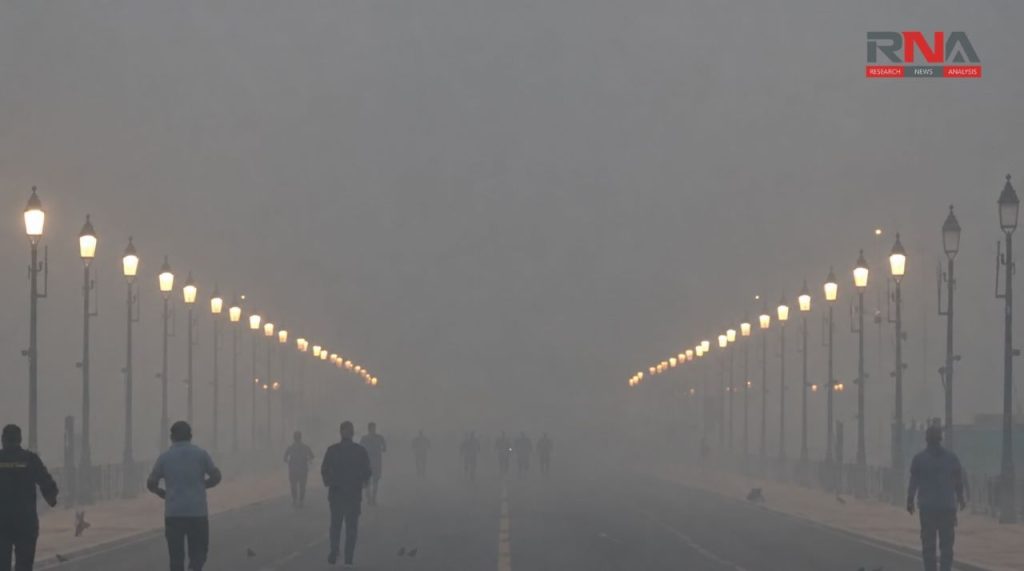
New Delhi: The national capital entered Diwali week with its air quality deteriorating to the “very poor” category on Monday, as pollution intensified despite the introduction of winter vehicle-entry restrictions. Delhi’s citywide air quality index (AQI) reached 314 at 10am, according to Central Pollution Control Board (CPCB), while several neighbourhoods recorded substantially higher readings.
The worsening conditions followed a sharp increase in the previous day’s pollution, with Delhi’s 24-hour average AQI rising from 117 on October 31 to 261 on Sunday. By Monday morning, the city had crossed the 300 threshold separating “poor” from “very poor” air quality, bringing renewed pressure on pollution-control agencies ahead of the festival.
The citywide reading stood at 312 at 9am before edging higher an hour later, although these figures were morning updates rather than the daily bulletin scheduled for 4pm. Separately, the widely reported AQI of 349 referred to conditions around ITO and Akshardham, rather than Delhi’s overall air quality.
Pollution spreads across Delhi-NCR
Morning readings reported around RK Puram reached 370, while India Gate and Janpath recorded 335, placing all three locations in the “very poor” category. The variation across neighbourhoods underlined why a citywide average can conceal more polluted pockets and why readings taken at different hours are not directly interchangeable.
The deterioration extended beyond the capital, with CPCB Sameer app readings showing Noida at 311 at 8.05am, also in the “very poor” category. Ghaziabad and Gurugram recorded 278 and 230 respectively, both classified as “poor”, while Faridabad’s reading of 116 placed it in the “moderate” band.
Under the CPCB’s classification, readings between 201 and 300 indicate “poor” air, 301–400 “very poor”, and 401–500 “severe”. Its national AQI guidance associates prolonged exposure to “very poor” air with an increased risk of respiratory illness, with children, older people and those with existing illnesses requiring particular protection.
Forecast offers little sustained relief
The Air Quality Early Warning System for Delhi, operated by the Indian Institute of Tropical Meteorology, had projected “poor” conditions for Monday and Tuesday, followed by “very poor” air on Wednesday. Monday’s morning readings were already in that higher pollution band, while the forecast available during verification indicated “poor” to “very poor” conditions over the subsequent six days.
The forecast also showed winds strengthening during the afternoon before weakening again in the evening and overnight, making the dispersal of pollutants uneven through the day. The system identifies a combination of low wind speeds and a low ventilation index – a measure of the atmosphere’s capacity to disperse pollution – as unfavourable for clearing emissions.
There was no immediate benefit from rainfall, with the India Meteorological Department recording no rain at Delhi’s five principal weather stations in the 24 hours ending at 8.30am on Monday. The minimum temperature at Safdarjung settled at 16.4°C, according to the department.
Crop-residue burning was another contributor: Outlook, citing the air-quality Decision Support System, reported an estimated contribution of 18.57 per cent on Sunday, compared with 5.33 per cent a day earlier. These are modelled source estimates, rather than direct measurements of the share of smoke in every neighbourhood.
Border checks tighten as pollution rises
The deterioration coincided with the start of tighter vehicle-entry checks on November 1, with enforcement personnel examining emission standards and pollution certificates at Delhi’s borders. Forty teams comprising about 250 transport department and police personnel were deployed across the capital, according to Indian Express,
Delhi Police said 7,249 vehicles were checked, 714 were turned back and 38 end-of-life vehicles were impounded during that operation. Officers told the newspaper that the initial emphasis was on preventing non-compliant vehicles from entering and explaining the restrictions, with relatively few penalties issued on the first day.
The newspaper’s explanation of the winter restrictions said petrol and diesel vehicles registered outside Delhi that do not meet BS-VI emission standards face entry restrictions from Sunday (November 1, 2026), to January 31, 2027. Electric and CNG vehicles are exempt under the reported framework, while trucks travelling through Delhi to destinations elsewhere are required to use the peripheral expressways.
What the GRAP threshold means
Stage I of the Graded Response Action Plan (GRAP) was invoked on October 21, according to the Delhi environment department’s published notifications. The framework progressively strengthens pollution controls as conditions worsen, with Stage II corresponding to “very poor” air, Stage III covering AQI readings of 401–450 and Stage IV applying above 450.
Decisions to invoke additional stages rest with the Commission for Air Quality Management (CAQM), which considers prevailing pollution and meteorological forecasts. Monday’s readings were within the Stage II range, but the crossing of that threshold should be distinguished from confirmation of a fresh implementation order.
The commission had already revised the GRAP schedule in September, moving measures concerning diesel generator sets and the entry of older buses from Stage II to Stage I so that they could be applied earlier. The changes also extended certain Stage III vehicle restrictions to Sonipat and tightened provisions governing older goods vehicles, broadening the regional response to winter pollution.