


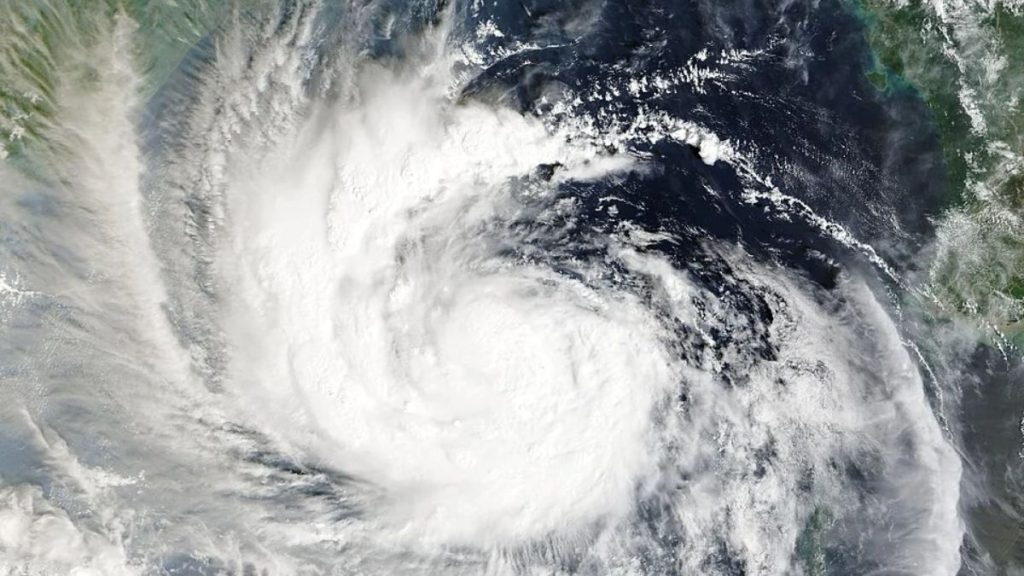
New Delhi: Cyclone Arnab began crossing the Andhra Pradesh coast early Wednesday, bringing heavy rainfall and damaging winds as the chief minister, N Chandrababu Naidu, ordered accelerated relief and preliminary crop-loss assessments. Officials were directed to clear roads and restore essential services while emergency teams assisted people evacuated from vulnerable coastal areas.
The India Meteorological Department (IMD) classified Arnab as a very severe cyclonic storm. At 5.30am, its centre was about 30 kilometers east of Narsapur, with landfall underway south of Yanam and forecast winds of 115–125 kilometers per hour, gusting to 140 kilometers per hour. The IMD warned of a storm surge 1–1.5 metres above normal tide in low-lying coastal areas.
Andhra Pradesh state disaster management authority (APSDMA) managing director, Prakhar Jain, had earlier urged residents to remain alert as the cyclone crossed the coast. Heavy rainfall and gusty winds affected the erstwhile Srikakulam, Visakhapatnam, East Godavari, West Godavari and Krishna districts. Subsequent weather reports indicated that Arnab completed landfall on Wednesday morning, although heavy rainfall and strong winds continued to affect coastal areas.
Naidu reviewed the situation with district collectors and officials from the electricity, irrigation, roads, agriculture and local administration departments. Telangana Today reported that the discussions also involved a teleconference connecting about 32,000 officials and field personnel.
The chief minister instructed teams to clear trees blocking local roads within two hours and remove obstructions from national highways without delay. He ordered electricity supplies restored once winds subsided and asked officials to ensure food, drinking water and medical facilities were available at shelters.
Preliminary reports indicated uprooted trees, damaged crops and power interruptions, particularly in the Godavari districts. Low-lying areas of Dr BR Ambedkar Konaseema district were inundated, but district-level estimates of agricultural losses were not yet available.
Naidu directed officials to assess affected crops, safeguard horticultural plantations and prevent breaches in tanks and canals. The administration was also instructed to take measures to prevent floodwater from entering agricultural fields.
Naidu also directed officials to communicate the state government’s cyclone response and relief measures to the central government.
Evacuations, medical teams and disrupted services
At least 89,000 people had been evacuated from vulnerable areas of Andhra Pradesh, according to an official figure cited by the Associated Press. Separately, Reuters reported more than 180,000 evacuees across Andhra Pradesh and Odisha combined.
DD India reported that the state had identified 2,199 cyclone shelters, but that figure does not establish how many were occupied. Twelve National Disaster Response Force (NDRF) teams and 10 State Disaster Response Force (SDRF) teams were assigned across 14 districts.
Authorities deployed 1,087 medical teams and kept 1,274 ambulances and 8,281 emergency beds ready. Pregnant women were moved to hospitals as a precaution, while drinking water tankers and generators were kept available.
Visakhapatnam recorded 216 millimeters of rainfall between Tuesday morning and 5.30am Wednesday, according to weather data reported by NDTV. The waterlogging affected roads in Vijayawada, while fallen trees and electricity poles disrupted services elsewhere.
The ministry of civil aviation confirmed flight suspensions at Visakhapatnam, Vijayawada and Rajahmundry airports. Access to Visakhapatnam’s RK beach was restricted amid hazardous sea conditions.
Cyclone impact extends beyond Andhra Pradesh
Neighbouring Odisha also faced heavy rainfall, evacuations and widespread precautionary closures. Authorities identified approximately 48,000 people in vulnerable areas for relocation and prepared 466 cyclone shelters. Educational institutions were closed across several districts, while disaster-response teams were deployed in areas facing extremely heavy rainfall. Separately, the Times of India reported that a 40-year-old woman died in Puri district on Tuesday after a falling tree brought down a wall of her house during heavy rain and winds.
The cyclone’s influence extended to other eastern and central states. The IMD forecast heavy rainfall across parts of West Bengal between Wednesday and Friday, with fishermen advised against venturing into the sea. Telangana and Chhattisgarh also faced warnings of heavy to extremely heavy rainfall, raising concerns over flooding and agricultural damage. Tamil Nadu was expected to experience comparatively limited effects, with scattered rainfall forecast in some areas.
Andhra Pradesh officials reported no fatalities during Naidu’s morning review. However, local media reported a death in Odisha’s Puri district, while comprehensive casualty and damage assessments across affected states remained incomplete. Authorities are continuing relief operations, restoring essential services and assessing agricultural losses.