


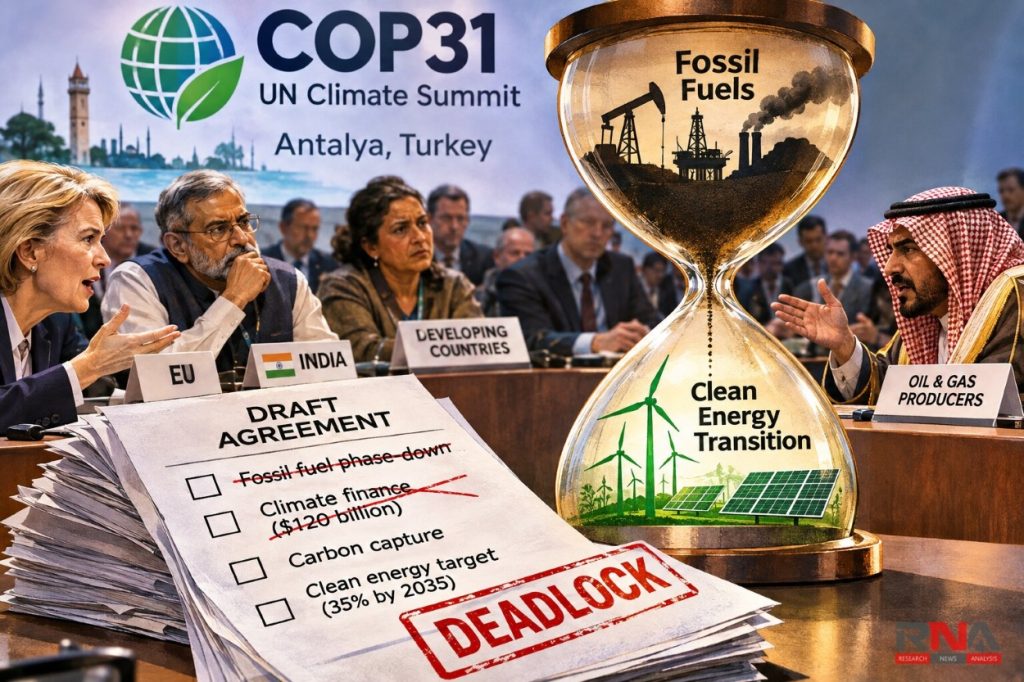
New Delhi: The United Nations climate summit, COP31, has entered an unscheduled extension after nearly 200 countries failed to reach an agreement on reducing dependence on fossil fuels, exposing deep divisions over the future of international climate action. Negotiations continued into Saturday after a revised draft agreement removed references to coal, oil and natural gas, prompting strong objections from several countries and raising concerns that the summit could conclude without meaningful progress on tackling global warming.
The two-week conference, which began on November 9 in the Turkish Mediterranean city of Antalya, was scheduled to conclude on Friday, but negotiators remained divided over several critical issues. Apart from fossil fuel commitments, disagreements over financial assistance to developing countries, cleaner energy technologies and the responsibilities of major emitters have complicated efforts to produce a consensus document.
The summit president and Turkey’s environment minister, Murat Kurum, acknowledged the difficulties facing negotiators during a late Friday session that approved some technical decisions but failed to resolve the principal disputes. Australia’s climate change and energy minister, Chris Bowen, who is overseeing the negotiations under COP31’s unusual shared leadership arrangement, continued consultations to secure a compromise.
Fossil fuel dispute divides countries
The immediate controversy centres on the removal of fossil fuel references from the revised draft agreement circulated on November 19. An earlier version had proposed accelerating the transition away from fossil fuels, but opposition from major oil and gas producers, particularly Saudi Arabia, contributed to the exclusion of such language from the subsequent text.
The European Union reacted sharply, warning that the proposed agreement could undermine the central purpose of the negotiations by avoiding the principal sources of greenhouse gas emissions. Panama and several other countries also demanded an explicit commitment to moving away from fossil fuels, with Panama indicating that it could reject an agreement that failed to address the issue.
The disagreement reflects a recurring fault line in international climate diplomacy between countries seeking faster decarbonization and those concerned about the economic consequences of restricting fossil fuel production and consumption. Oil-exporting economies argue that energy security, development requirements and technological capabilities must be considered alongside emission-reduction targets, while climate-vulnerable nations insist that delaying the transition would increase the severity of future disasters.
The dispute is particularly significant because the COP28 summit in Dubai in December 2023 produced the first global agreement explicitly calling for a transition away from fossil fuels in energy systems. Although that agreement did not mandate an immediate phase-out, it represented a diplomatic breakthrough that several countries fear could now be weakened through less ambitious language.
Climate finance emerges as another obstacle
Financial assistance to developing countries has become another major source of disagreement, particularly after the revised negotiating text removed a proposed $120 billion target for climate adaptation funding. Poorer countries argue that commitments to reduce emissions cannot be implemented effectively without predictable financial support for renewable energy, resilient infrastructure and protection against increasingly severe climatic events.
The dispute also concerns responsibility for financing the transition, with developing economies maintaining that industrialized countries should shoulder a greater share because of their historically higher greenhouse gas emissions. Wealthier countries, meanwhile, face domestic fiscal pressures and competing spending priorities, complicating negotiations over the scale and distribution of international climate assistance.
Another contentious proposal seeks to increase electricity’s share of global final energy consumption from approximately 21 per cent to 35 per cent by 2035. However, critics point out that electrification alone cannot guarantee lower emissions unless the additional electricity is generated through clean energy sources rather than coal- or gas-fired power stations.
Delegates also remain divided over carbon capture and storage technologies, which aim to prevent industrial emissions from entering the atmosphere. Supporters consider these technologies essential for reducing emissions in difficult-to-decarbonize industries, but opponents fear their expansion could provide justification for prolonging fossil fuel dependence.
What the deadlock means for India
For India, the negotiations carry significant implications for energy security, industrial development and access to international climate finance. New Delhi has consistently emphasized that climate commitments must reflect differing national circumstances and the principle of common but differentiated responsibilities, under which developed countries are expected to assume greater obligations.
The Indian government outlined these priorities ahead of COP31, stressing equitable climate action, adequate financing and recognition of developing countries’ economic requirements. The environment minister, Bhupender Yadav, also participated in ministerial consultations on emission-reduction measures alongside Germany’s environment minister, Carsten Schneider, highlighting India’s direct involvement in efforts to resolve the dispute.
India’s position is particularly important because its rapidly expanding economy requires substantial additional electricity generation, industrial capacity and transport infrastructure. Although the country is increasing renewable energy deployment, an accelerated fossil fuel transition without affordable alternatives and sufficient international financing could create difficult trade-offs between development, energy affordability and emission reductions.
New Delhi has also emphasized the historical responsibility of developed economies for accumulated greenhouse gas emissions, arguing that developing countries should not face identical obligations despite their substantially different development trajectories. This position places India at the centre of negotiations over how climate ambition can be reconciled with economic equity.
Global climate diplomacy faces another credibility test
The deadlock comes against a troubling scientific backdrop, with United Nations assessments indicating that existing climate commitments remain inadequate to prevent the world from exceeding the Paris Agreement’s 1.5°C warming threshold. Rising temperatures are intensifying concerns over extreme weather, food security, water availability and displacement, particularly across vulnerable developing regions.
The absence of the United States from formal climate negotiations has further complicated efforts to build consensus, removing the world’s largest historical emitter from a process already weakened by geopolitical tensions and disputes over financial responsibility. The ongoing West Asian conflict and associated energy-market disruptions have also reinforced competing national priorities concerning fuel security and economic stability.
Negotiators were working towards another revised agreement on Saturday, although the extent of any compromise remained uncertain as countries continued to defend their competing demands. The eventual outcome will determine whether COP31 can preserve momentum towards the Paris Agreement’s objectives or become another illustration of the widening gap between international climate commitments and the political willingness to implement them.