


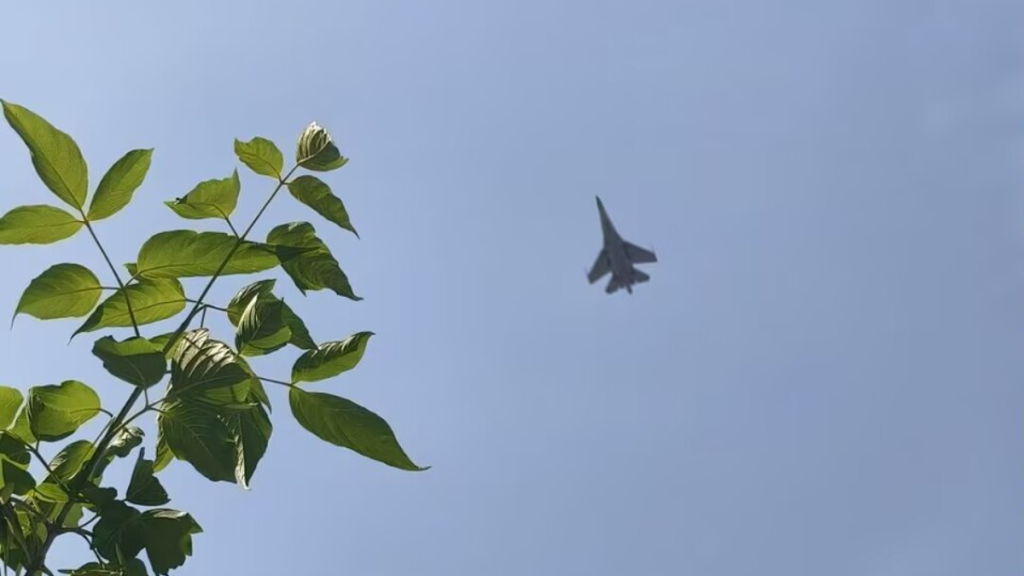
New Delhi: A Chinese military aircraft reportedly entered Indian airspace over Sikkim and remained there for nearly 25 minutes despite repeated warnings from the Indian Air Force. Thursday incident has raised fresh concerns over China’s military activity near India’s sensitive northeastern frontier, particularly around the Siliguri Corridor, which connects the northeast with the rest of the country.
The IAF detected the aircraft at around 8am on Thursday when it was flying at an altitude of approximately 25,000 feet. IAF repeatedly warned the aircraft to return to Chinese territory, but it continued hovering over the area, Outlook reported. The identity of the aircraft, its exact flight path and the time it left Indian airspace remain unknown.
This is not the first time Chinese military aircraft have raised concerns along India’s borders. On November 7, 2017, four Chinese helicopters reportedly entered Ladakh, with one hovering over the area for around 30 minutes. Earlier, on October 11, 2017, two Chinese helicopters reportedly entered Indian airspace in Uttarakhand’s Barahoti sector.
In June 2017, two Chinese force helicopters also hovered over Chamoli district in Uttarakhand for around five minutes before leaving. During the 2020 eastern Ladakh standoff, Chinese military helicopters were spotted flying close to the line of actual control (LAC). The IAF deployed fighter aircraft to patrol the region. In June 2022, another Chinese aircraft reportedly flew close to Indian positions in eastern Ladakh, prompting the IAF to activate its response measures.
Why Sikkim’s location matters
The reported incident is significant because of its proximity to the Siliguri Corridor, popularly known as the “Chicken’s Neck”. The narrow stretch in West Bengal measures around 20–22km at its thinnest point and connects India’s eight northeastern states with the rest of the country. Sikkim also lies close to Doklam, where Indian and Chinese troops faced off for 73 days in 2017.
Despite efforts to improve bilateral relations, tensions along the border continue. In October, the ministry of external affairs said that situations along the border get disturbed when Chinese forces move away from established patrolling patterns. The remarks came amid reports of a face-off in Arunachal Pradesh’s Taksing area.
On Saturday, the external affairs minister, S Jaishankar, said the China border had become “more alive” and required a much greater commitment of Indian troops on a sustained basis. He also highlighted improvements in India’s roads, bridges, tunnels and airfields since the 2020 Galwan clash.
The latest reported aircraft movement adds another concern as both countries continue efforts to maintain peace along the border.