


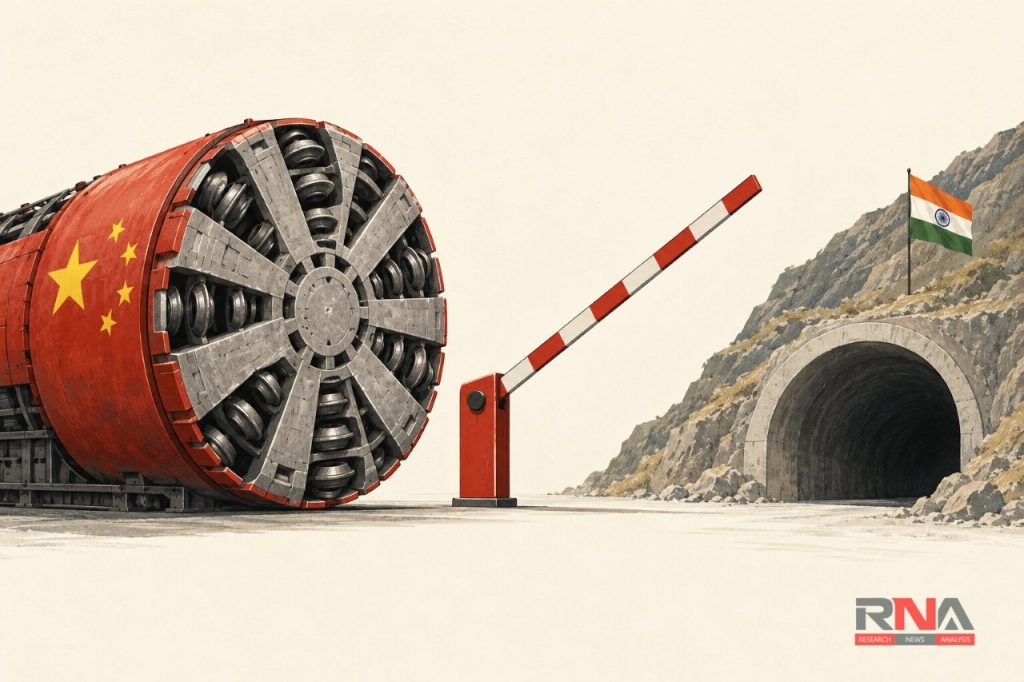
New Delhi: China’s impending export controls on tunnel-boring machines and specialized construction equipment have raised fresh concerns over supplies for India’s expanding railway, metro and road networks. The measures, which take effect on November 18, exposes a vulnerability that extends beyond acquiring giant excavators to securing the components needed to keep them operating.
The restrictions are not a blanket export ban, and Beijing’s published announcement does not name India. Their consequences will depend on how China classifies destinations, processes applications and permits shipments of equipment and replacement parts, rather than automatically bringing Indian construction projects to a halt.
Under the announcement issued on October 19, China’s commerce ministry and customs administration will require licences for covered exports to sensitive countries and regions with which China has disputes. Shipments to other destinations will require registration and export documentation, with restrictions also governing onward transfers of Chinese-origin equipment.
The controls cover several categories of tunnel-boring machines, including earth-pressure-balance and slurry-shield machines, as well as equipment designed to excavate rock. Specified cutterheads, cutting tools, screw conveyors, segment erectors, main-drive systems and remanufacturing technologies are also included, widening the potential exposure beyond purchases of complete machines.
Beijing says the equipment has civilian and military applications and that the measures are intended to protect national security. A commerce ministry spokesperson said applications meeting the requirements would be approved and offered dialogue with trading partners, presenting the arrangement as a system of controlled trade rather than a universal prohibition.
For India, the concern is sharpened by the inclusion of machinery suited to difficult terrain: specified walking excavators and high-altitude concrete-spraying equipment. The latter category covers machines designed for use above 3,000 metres that meet a combination of technical thresholds, making the controls relevant to some forms of mountain construction.
The Himalayan dimension gives the decision strategic significance, although it does not establish that every Indian border project will be affected. Bloomberg reported that analysts see the inclusion of high-altitude equipment as an indication of Beijing’s concern about Chinese machinery contributing to another country’s military infrastructure.
India has already experienced difficulties obtaining tunnelling equipment manufactured in China, including machines supplied by Germany’s Herrenknecht. During an interaction with Germany’s then vice-chancellor, Robert Habeck, in 2024, the commerce and industry minister, Piyush Goyal, complained that Beijing was preventing shipments intended for Indian projects.
Herrenknecht subsequently told Indian Express that unusual customs-clearance conditions had obstructed deliveries from China to India. That experience highlighted an important distinction for procurement: buying from a European company does not necessarily remove exposure to Chinese export decisions when the equipment is manufactured there.
The Mumbai-Ahmedabad high-speed railway illustrates both the dependence on specialized equipment and why the latest restrictions should not be confused with a fresh stoppage. Official railway updates show that its two tunnel-boring machines had already begun excavation in July, several months before the new controls were announced.
The first machine began its six-kilometre drive from Vikhroli towards Bandra Kurla Complex on July 5, while the second started from Sawli, near Ghansoli, towards Vikhroli on July 18. The second machine’s 10-kilometre drive includes the seven-kilometre section beneath Thane Creek, planned as India’s first undersea rail tunnel.
Together, the machines are assigned 16 kilometres of the project’s 21-kilometre underground section, with the remaining five kilometres already completed using the New Austrian Tunnelling Method, according to the July update. These milestones establish that the equipment reached the project and entered service; they do not establish that its future supply of controlled components is assured.
Replacement parts could therefore become as important as deliveries of new machines. The founder of the Global Trade Research Initiative, Ajay Srivastava, told Bloomberg that heavy wear creates a continuing need for components, meaning restrictions could affect equipment already deployed as well as future procurement.
China’s position is substantial, although it does not have an exclusive hold on tunnelling technology. Bloomberg cited Chinese state-media estimates putting the country’s global industry share at about 70 per cent, while noting that manufacturers in Germany, the United States and Japan offer alternatives.
India’s immediate policy response has combined engagement with calls for domestic manufacturing. Asked about the machinery controls during a visit to The Hague on October 27, Goyal said, “We will work on it”, while maintaining that India remained open to Chinese suppliers meeting its requirements through fair trade.
On the same day, the road transport and highways minister, Nitin Gadkari, urged industry to develop tunnelling machinery domestically. Economic Times reported that he cited a potential ₹7 lakh crore to ₹8 lakh crore of tunnel development over five years, including metro and hydropower projects, underlining the scale of demand for reliable equipment supplies.
Larsen & Toubro is developing a prototype tunnel-boring machine, its president, R. Shankar Raman, told Bloomberg, potentially opening a route to supplying its own projects and other buyers. He nevertheless identified price competition with China’s established, large-scale manufacturing industry as a major obstacle to building a commercially sustainable Indian alternative.
As the November 18 implementation date approaches, the practical test will be whether Indian buyers can obtain covered equipment and components within their construction schedules. The published rules create that uncertainty, but the evidence available so far does not justify treating them as confirmation that India’s major tunnelling projects have stopped or that all future supplies will be denied.