


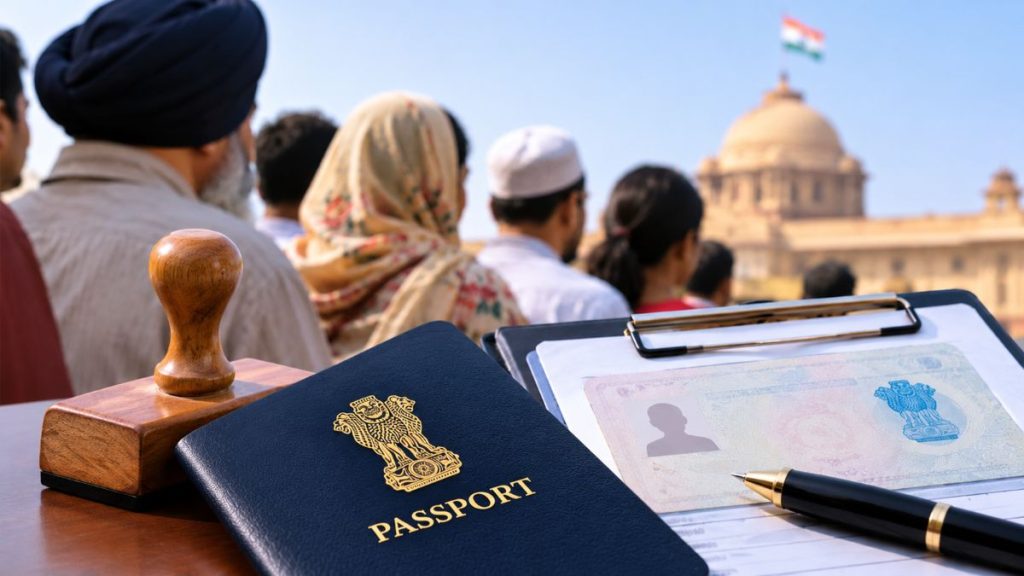
New Delhi: The Centre has made visas mandatory for members of six minority communities from Pakistan, Bangladesh and Afghanistan who entered India by December 31, 2024, citing religious persecution, to continue residing in the country. The revised rules retain their exemption from passport and visa requirements for entry but introduce a separate visa condition for continued stay.
The Ministry of Home Affairs introduced the changes through notification S.O. 6027(E), dated November 4, amending the Immigration and Foreigners (Exemption) Order, 2025. Published in the official Gazette on Thursday, the amendment came into force the same day.
The new requirement covers Hindus, Sikhs, Buddhists, Jains, Parsis and Christians who sought shelter in India because of religious persecution or fear of persecution. It applies to those who entered without valid passports or travel documents and those whose documents subsequently expired.
Eligible individuals must now obtain an appropriate category of visa for continued residence, Scroll reported on Friday. The notification does not specify a separate visa category, application deadline or detailed procedure for affected residents.
The changes modify exemptions introduced in September 2025, without withdrawing the existing protection relating to entry documentation.
However, the December 31, 2024, cut-off differs from the Citizenship Amendment Act (CAA), 2019, which provides a facilitated citizenship pathway for eligible members of the same six communities who entered India by December 31, 2014.
The immigration exemption concerns entry and continued residence, while the CAA governs citizenship eligibility. Those covered by the later immigration cut-off do not automatically qualify for Indian citizenship under the CAA.
The amendment also provides passport related relief to certain Pakistani nationals who entered India on valid passports by December 31, 2009, intending permanent residence but cannot renew their documents because they lack Pakistan’s computerized national identity card.
Separate exemptions cover specified former Indian citizens belonging to the Muslim community who migrated to Pakistan between 1947 and 1965 and returned to settle in Keralam by December 31, 2009, subject to prescribed conditions.
People of Indian origin holding Malaysian or Singaporean citizenship who returned by the same date and cannot renew their passports also receive relief. These categories must obtain appropriate visas for continued stay.
The amendment also defines the government’s visa manual as the document containing visa and immigration instructions. Indian citizens travelling to Nepal or Bhutan, and Nepali and Bhutanese citizens entering or leaving India, must produce identity documents specified in the manual.
Indian citizens travelling to or returning from third countries through Nepal or Bhutan must possess valid passports and use designated immigration posts. Nepali and Bhutanese citizens travelling through other countries require passports, with visas additionally mandatory for those embarking from or transiting through China, Macau, Hong Kong or Pakistan.
Registered Sri Lankan Tamil nationals who sought shelter in India by January 9, 2015, retain their passport and visa exemptions. Similar exemptions apply to Tibetans who entered on permits issued by the Indian embassy in Kathmandu between 1959 and May 30, 2003, or subsequently through designated border posts with special entry permits, subject to registration requirements.
Separate exemptions apply to Indian armed forces personnel travelling on duty, accompanying family members using government transport and eligible foreign military vessel crews visiting India for repairs.
The revised framework preserves specified exemptions while introducing additional documentation requirements for continued residence, with implementation procedures remaining an important consideration for affected individuals.