


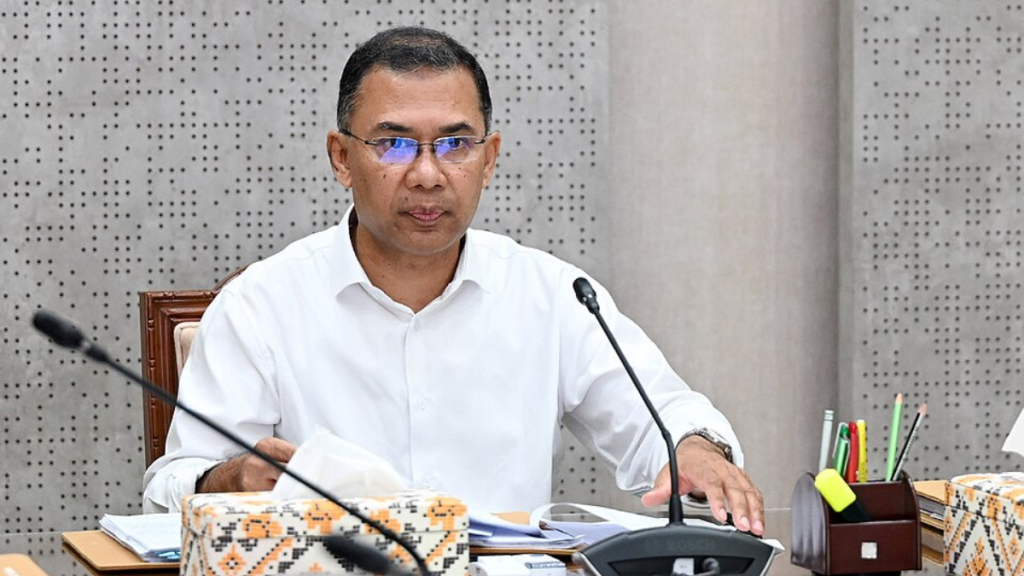
New Delhi: Bangladesh’s decision to keep its prime minister, Tarique Rahman, away from the BRICS Summit in New Delhi is more consequential than a dispute over the wording of an invitation, signalling Dhaka’s determination to define the terms of its early engagement with India. By insisting that Rahman’s first visit to India should be bilateral rather than incidental to a multilateral summit, the new government is sending an unmistakable message that the relationship will be reset through direct negotiation rather than diplomatic optics.
Bangladesh state minister for foreign affairs, Humaiun Kobir, said on Thursday that Rahman had been invited to the BRICS outreach session in his capacity as chair of the Bay of Bengal Initiative for Multi-Sectoral Technical and Economic Cooperation (Bimstec), not as Bangladesh’s prime minister. Dhaka therefore saw little basis for sending either Rahman or another government representative to the September 12−13 BRICS summit.
On the surface, the distinction may appear semantic, but it carries diplomatic weight. A BRICS outreach invitation extended through Bangladesh’s Bimstec chairmanship places the emphasis on Dhaka’s regional role, whereas a bilateral invitation to Rahman as prime minister would put the political relationship between India and Bangladesh at the centre of the engagement.
New Delhi, for its part, had made a deliberate distinction between the two tracks. India invited Rahman to the BRICS outreach session as the current Bimstec chair while also extending a separate invitation for a bilateral visit, meaning that Dhaka’s objection cannot simply be reduced to the absence of an Indian invitation altogether.
That is what makes the episode strategically interesting. Dhaka appears to be saying that Rahman’s first political engagement with New Delhi should not be subsumed into an international summit in which Bangladesh is present primarily because it currently heads another regional organization.
Kobir’s remarks went further, indicating that the government wants Rahman’s India visit to take place when the circumstances are conducive. Bangladeshi reporting has also emphasized that Dhaka wants a bilateral visit to be built around an agreed agenda and meaningful outcomes, rather than simply producing ceremonial photographs and statements.
The decision therefore offers an early indication of how Rahman’s government intends to manage India. It does not suggest that Dhaka wants to disengage from New Delhi; rather, it suggests that the new leadership wants greater negotiating space and does not intend to allow the relationship to be defined by India’s diplomatic timetable.
That approach matters because the political circumstances surrounding the relationship have changed sharply since Sheikh Hasina’s departure from power in 2024. Rahman’s government is now attempting to establish its own political legitimacy and foreign-policy priorities, while India is adjusting to a Bangladesh in which the political actors and assumptions that shaped the previous bilateral relationship are no longer dominant.
New Delhi has nevertheless moved quickly to establish contact with the new government. The prime minister, Narendra Modi, congratulated Rahman after the Bangladesh Nationalist Party’s election victory in February, and the Lok Sabha speaker, Om Birla, subsequently delivered Modi’s invitation for the newly elected prime minister to visit India during his trip to Dhaka for the February 17 swearing-in ceremony.
That invitation is important because it demonstrates that a bilateral channel already exists independently of BRICS. Dhaka’s current position, therefore, is less a rejection of an India visit than an attempt to ensure that the eventual visit begins with a substantive bilateral agenda and is not interpreted as an endorsement of any particular regional or multilateral framework.
For India, this presents a delicate diplomatic challenge. New Delhi has strong strategic reasons to stabilize relations with Dhaka, given Bangladesh’s geographical importance to India’s north-east, its position along the Bay of Bengal, the extensive network of economic and transport links between the two countries and the wider security implications of developments in the neighbourhood.
Bangladesh, meanwhile, has its own reasons for seeking a recalibrated relationship. Its government is likely to place greater emphasis on reciprocity in trade, water-sharing, border management, connectivity and security cooperation, while also seeking room to maintain relationships with other major powers without those ties being interpreted in New Delhi as a strategic shift against India.
The water question could become particularly important. Bangladeshi officials have recently stressed the need for serious negotiations with India over the Ganga water-sharing arrangement, which is due to expire in December, adding a concrete bilateral issue to the broader diplomatic recalibration.
The broader regional context also matters. Bangladesh is currently chairing Bi, a grouping that connects India with several countries around the Bay of Bengal, giving Dhaka an institutional role that extends beyond its bilateral relationship with New Delhi and provides the government with additional diplomatic space.
India’s decision to invite Rahman to the BRICS outreach session through that Bimstec role was consequently understandable from New Delhi’s perspective. But Dhaka’s response shows that institutional logic and bilateral political optics do not necessarily coincide, particularly when a new government is still establishing its foreign-policy identity.
There is also a less visible but potentially important message for India’s wider neighbourhood diplomacy. If Dhaka believes that its prime minister’s first visit should be structured around specific bilateral deliverables, other neighbouring capitals will be watching how New Delhi responds – particularly whether India treats the hesitation as a diplomatic slight or as the opening position of a new government seeking a more balanced relationship.
The episode should therefore not be overstated as a new crisis. Bangladesh’s decision does not close the door on a Rahman visit, and Dhaka has explicitly left the possibility of bilateral engagement open; what it has rejected is the idea that the prime minister’s first India visit should take place simply because an opportunity has arisen around a multilateral summit.
There is, however, a revealing difference in the explanations coming from Dhaka. While Kobir has publicly focused on the Bimstec basis of the invitation, Bangladesh’s high commissioner to India, Riaz Hamidullah, has described the decision more broadly as the result of the “context and circumstances”, without specifying what those circumstances were.
That divergence is worth watching because diplomacy is often shaped as much by what governments decline to say as by what they put on record. It suggests that the BRICS question may be only the visible part of a more complicated negotiation over the political tone and substance of the India-Bangladesh relationship.
For New Delhi, the most productive response may therefore be to look beyond the immediate disappointment of Rahman’s absence and concentrate on what a substantive bilateral engagement can deliver. A successful reset will require both sides to identify areas where interests converge while addressing contentious issues without allowing them to become symbols of national pride or political identity.
The BRICS episode has thus produced a useful early reading of Dhaka’s diplomatic posture. Bangladesh is not turning away from India, but it is signalling that the next phase of the relationship will have to be negotiated on terms that reflect its new political reality – and that, for Rahman’s government, the substance of the bilateral relationship matters more than the convenience of the diplomatic calendar.