


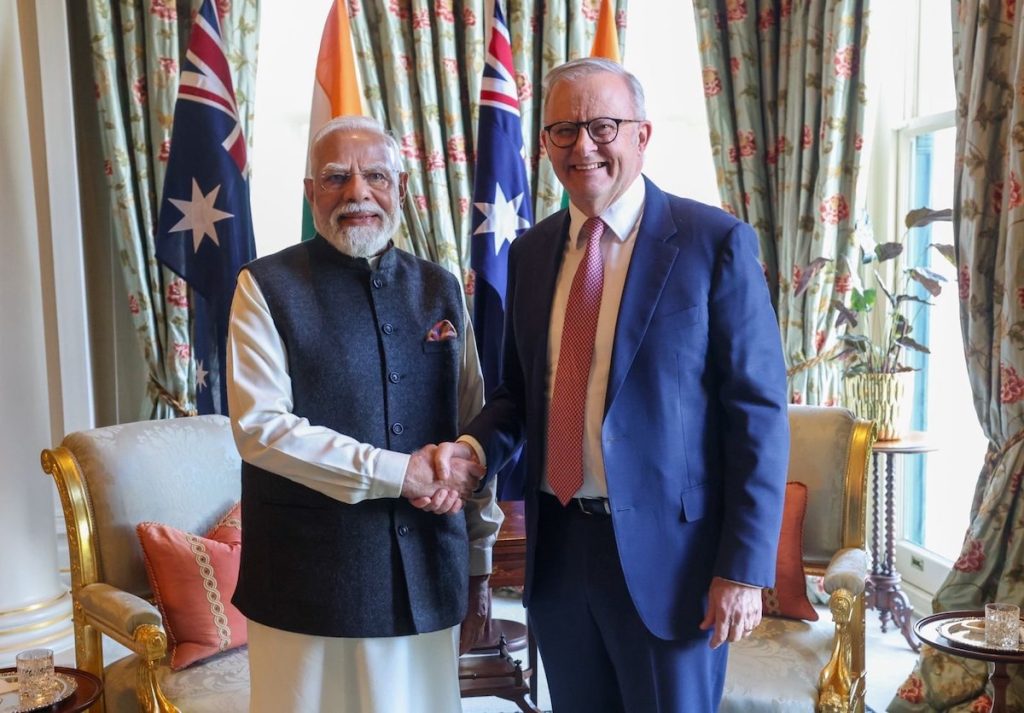
India and Australia have finally operationalized a uranium supply arrangement more than a decade in the making, signing an agreement in Melbourne on Thursday, which clears the way for regular exports of Australian uranium to India for civil nuclear use. The announcement came as the prime minister, Narendra Modi, met the Australian prime minister, Anthony Albanese, for the third India-Australia Annual Summit, part of a three-nation tour that also took Modi to Indonesia and, from Melbourne, onward to New Zealand.
What was exactly signed?
The two countries did not sign a fresh treaty. Instead, they finalized what officials called an “administrative arrangement” – the technical, plumbing-level agreement needed to operationalize the Australia-India Nuclear Cooperation Agreement of 2015, itself a follow-on to a broader civil nuclear pact the two sides had reached in 2014. Albanese told reporters the arrangement would enable “the export of Australian uranium to India for exclusively peaceful purposes” and under International Atomic Energy Agency safeguards.
The foreign secretary, Vikram Misri, briefing journalists in Melbourne, explained why it had taken so long. An administrative arrangement had actually been concluded earlier, he said, but could not be put into effect because the two sides had not fully agreed on the reporting and accounting procedures that govern how safeguarded uranium is tracked once it leaves Australian shores. Those procedural questions have now been resolved, satisfying both countries’ expectations on supply, handling and reporting.
Neither government has yet disclosed how much uranium will flow to India or on what timeline – those details are expected to be worked out in commercial contracts between Indian and Australian entities in the months ahead.
Why this matters so much for India?
For India, the significance lies less in any single shipment and more in what the deal unlocks strategically.
A direct line to the world’s largest uranium reserves:
Australia holds roughly 28 to 31% of the world’s identified uranium resources – more than double those of Kazakhstan, the next-largest holder – built around vast deposits such as Olympic Dam in South Australia, the world’s largest known uranium find.
Until now, that resource base sat largely out of reach for India because of longstanding western unease, dating back to India’s 1974 and 1998 nuclear tests, about supplying a country outside the Nuclear Non-Proliferation Treaty. The new arrangement gives India contractual access to that pool for the first time in a substantive way.
Diversification away from a narrow supplier base:
India currently leans heavily on Kazakhstan, which alone accounts for close to 80% of its uranium imports, alongside smaller volumes from Canada, Uzbekistan and Russia. India’s own reserves, concentrated in Jharkhand and Andhra Pradesh, are low-grade and expensive to mine, so imports will remain essential for years to come.
Bringing in a fourth major, reliable supplier reduces India’s exposure to disruption in any one relationship or region – a lesson reinforced by the fact that the Melbourne summit itself unfolded against the backdrop of a fraying US-Iran ceasefire, with fresh American strikes on Iran and Iranian retaliation against shipping in the Strait of Hormuz, a reminder of how quickly energy supply lines can be threatened by conflict.
Fuel for a 100-gigawatt ambition:
India currently operates 25 reactors with a combined capacity of under 9,000 megawatts, but the government has set a target of at least 100 gigawatts of nuclear capacity by 2047, under the Nuclear Energy Mission announced in the 2025-26 Union budget. Reaching that goal – a more than tenfold increase – will require India to add over four gigawatts of nuclear capacity every year for two decades, and each new reactor needs a secure fuel supply behind it. Misri called the Australian agreement “a major shot in the arm” for those clean energy ambitions.
A legal and policy backdrop that is finally catching up:
The deal also lands at a moment when India has been overhauling the domestic rules that long discouraged foreign nuclear suppliers from doing business with it. Parliament passed the Sustainable Harnessing and Advancement of Nuclear Energy for Transforming India (Shanti) Act in December 2025, replacing the Atomic Energy Act of 1962 and the Civil Liability for Nuclear Damage Act of 2010.
The new law caps supplier liability and opens limited private sector participation in a sector that had been an exclusively government preserve, addressing precisely the kind of concerns that kept firms wary for years, even after the landmark India-US nuclear deal of 2008.
A strategic signal:
The uranium arrangement did not arrive alone. It was one of 18 outcomes from the summit, alongside a new India-Australia Joint Declaration on Defence and Security Cooperation, replacing a 2009 security declaration, and a Maritime Security Collaboration Roadmap. The two countries also agreed to hold an annual defence ministers’ dialogue, expand military exercises and aircraft deployments under their mutual logistics support arrangement, and signed a memorandum of understanding between the Indian Coast Guard and Australia’s Maritime Border Command. Albanese described India as “a top-tier security partner”.
Taken together, the outcomes point to a relationship being reshaped around both clean energy and Indo-Pacific security, at a time when China’s recent test of an intercontinental ballistic missile into the South Pacific was reportedly raised by Albanese in his talks with Modi, according to Misri.
What is in it for Australia?
Australia gets a large new market for a resource it has struggled to fully monetise – despite holding the world’s biggest uranium reserves, it ranks only fourth in production, held back by domestic mining restrictions and a broader legislative ban on nuclear power at home.
Selling more uranium abroad, including to India, gives Canberra a way to extract commercial value from those deposits while also diversifying its trade relationships beyond China, which remains its largest trading partner. Albanese noted that India is already Australia’s fifth-largest trading partner, with two-way goods and services trade worth about A$54.4 billion in the last reported year, and around a million people of Indian origin now live in Australia.
The regional backdrop
The Melbourne summit’s timing was notable. It took place even as the two leaders felt compelled to issue a joint statement expressing concern over the deteriorating security situation in West Asia and urging restraint from all parties – underlining how directly global energy and security anxieties fed into the logic of tying India closer to a stable, allied uranium supplier.
For India, an uranium deal a decade in the waiting is as much about insulating its energy future from geopolitical shocks as it is about the tonnes of fuel that will eventually cross the Indian Ocean.