


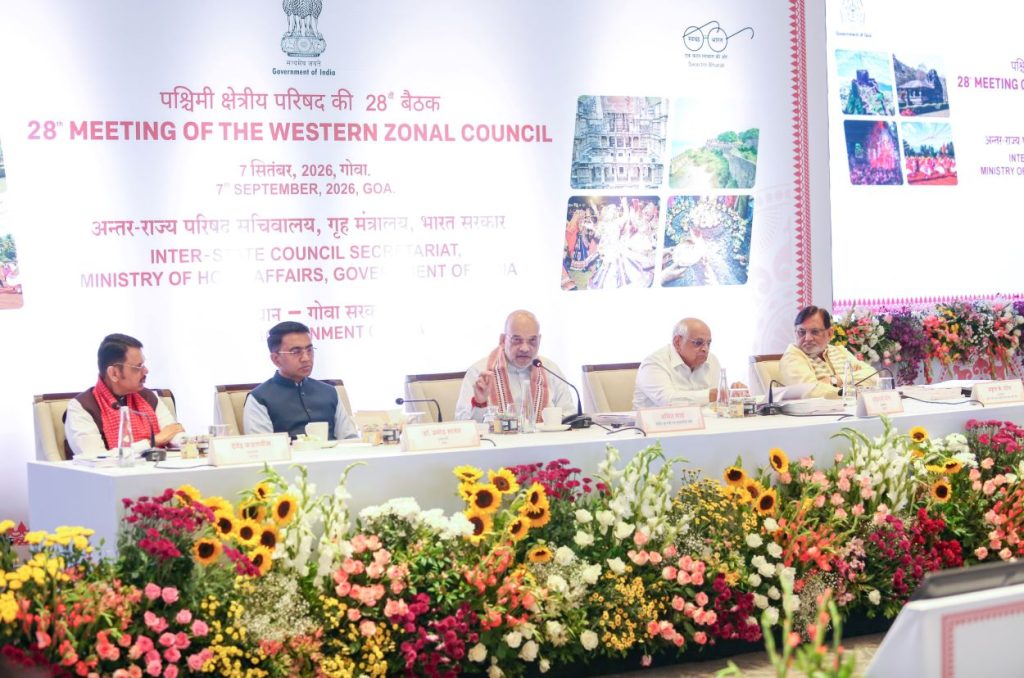
New Delhi: The Union home minister, Amit Shah, has said the Centre will intensify efforts to strengthen India’s coastal security over the next two years, signalling that maritime surveillance and protection of vulnerable coastal facilities will receive greater policy attention. He made the announcement while chairing the 28th Meeting of the Western Zonal Council in Panaji, Goa, on Monday.
“Over the next two years, the Ministry of Home Affairs will move forward very seriously on coastal security,” Shah told the meeting, without disclosing specific projects, expenditure or implementation timelines. His remarks nevertheless indicate that the government is preparing a sustained programme involving the Centre, coastal states, security agencies, port authorities and fishing communities.
The meeting was attended by the chief minister of Goa, Pramod Sawant; the chief minister of Gujarat, Bhupendra Patel; the chief minister of Maharashtra, Devendra Fadnavis; and the administrator of Dadra and Nagar Haveli and Daman and Diu, Praful K Patel. Senior officials representing the Union government, the three states and the Union territory were also present.
Shah’s announcement followed his review of Goa’s law-and-order and security situation a day earlier, when coastal security figured alongside narcotics trafficking, fugitives, disaster management, police modernization and the implementation of the new criminal laws. The proximity of the two meetings underscored the Centre’s concern over the interconnected risks posed by maritime infiltration, smuggling networks and organized crime along the western seaboard.
India’s coastal-security system is distributed across several authorities, with the Indian Navy responsible for overall maritime security, the Indian Coast Guard coordinating coastal security in territorial waters and state marine police patrolling areas closer to the shore. Port authorities, customs agencies, intelligence organizations and local police forces also form part of this layered arrangement.
The Centre’s latest push is expected to build on measures initiated after the November 26, 2008 Mumbai terrorist attacks, whose perpetrators entered India by sea. Those measures included the expansion of coastal police infrastructure, improved maritime-domain awareness, greater registration of fishing vessels and the establishment of mechanisms for sharing information between the Indian Navy, Indian Coast Guard and state agencies.
The government is also establishing a Bureau of Port Security as a statutory body under the Merchant Shipping Act, 2025, with responsibility for regulating and inspecting security arrangements for ships and port facilities. The proposed bureau will collect and share security information, oversee port-security standards and maintain a dedicated division to protect information-technology infrastructure from cyberattacks.
During a review in July, Shah directed officials to create a database of personnel deployed under the bureau and ensure that ports covered by its security framework had container-scanning facilities. He also asked the Central Industrial Security Force to conduct trial runs of proposed arrangements at major facilities, including Jawaharlal Nehru Port, Visakhapatnam Port and Mundra Port.
Fishing harbours and smaller fish-landing centres remain particularly important because their dispersed locations and varying levels of surveillance can create gaps in the security network. Shah previously directed district administrations to identify all such centres, deploy permanent police personnel at them and simplify the registration of fishermen.
The Centre has also been promoting Nabhmitra, an Isro-developed satellite-based system designed to improve communication with fishing vessels and provide alerts, weather information and emergency assistance at sea. Wider adoption could serve the dual purpose of protecting fishermen and strengthening the authorities’ ability to identify suspicious or unregistered maritime activity.
At the zonal council meeting, Shah also asked western states to take a leading role in implementing the Bharatiya Nyaya Sanhita, Bharatiya Nagarik Suraksha Sanhita and Bharatiya Sakshya Adhiniyam. The three laws, which replaced the Indian Penal Code, Code of Criminal Procedure and Indian Evidence Act, respectively, came into force on July 1, 2024.
Cybercrime and vulnerabilities in cooperative banking were among the other security-related subjects discussed. Shah called for urban cooperative banks to be linked with fraud-reporting and monitoring systems, encouraged them to adopt MuleHunter AI and sought their integration with the Indian Cybercrime Coordination Centre.
The home minister further urged the western region to take the lead in India’s campaign against narcotics, an issue with a direct maritime-security dimension because ports, container traffic and remote stretches of coastline can be exploited by international trafficking networks. Stronger cooperation among customs, the Coast Guard, state police, intelligence agencies and port operators is therefore central to detecting consignments before they enter domestic distribution networks.
Shah described the western region as India’s “WEST Engine”, with the acronym referring to “wealth and finance, exports and ports, start-ups and semiconductors, and tourism and the blue economy”. He said its economic importance – encompassing major ports, Mumbai’s financial sector, Goa’s tourism industry and Gujarat’s emerging semiconductor projects – made both security and effective inter-state coordination particularly important.
He also cited the increased frequency of zonal council meetings, saying 71 meetings of the councils and their standing committees had been held since 2014, compared with 25 between 2004 and 2014. According to the government, these meetings considered 1,893 issues, of which 1,445 were resolved, while the councils increasingly shifted from dispute settlement towards monitoring development and welfare programmes.