


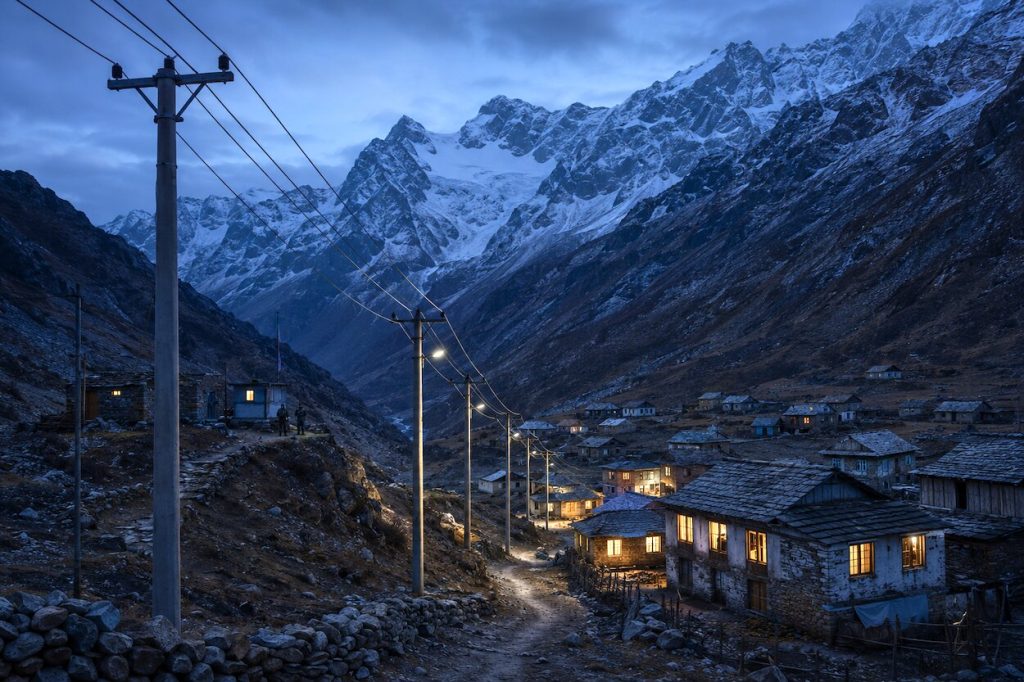
New Delhi: Grid electricity is set to reach 12 remote, seasonally inhabited villages in Uttarakhand’s Johar valley for the first time since India’s independence, improving basic services in a strategically important region close to the line of actual control (LAC) with China. The ₹21-crore project will also provide a more reliable source of power to Indo-Tibetan Border Police personnel deployed in the high-altitude valley.
The Uttarakhand Power Corporation Limited (UPCL) has laid a 12-kilometre distribution line to Rasgadi, about 50 kilometres from the border by road and 17 kilometres by air. Nearby Bugdiyar, where the ITBP maintains a camp, is also expected to be connected shortly, according to a Times of India report.
The two settlements have a combined seasonal population of about 180, with most residents moving to lower altitudes during the severe Himalayan winter and returning in summer. Until now, villagers and security personnel have relied largely on solar lanterns, small solar installations and diesel generators, while kerosene – once widely used for lighting – is no longer readily available.
UPCL had planned to energize the lines to Rasgadi and Bugdiyar on Saturday, after completing mandatory tests. The commissioning was delayed after a landslide uprooted eight electricity poles, underlining the difficulties of building and maintaining infrastructure in the fragile Himalayan terrain.
The full project involves laying 61 kilometres of power lines and is scheduled for completion by March 2027. Besides Rasgadi and Bugdiyar, it will cover Milam, Laspa, Martoli, Bilju, Burfu, Mapa, Tola, Ganghar, Panchu and Railkot.
The executive engineer of UPCL’s works division, DD Pangti, said construction began on January 26, 2026, and the corporation intended to connect all 12 villages within the stipulated period. He said the supply would benefit both the local population and ITBP units operating in the valley, ETEnergyworld reported.
Residents hope dependable electricity, together with improving road access, will help expand tourism and create income-generating opportunities in Upper Johar valley. The region contains historically important settlements such as Milam and Martoli, which once formed part of a flourishing trans-Himalayan trade network before commercial movement across the border ceased following the 1962 India-China war.
The Johar valley project forms part of a wider effort to extend essential infrastructure to Uttarakhand’s sparsely populated frontier. In July, the state announced plans to connect 52 border villages to the national grid, including 20 in Darma valley, 18 in Vyas valley and 14 in Johar valley, according to Press Trust of India.
UPCL has separately completed the tendering process for grid connections to 882 homes in eight border villages and 43 ITBP outposts across Pithoragarh, Uttarkashi and Chamoli districts. The work is being pursued under the Centre’s “Vibrant Villages Programme” and Border Out Post scheme, which combine local development with the operational requirements of border-guarding forces, as detailed in an earlier PTI report.
Launched in 2023, the first phase of the Vibrant Villages Programme prioritizes 662 settlements along India’s northern frontier, including 51 in Uttarakhand. Its stated objectives include improving roads, electricity, telecommunications, healthcare and livelihood opportunities so that migration from remote border communities can be reduced, according to the Union home ministry.
For Johar valley, however, providing electricity is only one part of the challenge. Reliable maintenance, road access, telecommunications and livelihood support will determine whether the new infrastructure produces lasting economic activity and encourages families to spend longer periods in their ancestral villages.