


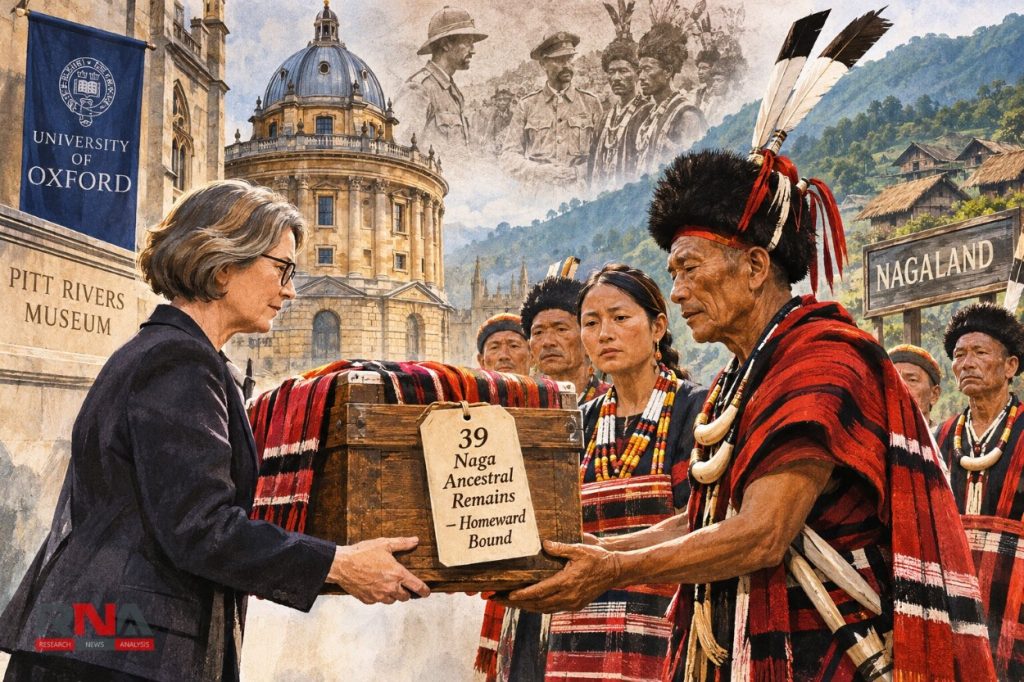
New Delhi: More than a century after their remains were taken from India’s northeastern hills during British colonial rule, 39 Naga ancestors are finally returning to their homeland following a formal handover by the University of Oxford. The transfer, completed at the university’s Pitt Rivers Museum on Monday, marks a significant achievement for the Naga community’s six-year campaign to reclaim its ancestral heritage and confront the legacy of colonial-era collecting practices.
The remains, primarily human skulls, were handed over to representatives of the Forum for Naga Reconciliation (FNR) and the Naga Tribe Hohos during a ceremony attended by tribal elders, scholars and university officials. According to an AFP report, nearly 30 Naga representatives travelled to Britain for the occasion, which formally transferred responsibility for the remains to the communities from which they originated.
The transfer agreement was signed by the museum’s director, Professor Laura Van Broekhoven, and the FNR representative, Rev Dr Wati Aier. The signing was witnessed by Visier Sanyü, representing the FNR, and Thejao Vihienuo, representing the Naga Tribe Hohos, according to a joint statement issued by the Naga organizations.
Following the ceremony, the remains were removed from Oxford to begin their journey to Nagaland, bringing an end to more than a century of institutional custody. The delegation is expected to return through India before accompanying the remains to their final resting place, where a collective memorial is planned to honour the ancestors and symbolize reconciliation.
How the remains reached Britain
The Pitt Rivers Museum, established in 1884, possesses one of the world’s most extensive collections of Naga cultural materials, comprising thousands of objects acquired during British rule. Its official account of the repatriation identifies two colonial administrators and anthropologists, John Henry Hutton and James Philip Mills, as the principal collectors responsible for bringing most of the ancestral remains to Oxford between approximately 1910 and 1940.
The museum has acknowledged that colonial collecting frequently occurred within unequal relationships of power, including military expeditions in which cultural objects and human remains were confiscated. Its historical records include references to the 1936 Pangsha expedition, during which Mills accompanied an armed party and documented the acquisition of human remains.
Although colonial accounts often classified Naga skulls as trophies associated with historical headhunting practices, contemporary Naga researchers have challenged such sweeping interpretations. They argue that some remains belonged to respected ancestors and village leaders, raising serious questions about the circumstances of their removal and whether communities ever consented to their acquisition.
Six years of negotiations
The campaign gathered momentum in 2020 when the Pitt Rivers Museum removed human remains from public exhibition following an ethical review of its collections. The decision prompted the Naga anthropologist, Professor Dolly Kikon, now associated with the University of California, Santa Cruz, to contact the museum and initiate discussions about restitution.
The initiative subsequently developed into a community-led movement involving the FNR, its Recover, Restore and Decolonise (RRaD) team, tribal organizations, elders and researchers. Through consultations across Naga communities, the campaign sought to establish collective agreement on the return of the remains and the appropriate arrangements for their burial.
A Naga delegation formally presented its repatriation request in June 2025, and the University of Oxford Council approved the return of 39 ancestral remains on July 13, 2026. One additional remain was excluded because the available documentation could not establish its Naga provenance, illustrating the difficulties involved in reconstructing incomplete colonial collection records.
The museum also retains numerous Naga cultural objects, including items containing or potentially containing human hair, which are outside the present transfer. Consequently, the repatriation represents an important first step rather than a comprehensive settlement of questions surrounding the ownership and future of Naga heritage held overseas.
A homecoming with wider significance
Addressing the handover ceremony, Oxford’s vice-chancellor, Professor Irene Tracey, acknowledged its historical importance and the contribution of Naga communities to the reconciliation process. Sanyü recalled the destruction inflicted on his village by British colonial forces, emphasizing the importance of confronting historical injustice without allowing it to perpetuate hostility.
Vihienuo described the return as recognition of the Naga people’s right to care for their ancestors, while the RRaD coordinator, Rev Dr Ellen Konyak, characterized the development as the beginning of a broader effort to reclaim Naga history. The ceremony incorporated traditional chants and songs, reflecting the cultural and spiritual significance of the occasion beyond its legal and institutional dimensions.
According to a report by Eastern Mirror, the remains were expected to reach Nagaland between November 13 and 15, although logistical arrangements had not been finalized. The Naga representatives intend to establish a shared memorial in Kohima, creating a place of remembrance intended to transcend tribal divisions and reinforce a common historical identity.
The return also forms part of a wider international reassessment of colonial museum collections, particularly those containing Indigenous human remains obtained without demonstrable consent. The Pitt Rivers Museum has previously returned ancestral remains to Indigenous communities in Australia, New Zealand and the United States, but the Naga initiative is especially notable for the extensive community consultations that preceded the transfer.
For the Naga people, whose communities extend across Nagaland, Manipur, Arunachal Pradesh, Assam and neighbouring Myanmar, the homecoming carries significance beyond the restoration of ancestral dignity. It offers a rare instance of collective action across geographical and tribal boundaries, demonstrating how the recovery of historical memory can provide common ground even where contemporary political differences persist.