


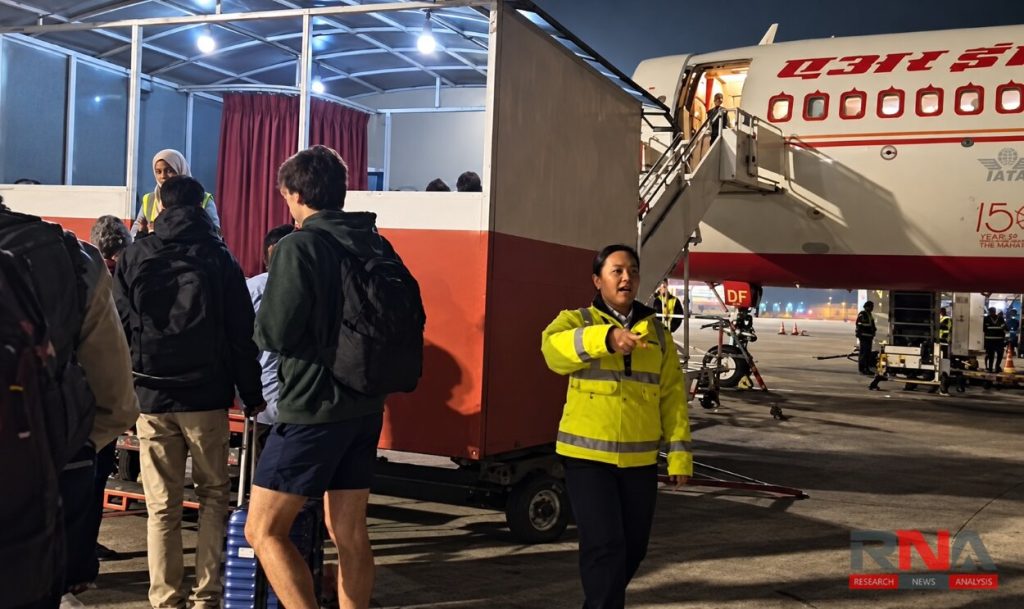
New Delhi: Indian security checks on passengers departing Kathmandu have come under renewed scrutiny after Nepali authorities failed to produce documents governing an arrangement introduced after the 1999 Kandahar hijacking. The additional screening continues 26 years later, raising questions about its authorization, oversight and the balance between aviation security and Nepal’s sovereignty.
A Kathmandu Post investigation published on Saturday found that Nepal’s tourism ministry, civil aviation regulator and home ministry could not provide the relevant records. Passengers on Air India and IndiGo undergo further checks before boarding, after completing Nepal’s screening.
However, missing files do not establish that Nepal never authorized the practice. Earlier reporting describes both a negotiated arrangement to restore flights after the hijacking and subsequent approval of procedures governing airline security personnel.
The immediate diplomatic picture is also disputed: Nepal’s foreign minister, Shisir Khanal, told Kathmandu Post that airport security had been discussed with Indian officials. The Indian embassy in Kathmandu, however, told the newspaper that the screening issue had not come up for discussion, recently or previously.
The hijacking of IC814
The arrangement originated in the aftermath of one of India’s most consequential hostage crises. On December 24, 1999, five terrorists seized Indian Airlines flight IC814, travelling from Kathmandu to New Delhi with 179 passengers and 11 crew members aboard.
The aircraft passed through Amritsar, Lahore and Dubai before reaching Kandahar, then under Taliban control, while passenger Rupin Katyal was fatally stabbed during the ordeal. The crisis ended on December 31, 1999, after India agreed to release Masood Azhar, Ahmed Omar Saeed Sheikh and Mushtaq Ahmed Zargar in exchange for the remaining hostages.
Indian Airlines subsequently suspended its Kathmandu services, making stronger security a central condition for their restoration. Flights resumed on June 1, 2000, after negotiations lasting more than five months, during which Nepal’s tourism industry suffered from the disruption to an important source of visitors.
A Rediff report described the unusual compromise that helped resolve the impasse as a specially constructed boarding ladder with a platform where Indian personnel could frisk passengers. Nepal had resisted allowing foreign security agencies to operate on its territory, while India wanted its own final check before passengers entered the aircraft.
The elevated platform offered a politically acceptable way to restart services without resolving the wider disagreement over foreign security personnel at the airport. That history shows the screening was a negotiated response to the hijacking, although it does not settle questions about the authority governing today’s operations.
Further evidence of formal approval appears in an archived Republica report on Air India’s screening procedures. It reported that Nepal’s national aviation security committee approved standard operating procedures following a ministerial decision dated January 21, 2009, permitting additional passenger screening.
The report quoted civil aviation officials as specifying that the personnel would belong to the airline, rather than India’s state security agencies. Officials also said the procedures covered staffing, responsibilities and access, although they declined to disclose the document on confidentiality grounds.
That distinction matters when assessing what Nepal permitted, because airline personnel conducting ground checks and sky marshals protecting aircraft in flight perform different functions. The archived account supports authorization for airline screening but does not establish permission for the separate deployment of Indian sky marshals.
Nepal’s own assessments, meanwhile, indicate that the security debate cannot be reduced to sovereignty alone. A high-level review, reported in November 2025, prepared by a committee led by the country’s former supreme court judge, Anil Kumar Sinha, identified poor coordination, overlapping responsibilities and weaknesses in airport security management.
The committee also questioned repetitive manual checks, highlighting gaps in modern explosive-detection equipment and the deployment of specially trained personnel. Its findings suggested that the number of checkpoints was an inadequate measure of how effectively the airport could detect and respond to threats.
Among its recommendations were a dedicated aviation security force, clearer accountability and stronger technical expertise within the system. Those findings add a practical dimension to the controversy: clarifying who may screen passengers must accompany an assessment of whether the overall security arrangements are effective.