


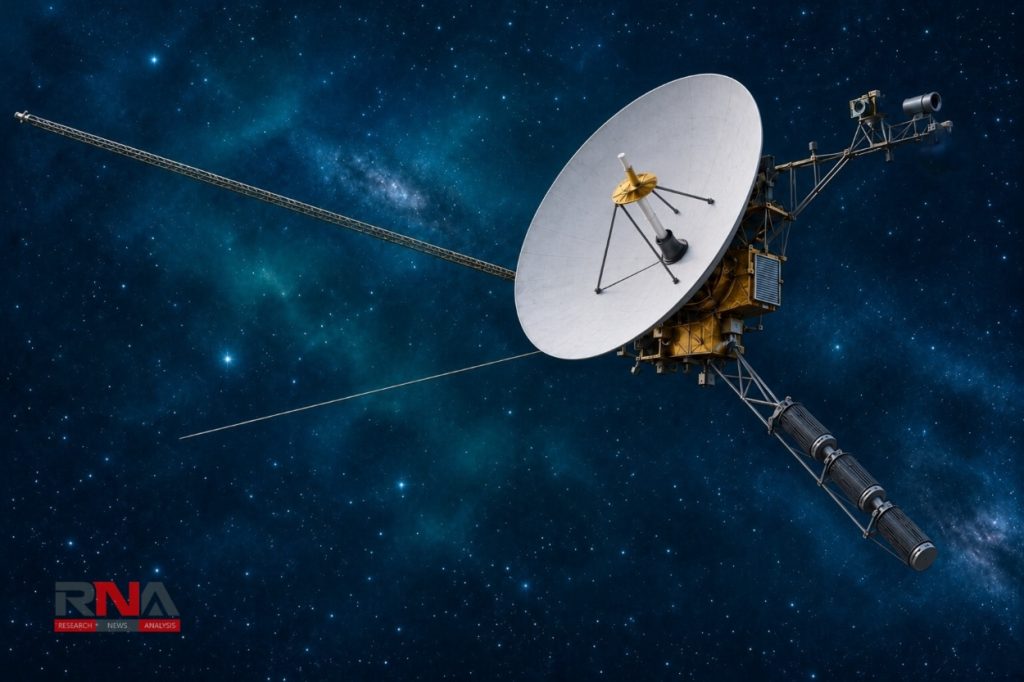
New Delhi: Nasa’s Voyager 1 has become the first human-made object to reach a distance of one light-day from Earth, marking an extraordinary milestone in a journey that began nearly half a century ago. The spacecraft, now approximately 25.9 billion kilometres from its home planet, has travelled so far into interstellar space that a radio signal takes 24 hours to reach it and another 24 hours for a reply to return.
According to the National Aeronautics and Space Administration (Nasa), Voyager 1 was calculated to have crossed the historic distance at precisely 5.16.07am Eastern Standard Time on November 18, 2026, or 3.46.07pm Indian Standard Time. However, mission controllers at the agency’s Jet Propulsion Laboratory (JPL) in California must await a signal from the spacecraft before independently confirming the milestone, underscoring the communication challenges confronting humanity’s most distant space mission.
The achievement comes 49 years, two months and 13 days after Voyager 1 was launched on September 5, 1977, initially to investigate Jupiter and Saturn rather than undertake an indefinite voyage beyond the planets. What began as a planetary exploration programme has evolved into an unprecedented scientific mission examining the conditions between stars, with the ageing spacecraft continuing to transmit valuable measurements despite its diminishing power supply.
What one light-day means
A light-day is a measurement of distance rather than duration, representing how far light travels through a vacuum in 24 hours at approximately 299,792 kilometres per second. At Voyager 1’s present distance, even the fastest possible electromagnetic communication cannot overcome the fundamental constraint imposed by the speed of light.
For mission controllers, the implications are considerable because instructions transmitted from Earth cannot produce an immediate response, and diagnosing a technical problem can require several days of exchanges. Nasa must therefore depend on carefully prepared commands, autonomous fault-protection systems and spacecraft hardware that has continued functioning well beyond its originally intended operational lifetime.
Voyager 1 is travelling at approximately 61,000 kilometres per hour relative to the Sun, a velocity that allows it to extend its distance from Earth by millions of kilometres over relatively short periods. Nevertheless, the enormity of interstellar distances means that even at this speed, the spacecraft would require many thousands of years to approach another star.
The achievement also demands an important distinction: Voyager 1 has entered interstellar space, but it has not necessarily escaped every region that scientists consider part of the solar system. It crossed the heliopause – the boundary separating the solar wind-dominated environment from surrounding interstellar plasma – in August 2012, although the much more distant Oort Cloud, a hypothetical reservoir of icy bodies associated with the solar system, lies considerably farther away.
From planetary exploration to interstellar discovery
Voyager 1 was launched 16 days after its twin, Voyager 2, under a Nasa programme designed to exploit a favourable alignment of the outer planets during the late 1970s. The spacecraft used gravitational assistance from planetary encounters to increase their velocities and alter their trajectories, enabling journeys that would otherwise have demanded substantially more propulsion.
Voyager 1 passed Jupiter in March 1979, providing detailed observations of the giant planet, its atmosphere, magnetic environment and moons, before encountering Saturn in November 1980. Its close investigation of Titan, Saturn’s largest moon, sent it onto a trajectory that ultimately carried it away from the plane of the planets and towards interstellar space.
The two spacecraft subsequently followed different routes, with Voyager 2 continuing to Uranus in 1986 and Neptune in 1989 before entering interstellar space in November 2018. Nasa expects Voyager 2 to reach the one-light-day distance in November 2035, approximately nine years after its older sibling achieves the distinction.
A 49-year-old spacecraft fighting for survival
The historic achievement comes at a particularly difficult stage of the mission, with Voyager 1 operating on increasingly limited electrical power generated by three radioisotope thermoelectric generators. These devices convert heat released through the radioactive decay of plutonium-238 into electricity, but their output declines by approximately four watts annually, forcing Nasa to progressively shut down instruments and auxiliary systems.
According to Nasa’s latest mission-status information, only two scientific instruments remain operational aboard Voyager 1 – its magnetometer and plasma wave subsystem. The magnetometer measures magnetic fields in interstellar space, while the plasma wave instrument examines oscillations in electrically charged particles, helping researchers understand the physical environment beyond the heliopause.
In September this year, JPL engineers completed an elaborate power-conservation operation, informally called the “Big Bang”, replacing three power-consuming devices with lower-energy alternatives. The changes were intended to preserve enough electricity for scientific operations beyond 2027, although Nasa acknowledges that the spacecraft’s age makes long-term predictions increasingly uncertain.
The probe also experienced an unexpected communications interruption in October, when ground stations failed to detect its signal during scheduled contact attempts on October 18 and 19. Communications resumed on October 20, but engineers subsequently discovered that one group of thrusters had stopped operating and its backup system had activated, prompting an investigation into the spacecraft’s autonomous fault-protection response.
Despite these problems, Nasa scientists believe the mission could continue returning information for several more years, potentially remaining in communication with Earth for another three to four years. The immediate objective is to keep the surviving instruments operational through the Voyagers’ 50th launch anniversary in 2027, although even that prospect depends on the continued reliability of ageing components.
Why Voyager 1’s discoveries still matter
The spacecraft’s scientific importance extends beyond its record-breaking distance because it provides direct observations of a region that conventional Earth-based telescopes cannot examine in comparable detail. Measurements of magnetic fields and interstellar plasma have already challenged assumptions about the boundary between the Sun’s influence and the surrounding galactic environment.
One unresolved question concerns the orientation of magnetic fields beyond the heliopause, which scientists expected to change more noticeably after the spacecraft crossed into interstellar space. Instead, measurements have revealed a more complicated relationship between solar and interstellar magnetic structures, suggesting that the transition is not as straightforward as earlier models predicted.
The mission has also established that powerful solar disturbances can propagate far beyond the planetary region, producing pressure waves that affect the interstellar environment. As the Voyager project manager, Suzanne Dodd, explained in comments reported by Reuters, the continuing observations may help determine where the Sun’s influence genuinely ends.
China follows the milestone
Voyager 1’s achievement has also attracted attention in China, where outlets including the state-linked People’s Daily and technology publication ITHome have reported on the spacecraft’s extraordinary journey. Their coverage has emphasized the nearly five decades required to reach one light-day and the immense distances separating interstellar exploration from even the most ambitious conventional planetary missions.
However, no formal reaction from the Chinese government or the China National Space Administration could be verified as of publishing this article. The Chinese coverage examined was primarily scientific rather than diplomatic, and there is no evidence that Beijing has issued a specific statement responding to Nasa’s latest milestone.
Beyond scientific measurements, Voyager 1 also carries a 12-inch gold-plated copper record containing selected sounds, images and greetings intended to represent life on Earth. Conceived as a message to any intelligence that might eventually encounter the spacecraft, the Golden Record will continue travelling through space long after the probe loses its ability to communicate.
Nasa estimates that Voyager 1 will pass within approximately 1.7 light-years of the star Gliese 445 in about 40,000 years, although its instruments will almost certainly have ceased operating long before then. Its present achievement therefore illustrates both the remarkable durability of human engineering and the enormous technological distances still separating present-day spacecraft from meaningful interstellar travel.