


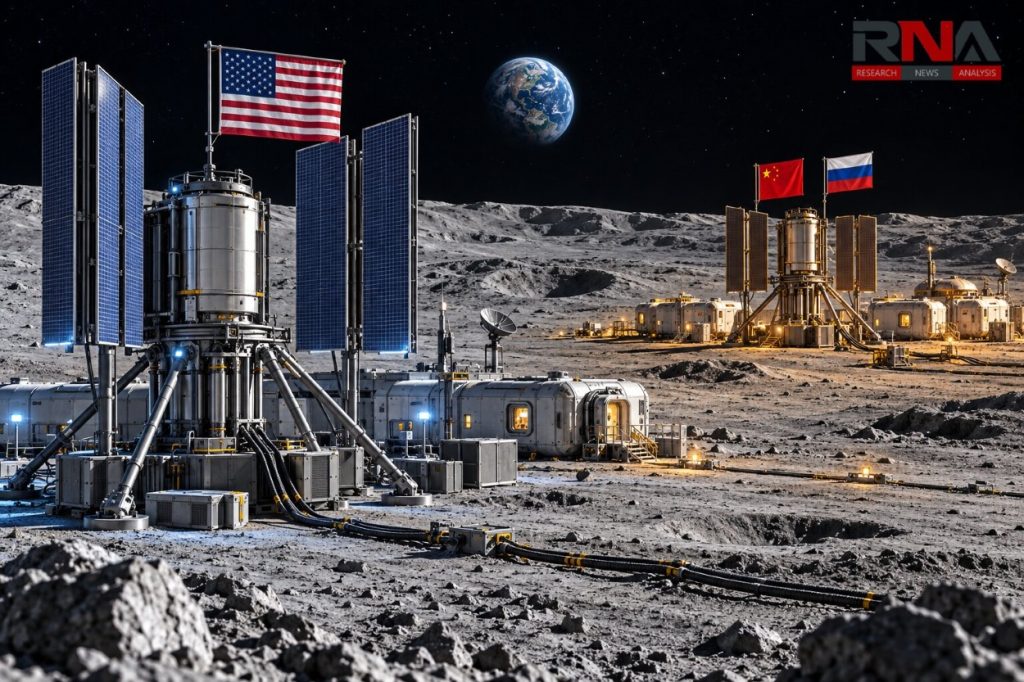
New Delhi: The United States and a China-Russia partnership are pursuing nuclear reactors to power future lunar bases, extending their competition in space from reaching Moon to sustaining operations there. Washington is targeting a lunar reactor by 2030, while Moscow and Beijing are working towards a power station by about 2036, with both programmes raising questions about radiation safety and access to the lunar surface.
Reliable electricity would allow spacecraft, scientific instruments and eventually human habitats to operate through prolonged darkness, reducing their dependence on solar power. The strategic stakes also extend to how countries establish infrastructure and coordinate activities around locations that several missions may want to use.
Nasa and the US energy department renewed their cooperation on lunar nuclear power on January 13, 2026, committing to develop, fuel, authorize and prepare a surface reactor for launch by 2030. Nasa’s current infrastructure plans identify the system as Lunar Reactor-1, or LR-1, and envisage its arrival on the Moon that year.
The US space nuclear policy memorandum issued on April 14 calls for a reactor producing at least 20 kilowatts of electrical power, with a lunar version capable of operating for at least five years. It also seeks a path towards larger systems, including a reactor producing at least 100 kilowatts that would be ready for launch in the 2030s.
These requirements have evolved considerably: Nasa’s earlier concept studies examined a 40-kilowatt system, while an August 2025 industry consultation sought at least 100 kilowatts. Those figures describe different stages of the programme, rather than the output of a completed reactor awaiting launch.
Russia and China, meanwhile, signed a cooperation memorandum in May 2025 covering an automated nuclear power station for their planned International Lunar Research Station. The project is intended to provide the dependable electricity needed to turn separate exploratory missions into a sustained scientific presence.
According to Reuters, Roscosmos contracted the Lavochkin Association to develop a lunar power plant by 2036, with Rosatom and the Kurchatov Institute among the participants. Its intended users include rovers, an observatory and infrastructure serving the joint research station.
The immediate engineering problem is the lunar night, which lasts approximately 14-and-a-half Earth days across much of the Moon. Solar-powered missions must store sufficient energy to survive that interval or suspend operations, while permanently shadowed areas present an even greater challenge.
A fission reactor could generate electricity continuously without sunlight, supplying habitats, communications equipment, rovers and experiments. Nasa sees that capability as essential to longer lunar missions and as a technology that could subsequently support exploration on Mars.
The south polar region is particularly attractive because permanently shadowed areas may contain water ice, making reliable power valuable for both scientific investigation and future resource use. Nuclear systems could support operations in these dark locations, although Nasa is also developing solar arrays, energy storage and surface electricity distribution technologies.
Space nuclear power already has a substantial history, but the proposed lunar reactors differ from the radioisotope generators used aboard many spacecraft. Radioisotope systems draw energy from radioactive decay, whereas fission reactors use a controlled chain reaction to generate heat that can be converted into electricity.
Safety remains a central design constraint, particularly during launch, landing and subsequent operation near astronauts or sensitive equipment. Nasa’s earlier studies explicitly identified radiation shielding and the ability to operate for years without human intervention as requirements, illustrating how little scope a lunar installation would have for conventional maintenance.
Launching a reactor before starting its chain reaction reduces the hazards associated with the radioactive products created during operation, but it does not remove the need to assess accidents involving its fuel. The United Nations principles on nuclear power sources in space require comprehensive safety assessments and safeguards against a reactor becoming critical prematurely, including during launch accidents.
The diplomatic problem concerns how safety precautions would affect other countries’ access to the Moon. The 1967 Outer Space Treaty prohibits national appropriation and establishes freedom of exploration and access, while its prohibition on nuclear weapons does not amount to a blanket ban on nuclear electricity generation.
The Artemis Accords envisage safety zones through notification and coordination to prevent harmful interference between operations. They specify that such zones should reflect scientific and engineering considerations, remain temporary and respect free access to celestial bodies.
This creates a practical tension: a reactor may require protective separation, but an extensive or long-lasting restricted area could complicate neighbouring missions. The accords provide coordination principles, rather than ownership rights, leaving implementation especially consequential as competing programmes develop lunar infrastructure.
For India, the debate has relevance beyond the US-China rivalry: Chandrayaan-3 landed in the Moon’s southern high latitudes on August 23, 2023, and India joined the Artemis Accords that year. Together, those steps give New Delhi a direct interest in both lunar exploration and the arrangements governing safe access for future missions.
The announced dates remain development targets, with neither programme yet demonstrating its proposed reactor on the lunar surface. Their success will depend on delivering dependable electricity while meeting the engineering, safety and coordination requirements of operating far from Earth.