


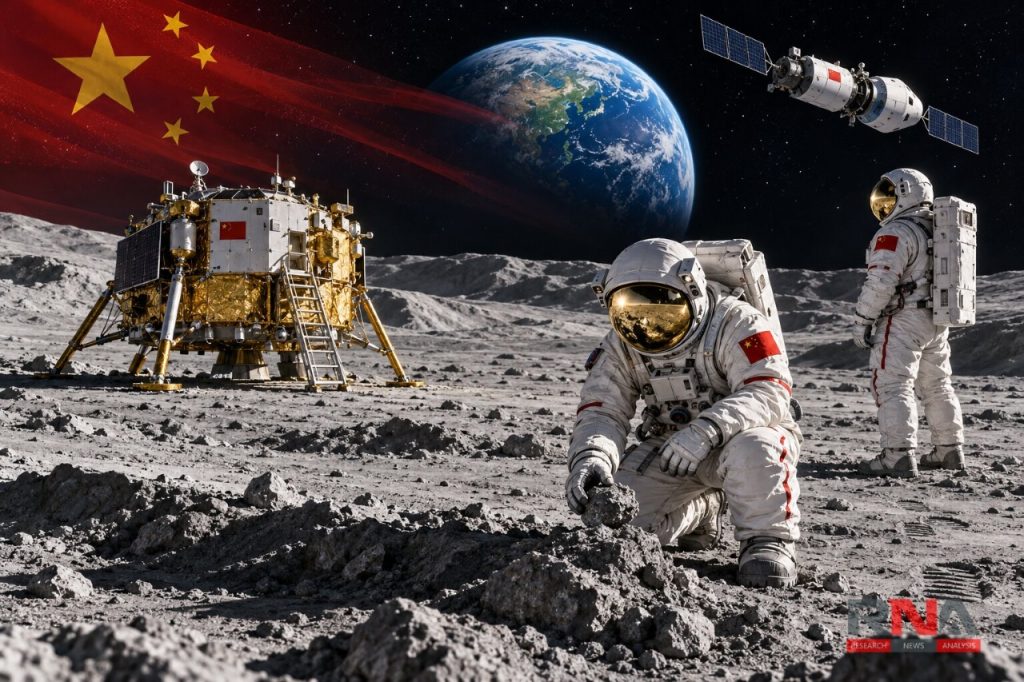
New Delhi: China has outlined how it intends to land astronauts on the Moon before 2030, using two separately launched spacecraft that will dock in lunar orbit before the descent. The planned mission will carry three astronauts towards the Moon, with two transferring to a lander for surface exploration while the third remains aboard the orbiting spacecraft.
The deputy chief designer of China’s crewed space programme and chief designer of its lunar exploration programme, Wang Xiang, explained the mission architecture at the seventh Manned Space Symposium in Beijing on Saturday. His presentation provided further details of the flight sequence and development work supporting Beijing’s previously announced lunar landing target.
The update builds on a two-launch approach outlined earlier by Chinese space authorities, rather than introducing an entirely new mission design. The programme remains in development, with uncrewed flights and further verification required before astronauts attempt the journey.
How the mission will work
Two Long March-10 rockets will separately launch the Lanyue lunar lander and the Mengzhou crewed spacecraft towards the Moon. Once both vehicles reach lunar orbit, they will rendezvous and dock, allowing the landing crew to move from Mengzhou into Lanyue.
The lander will then separate and descend to the surface, where the astronauts will conduct scientific exploration. After completing their work, they will lift off in Lanyue and dock again with Mengzhou, which will carry the reunited crew back to Earth.
The arrangement divides the mission between a spacecraft designed for travel between Earth and lunar orbit and a vehicle built for descent and ascent at the Moon. It also makes the docking operations essential to the mission: the astronauts must transfer between the two vehicles before landing and again before returning home.
Wang said the architecture suited China’s technical capabilities and infrastructure, while allowing the spacecraft and lander to be developed separately. That separation, he said, could help standardize production and establish a family of vehicles for longer-term exploration.
Escape systems and landing hardware tested
Development of Long March-10, Mengzhou and Lanyue is progressing, according to Wang, with several major tests already completed. These include Mengzhou’s launch-pad abort and maximum dynamic pressure escape tests, Lanyue’s landing-and-takeoff test, and a low-altitude demonstration and verification flight involving Long March-10.
A significant combined test took place at the Wenchang launch site in Hainan on February 11, when a prototype Long March-10 booster carried a Mengzhou test vehicle into flight. The spacecraft’s escape system then pulled its return capsule away at maximum dynamic pressure – the stage of ascent when aerodynamic loading is greatest – before the capsule descended by parachute into the sea.
That rocket-and-spacecraft trial tested whether the crew capsule could separate safely during a particularly demanding part of launch. It also gathered data on the booster’s controlled return, although the flight was a development test rather than a complete lunar mission.
Wang acknowledged that substantial challenges remained in bringing the system together. He said the programme was using common technical standards, quality requirements and integrated design procedures, with particular attention to checking the interfaces between its different components.
Uncrewed rehearsal before astronauts fly
China plans to test Lanyue without astronauts before committing a crew to a lunar landing. Wang said the objective was to verify as much of the eventual mission sequence as possible, including lunar orbit operations, docking, descent, a surface stay, ascent and a further rendezvous with Mengzhou.
Preparations for that flight have moved beyond general planning, with the China Manned Space Agency issuing an invitation for experimental payload proposals on October 22. The call is open to domestic organizations seeking to use available resources aboard the uncrewed lander, with submissions due by March 1, 2027.
The wider landing programme also includes the Wangyu lunar spacesuit and Tansuo crewed rover, alongside launch and ground-support infrastructure. Earlier official descriptions identified surface sampling, rover-based exploration and cooperation between astronauts and robotic systems among the mission’s intended activities.
Building on robotic lunar exploration
Wang said the crewed effort would draw on technologies, infrastructure and expertise developed through China’s Chang’e robotic missions. He argued that lunar exploration should first build knowledge and operational capability, with sustained surveys preceding attempts to use the Moon’s resources.
The Chang’e programme has already demonstrated several operations relevant to that progression, including lunar ascent, orbital rendezvous and sample return. On June 25, 2024, Chang’e-6 returned the first samples collected from the Moon’s far side, bringing back approximately 1.94kg of material for scientific study.
Those robotic achievements provide experience for the crewed programme, but carrying astronauts adds requirements for life support, emergency escape and safe return. The before-2030 landing remains a target, with the planned uncrewed flights serving as critical checks before China attempts to put its astronauts on the lunar surface.