


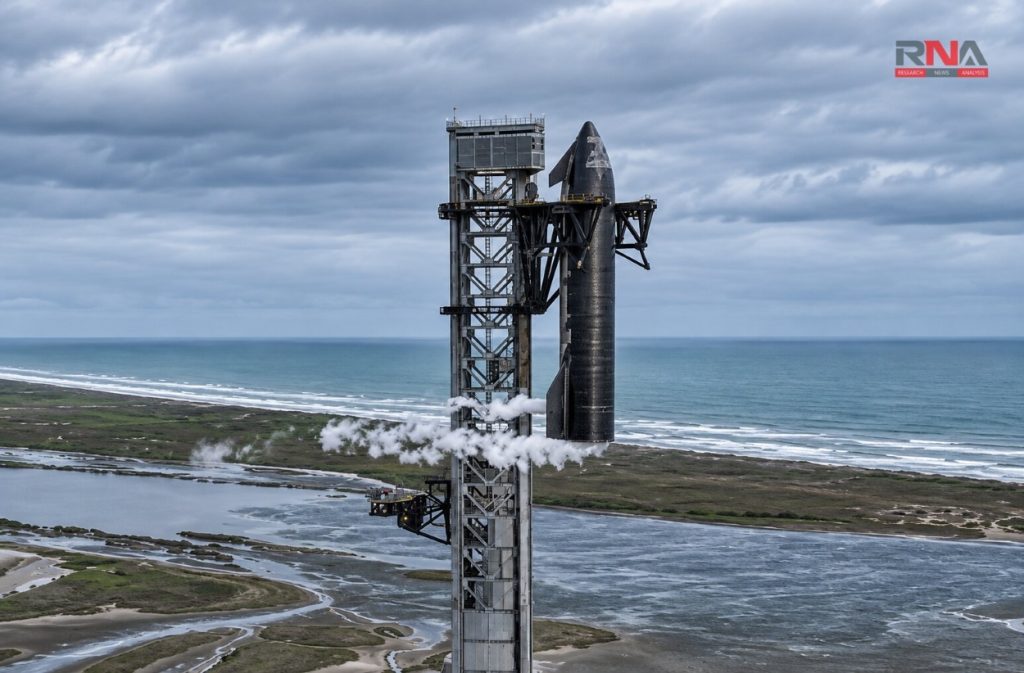
New Delhi: SpaceX has achieved a major breakthrough in reusable spaceflight after its Starship spacecraft returned from orbit and was caught in midair by enormous mechanical arms at its launch facility in Texas, marking the first successful recovery of the vehicle’s upper stage. The achievement brings the company closer to developing a fully reusable heavy-lift rocket capable of supporting frequent missions to Earth orbit, the Moon and eventually Mars, although a separate failure prevented the mission from accomplishing all its objectives.
The historic manoeuvre took place on Saturday at SpaceX’s Starbase facility in southern Texas, where the spacecraft descended vertically between two giant robotic arms attached to its launch tower. The successful recovery followed a flight lasting approximately 22.5 hours, during which Starship completed 14 orbits around Earth and deployed 26 next-generation Starlink communications satellites.
The spacecraft, designated Ship 42, was brought back to the same launch complex from which it had departed on Friday, demonstrating a recovery technique intended to eliminate the need for conventional landing legs. The tower’s mechanical arms, informally called “chopsticks”, secured the descending vehicle after its engines slowed its final approach, completing a manoeuvre that SpaceX had never previously attempted with an orbital Starship.
The company’s founder and chief executive, Elon Musk, celebrated the achievement, subsequently climbing the launch tower to inspect the recovered spacecraft. Musk examined the vehicle at close quarters and reported that it appeared to be in good condition, according to Associated Press.
How Starship completed its historic return
The mission, designated Flight 15, began when the 124-metre Starship rocket lifted off from Starbase with its super-heavy booster providing the initial thrust. After stage separation, the spacecraft continued into low Earth orbit at an altitude of approximately 275 kilometres, beginning a prolonged test of its orbital systems, thermal protection and controlled return capabilities.
During the flight, Starship released 26 Starlink V3 satellites, an important operational objective that demonstrated its growing usefulness as a satellite-launching platform. Three satellites carried specially configured cameras to inspect the spacecraft’s heat shield, providing additional information to engineers assessing whether it could safely withstand the extreme temperatures generated during atmospheric re-entry.
After completing its orbital operations, the spacecraft performed a controlled deorbit burn before plunging through Earth’s atmosphere, where aerodynamic heating produces temperatures capable of seriously damaging an inadequately protected vehicle. It subsequently slowed its descent, performed a landing-flip manoeuvre and used its engines to position itself between the launch tower’s arms.
The operation was particularly significant because recovering a spacecraft returning from orbital velocity presents greater technical challenges than retrieving a booster travelling along a shorter trajectory. According to SpaceX’s official Flight 15 mission profile, successful recovery depended on the coordinated performance of the heat shield, flight-control systems, engines and ground infrastructure.
Booster failure prevents complete mission success
Despite the successful spacecraft recovery, Flight 15 fell short of its original ambition to retrieve both stages of the rocket during the same mission. The super-heavy booster, designated Booster 22, encountered difficulties during its return sequence and abandoned its planned landing at Starbase.
SpaceX officials said preliminary indications suggested that the booster’s return burn had ended prematurely following a low-fuel-mass warning, leaving it outside the required trajectory for a safe tower catch. Its automated guidance system consequently diverted the vehicle towards the Gulf of Mexico, where it was subsequently destroyed, and engineers are investigating the underlying cause.
The setback nevertheless did not invalidate the upper-stage achievement, particularly because SpaceX had already demonstrated successful super-heavy catches during three earlier test flights. The latest mission established that the more demanding spacecraft recovery was technically possible, although reliably retrieving both stages remains an important outstanding objective.
Why the achievement matters for Moon and Mars missions
Starship has been designed as a fully reusable transportation system capable of carrying substantial payloads and, eventually, astronauts beyond Earth orbit. Unlike conventional expendable rockets, which sacrifice expensive hardware during launches, SpaceX intends to recover, refurbish and relaunch both stages repeatedly, potentially reducing the cost of accessing space.
The technology also has direct implications for the United States’ lunar exploration programme, under which Nasa has selected Starship as one of the vehicles intended to transport astronauts to the Moon. The agency’s revised Artemis plans envisage orbital testing of lunar landers before an attempted crewed lunar landing as early as 2028, making Starship’s operational reliability increasingly important.
However, capturing the spacecraft does not establish that it can immediately be flown again, because engineers must still inspect the recovered structure, engines and thermal protection system for damage. SpaceX must also demonstrate reliable orbital refuelling, repeated reuse and a sufficiently high launch frequency before Starship can fulfil its more ambitious lunar and interplanetary roles.
For India and other emerging space powers, the development highlights how reusable launch technology could reshape the economics and competitiveness of commercial space transportation. The Indian Space Research Organisation (Isro) has been pursuing reusable launch vehicle technologies, although India’s programmes remain technologically distinct from SpaceX’s much larger Starship system.
With SpaceX also preparing to expand Starship operations to Florida’s Kennedy Space Center, the programme is moving towards a more demanding phase of testing and operational development. Flight 15 has demonstrated that an orbital spacecraft can return to its launch tower for recovery, but the decisive challenge now is proving that such operations can become safe, economical and routine.