


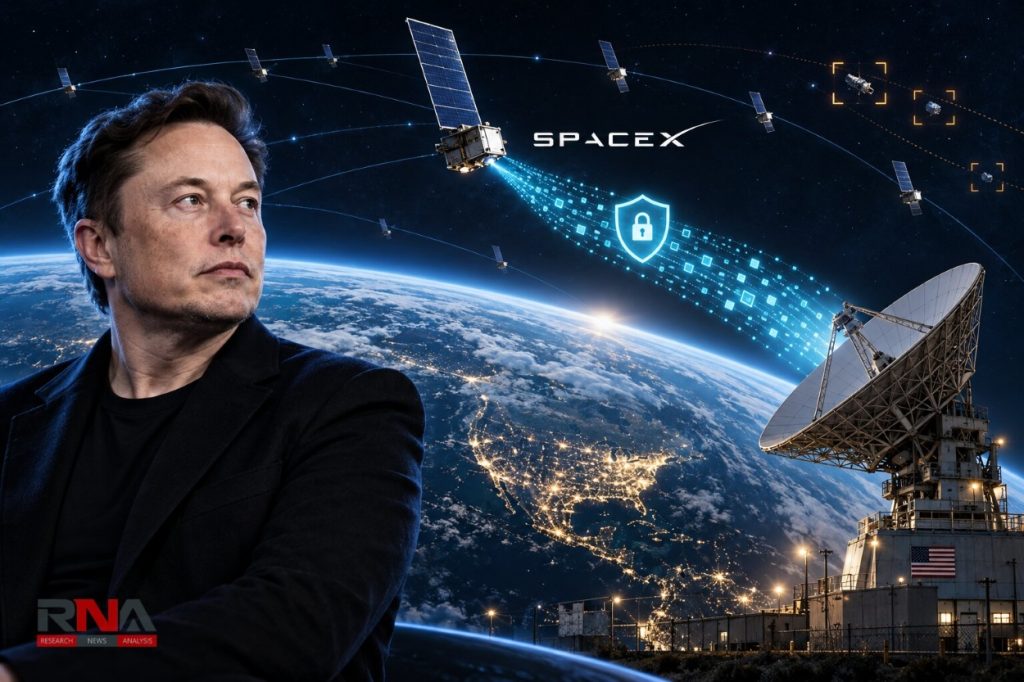
New Delhi: Elon Musk’s SpaceX has secured access to sensitive US military information on objects orbiting Earth under a data-sharing arrangement intended to improve space monitoring. The agreement has prompted concern among commercial tracking companies about its potential effect on competition in the growing orbital safety market.
Under the arrangement, first reported by Breaking Defense, the US Space Force’s Joint Commercial Operations Cell receives observations from SpaceX’s Stargaze system. In exchange, the company obtains detailed information from US Space Command’s High Accuracy Catalog of satellites and debris.
The Space Force says the exchanges involve controlled unclassified information, with no classified material included. An official told the publication that SpaceX’s access was restricted to internal use and could not be exploited for commercial gain.
The information includes Vector Covariance Messages, which describe an object’s estimated trajectory and the uncertainty surrounding that prediction, helping assess collision risks. Such details have been protected partly because they could reveal the capabilities of military tracking sensors.
SpaceX’s Stargaze system uses tens of thousands of optical star trackers aboard Starlink satellites to observe nearby objects. These instruments allow the broadband constellation to serve an additional purpose as a distributed network for monitoring orbital traffic.
According to SpaceX’s technical documentation, Stargaze processes more than 30 million observed transits daily and can observe many objects more frequently than ground-based radar systems. However, the company acknowledges that it does not track every object contained in public radar catalogues.
SpaceX also stresses that observations cannot replace advance information from satellite operators about their intended movements. Its documentation identifies operators themselves as the most authoritative source of trajectory information, particularly when they can disclose manoeuvres before carrying them out.
The company has been encouraging operators to submit predicted satellite paths for free collision screening through its space safety platform. Its October 6 update said Starlink had more than 11,000 satellites in low Earth orbit, illustrating the scale of the network that the tracking service supports.
Participation nevertheless involves a distinction between receiving safety warnings and obtaining access to the underlying database. As Data Centre Dynamics reported, operators receive information about potential close approaches, while SpaceX retains control of the broader Stargaze catalogue.
Rival providers fear military data could indirectly improve SpaceX’s external services, although Breaking Defense reported no evidence that this had happened. Separately, the Guardian reported concerns that government dependence on SpaceX could deepen as its role in orbital coordination expands.
The chief executive of Neuraspace, Chiara Manfletti, has argued for an approach that allows different platforms and national systems to exchange trusted information securely. Her comments, reported by Data Centre Dynamics, reflect the wider industry debate over how to improve coordination without requiring every operator to join one company’s platform.
The US government is also developing a civilian service, the Traffic Coordination System for Space, or TraCSS, through the National Oceanic and Atmospheric Administration’s Office of Space Commerce. Its purpose is to provide basic space situational awareness information and safety services to civilian and private operators.
That effort follows Space Policy Directive-3, signed by the US president, Donald Trump, on June 18, 2018. The policy assigned public space safety services to the commerce department while retaining the defence department’s responsibility for the authoritative catalogue of objects in orbit.
According to the Office of Space Commerce, TraCSS had onboarded 87 pilot user organizations representing more than 11,380 satellites by the end of this month, alongside 12 national government accounts. Those figures describe participating fleets, rather than satellites owned or controlled by the programme.
India is participating in the wider effort to strengthen international space safety cooperation. At an India-US workshop in Bengaluru on June 22–23, officials and industry representatives discussed TraCSS, Isro’s safe and sustainable operations management system, and opportunities for collaboration in satellite tracking and traffic coordination.