


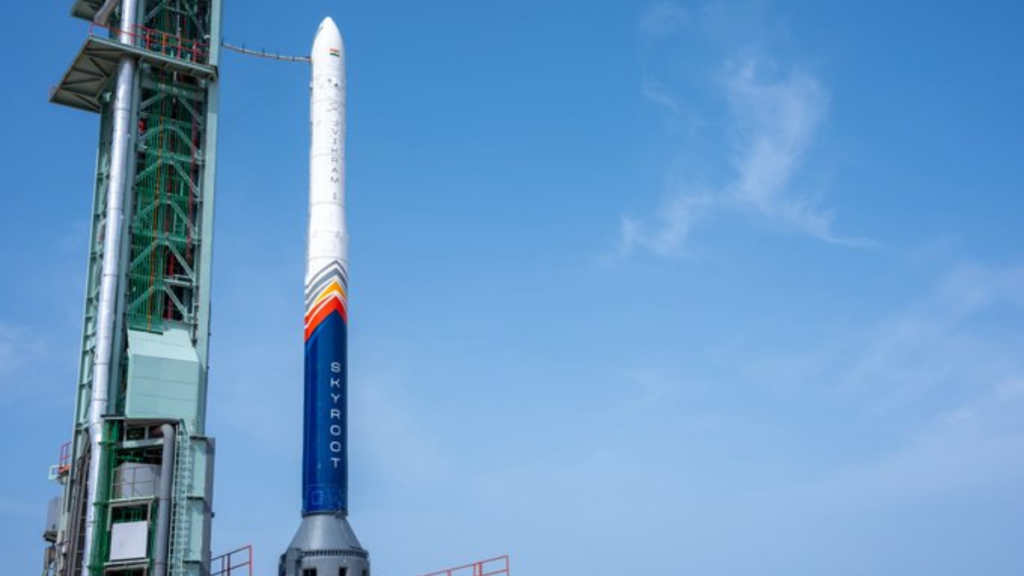
New Delhi: India’s private space sector is set for a landmark moment as Skyroot Aerospace prepares to launch Vikram-1, the country’s first privately developed orbital rocket, from the Satish Dhawan Space Centre in Sriharikota on Saturday. The mission, named Aagaman, is scheduled for liftoff at 11.30am and is expected to showcase the growing role of private companies in India’s space programme.
Unlike Skyroot’s Vikram-S, which made a successful suborbital flight in 2022, Vikram-1 is an orbital launch vehicle designed to place satellites into space. The mission will test the rocket’s overall performance, including its propulsion system, stage separation, guidance, navigation and other key technologies before it is used for commercial satellite launches.
Skyroot has completed the integration of all three stages of the rocket and stacked it on the launch pad. The company also carried out final checks of the vehicle, as well as telemetry systems and testing of tracking radars. Restrictions on airspace and maritime areas have been introduced for the launch, indicating that all major preparations are complete.
Mission Aagaman will not only test the launch vehicle but also carry multiple payloads from Indian start-ups. One of the key payloads is Mission Embrace developed by Hyderabad-based Cosmoserve Space. The experiment will test a soft robotic system designed to capture inactive satellites and space debris in orbit with flexible robotic arms. If it works, the technology could help future efforts to reduce the growing problem of space junk.
The mission is vital not only for Skyroot but also for India’s ambitions in commercial space. Many startups have entered the sector since the space sector was opened up for private participation but Vikram-1 is the first privately developed orbital rocket that is going to attempt to reach orbit from Indian soil.
A successful flight will solidify India’s position in the global satellite launch market and usher in a new era for the country’s private space industry.