


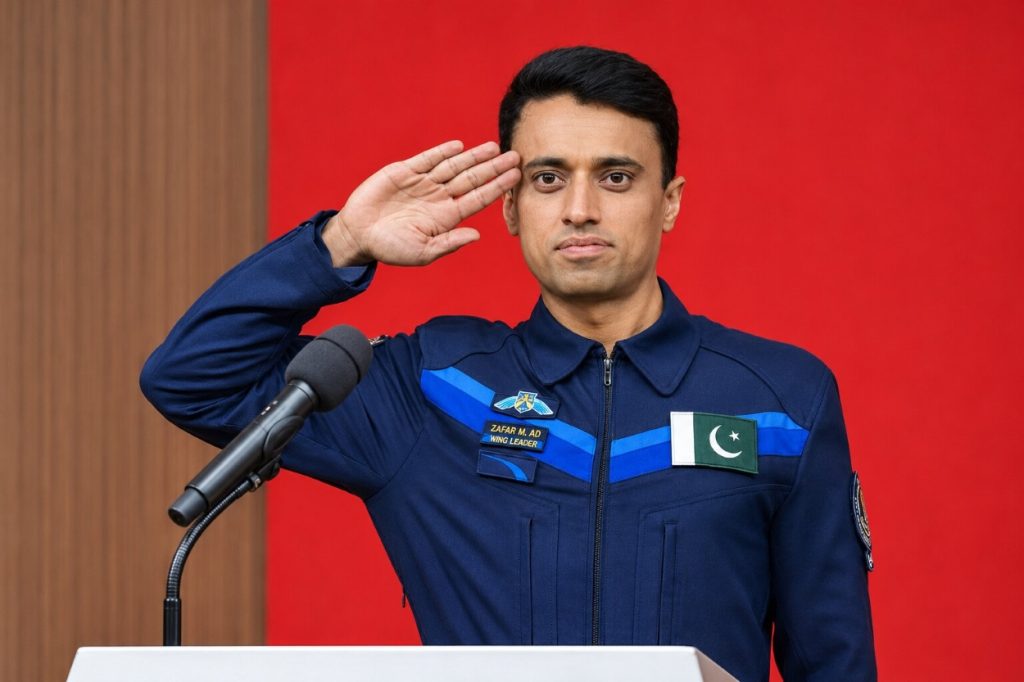
New Delhi: Pakistan is poised to enter the era of human orbital spaceflight with its air force pilot, Muhammad Zeeshan Ali, set to lift off aboard China’s Shenzhou-24 spacecraft on Wednesday. The mission will mark a double milestone – Ali will become the first Pakistani to travel into Earth’s orbit and the first foreign astronaut to board China’s independently developed Tiangong space station.
The China Manned Space Agency (CMSA) unveiled the three-member crew on Tuesday, naming Ali, 40, alongside veteran Chinese astronaut Tang Hongbo, 51, and first-time space traveller Wu Yi, 39. The mission represents a significant expansion of the strategic partnership between Beijing and Islamabad, extending their decades-old cooperation in defence, infrastructure and technology to human space exploration.
According to the mission details announced by the Chinese space agency, the spacecraft is scheduled to lift off aboard a Long March-2F rocket from the Jiuquan Satellite Launch Centre in northwestern China at 8.18am Beijing time (5.48am IST). Chinese officials said the astronauts were in good health, and the orbiting laboratory was functioning normally ahead of the launch.
What will Zeeshan Ali do in space?
Unlike his Chinese crewmates, who are expected to remain aboard Tiangong for approximately six months, Ali will spend around a week in orbit. He will serve as a payload specialist, a role primarily involving scientific research rather than piloting the spacecraft or commanding the mission.
The Pakistani astronaut will participate in routine activities aboard the space station and undertake experiments developed under the China–Pakistan scientific cooperation programme. According to Chinese reports, his assignments include four research projects covering biotechnology and materials science, including an experiment involving photosynthetic microorganisms in microgravity.
Such experiments allow scientists to study biological processes and material properties under conditions that cannot easily be replicated on Earth. The wider Shenzhou-24 expedition is expected to undertake around 90 scientific experiments and technological investigations during its stay aboard Tiangong.
Ali will return to Earth aboard the Shenzhou-23 spacecraft, which has been docked with Tiangong since May, alongside Chinese astronauts Zhang Zhiyuan and Lai Ka-ying, Hong Kong’s first astronaut. Their mission commander, Zhu Yangzhu, will remain aboard the station to undertake China’s first year-long human spaceflight, helping researchers understand the effects of prolonged exposure to microgravity on the human body.
From fighter pilot to astronaut
Ali’s selection follows an agreement signed in February 2025 between Pakistan’s Space and Upper Atmosphere Research Commission (Suparco) and the CMSA to facilitate Pakistani participation in China’s human spaceflight programme. Two candidates – Ali and Khurram Daud – were selected in April 2026 for intensive astronaut training in China.
Their preparations included simulated spaceflight operations, centrifuge training, emergency-response procedures and learning Mandarin to communicate with Chinese mission controllers and fellow astronauts. Ali revealed that a training programme originally intended to last a year had been compressed into seven months, with mastering the Chinese language among his biggest challenges.
Speaking at Tuesday’s pre-launch news conference, Ali expressed gratitude to Chinese scientists and instructors, saying he carried the aspirations of Pakistan’s 250 million people. He also expressed hope that the mission would lay the groundwork for further joint human spaceflights and eventually cooperation in lunar and planetary exploration.
Pakistan’s prime minister, Shehbaz Sharif, welcomed the development, describing it as a milestone in the country’s scientific advancement and its relationship with China. The president, Asif Ali Zardari, and the deputy prime minister and foreign minister, Ishaq Dar, also congratulated the astronaut and Pakistan’s scientific community.
Pakistan’s ambitions beyond Earth’s orbit
As RNA Media reported on October 18, Pakistan’s planning minister, Ahsan Iqbal, had announced the November 25 launch date and outlined Islamabad’s ambition of reaching the Moon by 2035. The forthcoming mission is part of Pakistan’s broader effort to accelerate its space programme by drawing on Chinese technological expertise and infrastructure.
Established in 1961, Suparco was among Asia’s earliest national space agencies, launching its first sounding rocket, Rehbar-1, in 1962. However, financial constraints and technological limitations prevented Pakistan from developing space capabilities comparable to those of Asia’s leading spacefaring nations.
In May 2024, Pakistan achieved an important breakthrough when its miniature lunar satellite, iCube-Qamar, reached lunar orbit aboard China’s Chang’e-6 mission. Islamabad is also developing its first lunar rover, Jinnah-1, which is scheduled to explore the Moon’s south polar region as part of China’s Chang’e-8 mission.
China’s expanding space diplomacy
For Beijing, Shenzhou-24 carries significance beyond its scientific objectives. Hosting an international astronaut transforms Tiangong from an exclusively Chinese-crewed facility into a platform for international human spaceflight cooperation, strengthening China’s position in global space diplomacy.
China completed the basic three-module configuration of Tiangong in 2022 after years of developing its own human spaceflight infrastructure. Restrictions imposed by the United States Congress in 2011 on Nasa’s bilateral cooperation with China had effectively excluded Beijing from the US-led International Space Station (ISS) partnership.
With the ISS expected to be retired around 2030, Tiangong could emerge as an increasingly important destination for countries seeking access to orbital research facilities. China is also pursuing a crewed lunar landing by 2030 and promoting the International Lunar Research Station project with Russia and other international partners.
For Pakistan, the immediate benefit lies in gaining experience in human spaceflight and microgravity research without incurring the enormous costs of developing independent crewed launch systems. Nevertheless, the mission also underscores Islamabad’s continuing dependence on Chinese launch infrastructure and advanced space technology.
In South Asia, India established its human spaceflight credentials in 1984 when Squadron Leader Rakesh Sharma travelled aboard a Soviet spacecraft. In June 2025, Group Captain Shubhanshu Shukla became the first Indian to visit the ISS, acquiring valuable operational experience ahead of Isro’s indigenous Gaganyaan programme.
Pakistan’s immediate achievement will be of a different technological scale, but its participation in Shenzhou-24 opens a new avenue for scientific development. Much will depend on whether Islamabad can translate the experience gained through Chinese cooperation into sustainable domestic research and engineering capabilities.