


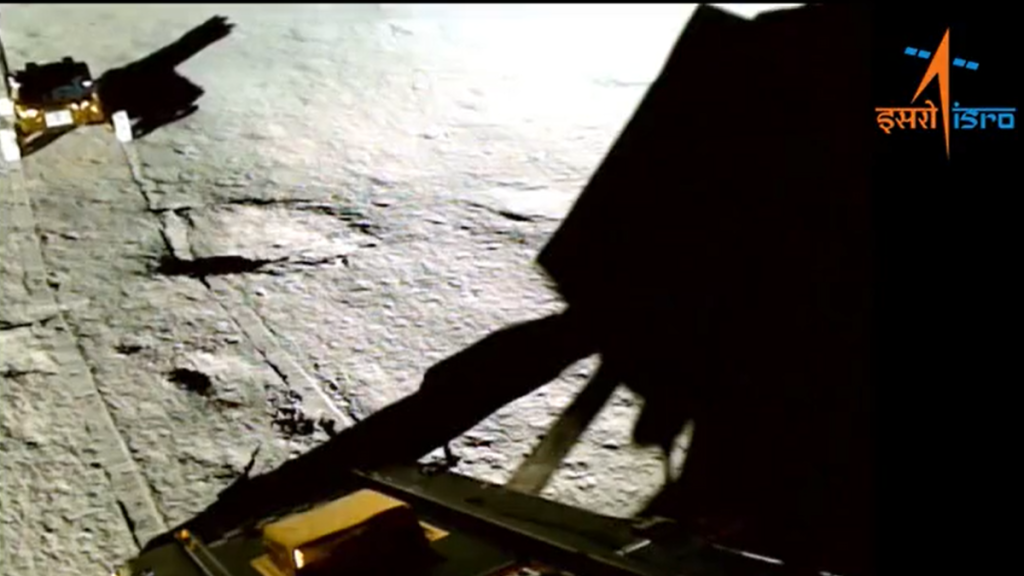
New Delhi: India’s space journey has moved far beyond the race to achieve individual milestones, with the country now building a wider ecosystem for human spaceflight, commercial launches and advanced space exploration. As India celebrates National Space Day on Sunday, August 23, the focus is increasingly on how achievements such as Chandrayaan-3 are helping create the foundation for the next generation of missions.
Chandrayaan-3’s Vikram lander made a successful soft landing near the lunar south polar region on 23 August 2023. India became the fourth country to achieve a soft lunar landing and the first to land near the Moon’s southern polar region, while the Pragyan rover demonstrated mobility and conducted experiments on the lunar surface.
The mission studied the Moon’s surface temperature, seismic activity, plasma environment and elemental composition, with Pragyan also confirming the presence of sulphur. More importantly, Chandrayaan-3 demonstrated that India had developed the technology and confidence to attempt increasingly complex missions beyond Earth.
That ambition is now visible in Gaganyaan, India’s first human spaceflight programme. Isro is conducting uncrewed missions and qualification tests covering the crew module, parachutes, tracking and communication systems before astronauts are sent into orbit, with the first crewed mission currently targeted for the first quarter of 2027, subject to successful completion of the required tests.
Gaganyaan is also being positioned as the foundation for a larger human-spaceflight programme. India is working towards the proposed Bharatiya Antariksh Station, with its first module targeted as part of a planned low-Earth-orbit space station by 2035, while the country has a longer-term goal of sending an Indian astronaut to the Moon by 2040.
Entry of private industry
One of the biggest changes in India’s space sector is happening on the ground, where private companies are taking a growing role in building and commercializing space technologies. As earlier reported by RNA, IN-SPACe chairman Dr Pawan Goenka has said Isro will eventually stop manufacturing launch vehicles itself, with production increasingly shifting to private companies and public sector undertakings.
The transition has already begun with the Small Satellite Launch Vehicle (SSLV), whose technology and production rights have been transferred to Hindustan Aeronautics Limited (HAL). Isro will support HAL during the initial phase before the company moves towards independent production, with the potential to manufacture six to 10 SSLVs annually depending on demand.
The model is expected to expand further, with the PSLV and LVM3 also headed towards private production. This would allow Isro to concentrate more on research, new technologies and scientific missions, while industry takes responsibility for producing mature launch systems at scale.
The opening of the sector has led to rapid growth in Indian space startups. According to Goenka, India now has around 450 space startups, with about 20 ready to scale their commercial operations across areas including launch vehicles, satellites, space-based data, in-space computing, data centres and refuelling.
Companies such as Skyroot Aerospace are also developing orbital launch capabilities, showing how India’s space ambitions are increasingly being supported by private innovation. The government is looking to strengthen this ecosystem by becoming an anchor customer for space-based applications in areas such as defence, agriculture, weather forecasting and urban planning.
The scale of this transition is also visible in satellite development, with Goenka saying 31 satellites have been placed with private companies out of 52 satellites under development. Together, these developments point towards a space sector in which Isro, established industry and startups increasingly share the responsibility for India’s future in orbit.
A space power building for the future
India’s expanding space capabilities are also becoming important for national security and critical infrastructure. Satellites already support communications, navigation and weather services, while space-based sensors could provide earlier warning of missile launches by detecting infrared signatures soon after ignition.
The larger transformation, however, is the creation of a sustained Indian presence across the space sector. From Chandrayaan-3 and Gaganyaan to the proposed space station and a growing private industry, India is moving from demonstrating what it can achieve to building the capabilities needed to do much more.
National Space Day was first observed on August 23, 2024, a year after the Chandrayaan-3 landing. Since then, India’s space sector has expanded significantly, with the country moving ahead with human spaceflight, plans for a space station and greater participation from private companies