


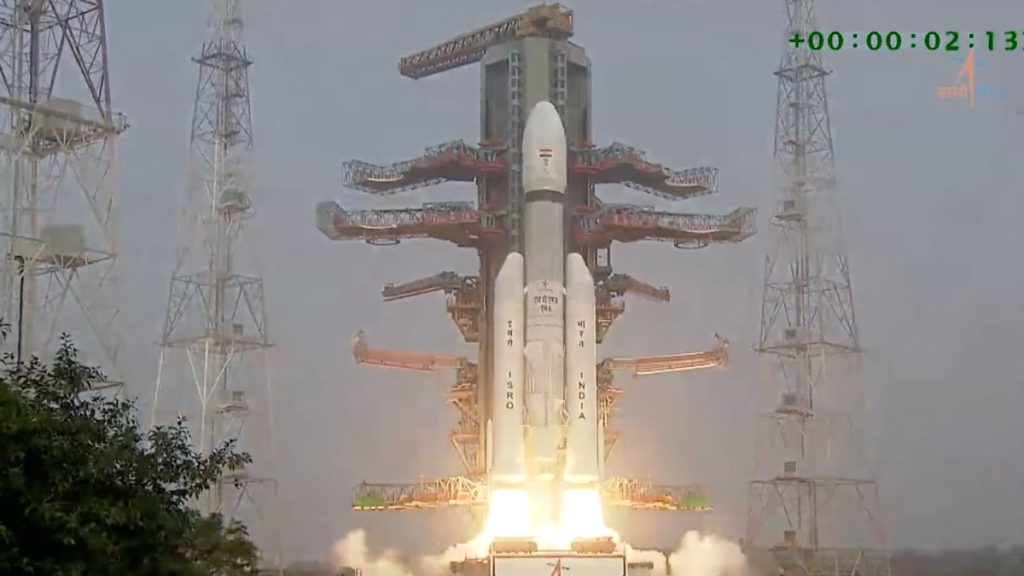
New Delhi: The Indian Space Research Organization (Isro) carried out 29 collision avoidance manoeuvres over the past 18 months to protect operational satellites from potential collisions. The figure highlights the growing challenge posed by space debris as Earth’s orbit becomes increasingly congested.
The Union minister for science and technology, Jitendra Singh, told the Lok Sabha in a written reply on Wednesday that Isro carried out 20 collision avoidance manoeuvres in 2025 and 9 more so far in 2026. He added that 20 of India’s 22 operational satellites are currently in low Earth orbit (LEO), the most congested region of space.
LEO extends up to about 2,000km above Earth.
A collision avoidance manoeuvre involves adjusting a satellite’s orbit when tracking systems predict a dangerously close approach with another spacecraft or fragment of debris. Such manoeuvres have become increasingly common worldwide as governments and private companies continue launching satellites at an unprecedented pace.
The latest figures highlight a growing global concern over space debris. Thousands of active satellites, defunct spacecraft, spent rocket stages and millions of debris fragments are already orbiting Earth, increasing the risk of collisions.
Experts warn that even a tiny piece of debris travelling at extremely high speed can seriously damage or destroy an operational satellite. As reported earlier by RNA Media, the issue came into sharper focus this week after a discarded SpaceX Falcon 9 rocket stage was believed to have struck the Moon following months of drifting through deep space.
Scientists are studying the impact to better understand crater formation and to improve methods for tracking large objects travelling through space. Although the Falcon 9 impact posed no threat to Earth, scientists said it highlighted a growing challenge for the global space community.
As more countries and private companies launch satellites and plan missions to the Moon, managing spacecraft and rocket stages after they complete their missions is becoming increasingly important.
Experts say better debris tracking and responsible disposal of space hardware will be key to keeping space safe. Most collision risks occur in low Earth orbit, where the majority of operational satellites are located. In 2025, Isro tracked more than 1.5 lakh close-approach alerts involving Indian satellites and carried out 20 operational manoeuvres, including 14 in low earth orbit, four involving satellites in geostationary earth orbit (GEO), and 2 for the Chandrayaan-2 orbiter.
To identify potential collision risks, Isro combines international tracking alerts with indigenous surveillance systems and orbital prediction models that continuously monitor the movement of satellites and debris.
India is also strengthening its space situational awareness capabilities. Isro currently operates a multi-object tracking radar at Sriharikota to monitor large objects in low earth orbit.
In addition, an optical telescope being developed at Hanle, Ladakh, under the Network for Space Object Tracking and Analysis (Netra) programme is nearing completion. The facility will be capable of tracking objects measuring 30 centimetres or larger in geostationary earth orbit.
The government also reaffirmed that India’s first crewed Gaganyaan mission remains on track for 2027. Before that, Isro plans to conduct an uncrewed mission carrying the humanoid robot Vyommitra by the fourth quarter of 2026, followed by two more uncrewed test flights.
With more satellites and spacecraft entering orbit every year, Isro’s latest figures highlight that managing space debris is no longer just a technical challenge but an essential part of modern space operations.