


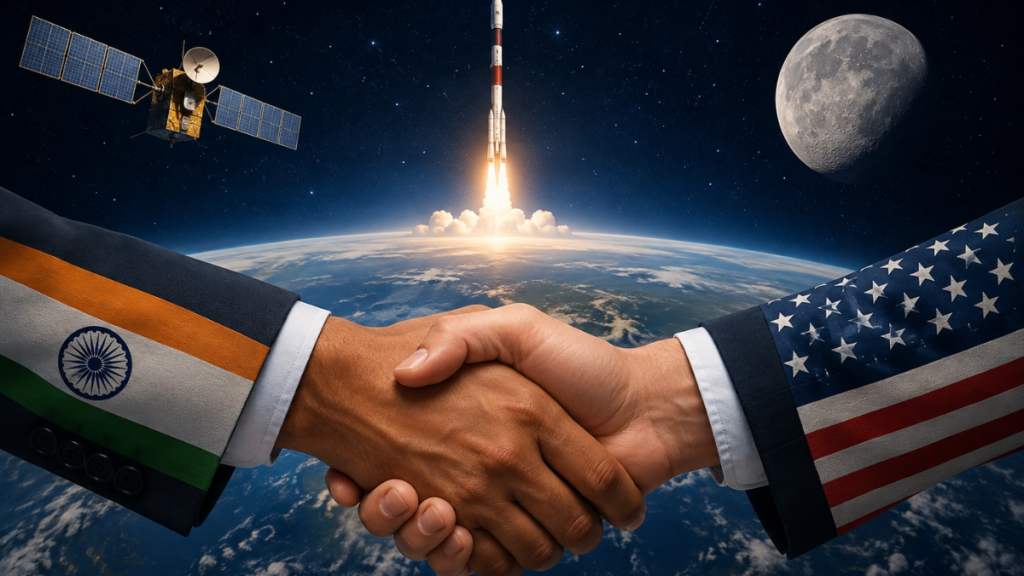
New Delhi: India and the US have agreed to expand cooperation in civil and commercial space after senior officials from both countries met in Bengaluru for the ninth India-US Civil Space Joint Working Group on August 5 and 6, 2026.
The meeting, hosted by India at the headquarters of the Indian Space Research Organisation (Isro), reviewed ongoing programmes and discussed new areas of cooperation in Earth observation, human spaceflight, lunar science, commercial space and the peaceful use of outer space.
Isro chairman V Narayanan and US Ambassador to India Sergio Gor addressed the opening session. Senior officials from Isro, the National Aeronautics and Space Administration (Nasa) and the US department of state also took part in the talks.
Broader space partnership
The meeting comes at a time when India-US space cooperation is moving beyond traditional satellite applications into more complex areas of exploration and human spaceflight.
A major pillar of the partnership is the Nasa-Isro Synthetic Aperture Radar mission, or Nisar, which was launched from Sriharikota on July 30, 2025. The Earth-observation satellite combines US and Indian radar systems to monitor changes in land, ice, forests, coastlines and other parts of the planet’s surface.
The mission is designed to provide high-resolution data for scientists studying climate change, natural hazards, agriculture and ecosystems. Its successful launch marked one of the most visible outcomes of years of scientific and technical cooperation between the two space agencies.
Human spaceflight gains prominence
Human spaceflight was another important focus of the Bengaluru talks.
The two sides reviewed cooperation linked to astronaut training, mission operations and research in microgravity. The experience gained from Group Captain Shubhanshu Shukla’s mission to the International Space Station in 2025 has added a new operational dimension to the partnership.
Shukla flew as pilot on Axiom Mission 4 and became the first Indian to visit the International Space Station. His mission included Indian scientific experiments in areas such as biology, agriculture and human physiology.
The experience is expected to support India’s Gaganyaan programme, which aims to develop an indigenous capability to send Indian astronauts into low Earth orbit and return them safely.
Lunar and scientific cooperation
The working group also discussed future cooperation in lunar exploration and scientific research.
According to the official US readout, the two sides explored opportunities connected with future Moon missions and wider scientific cooperation. They also discussed open scientific data and coordination under principles supported by the Artemis Accords, which India joined in 2023.
The Artemis Accords set out non-binding principles for peaceful space exploration, transparency, interoperability, emergency assistance and the sharing of scientific information.
However, no new joint lunar mission, hardware contribution or binding timeline was announced at the meeting.
Commercial space up in agenda
Commercial cooperation also featured prominently in the discussions.
India and the US have increasingly sought to connect their private space sectors as both countries open more areas of space activity to commercial participation. The two sides discussed cooperation involving satellite services, launch systems, advanced space technologies and space sustainability.
This commercial push is also linked to the broader India-US initiative on strategic technologies, under which governments, companies and research institutions are being encouraged to work together in critical and emerging sectors.
The Bengaluru dialogue underlines the steady expansion of India-US space ties. What began largely with scientific exchanges and satellite applications now includes Earth observation, astronaut missions, lunar exploration and private-sector collaboration.