


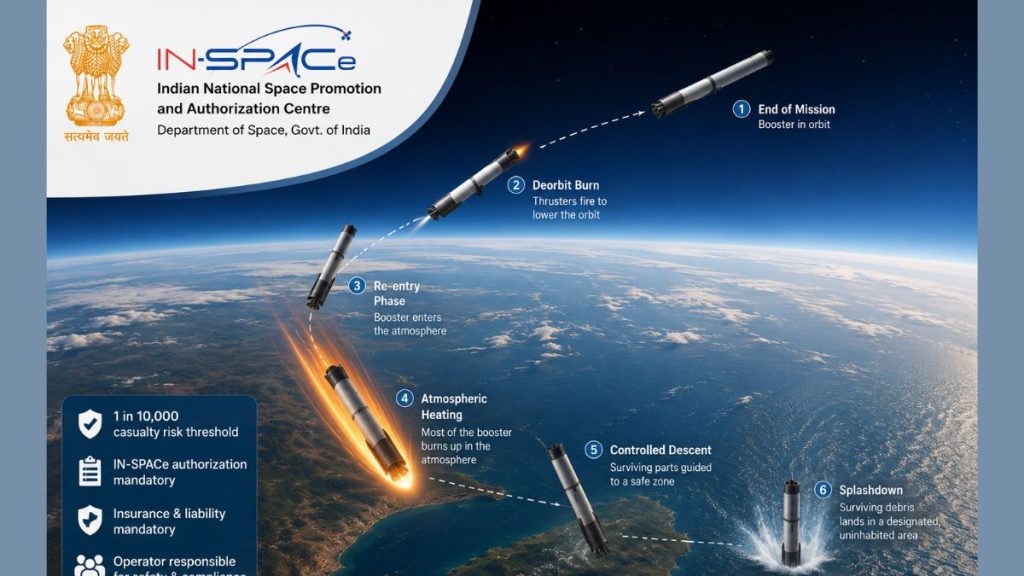
New Delhi: India’s space regulator, the Indian National Space Promotion and Authorization Centre (IN-SPACe), has issued the country’s first dedicated rules for the planned re-entry of satellites and other space objects by private companies. The framework makes government authorization compulsory before any company can deliberately bring a spacecraft back to Earth, whether the re-entry happens over India or elsewhere in the world.
The guidelines come as India’s commercial space sector has expanded rapidly since the Indian Space Policy 2023 opened the field to private players. Until now, India had rules for launching satellites but none specifically for how they should be safely disposed of at the end of their working life.
Planned re-entry is the controlled return of a satellite or rocket stage to Earth after its mission ends. Operators use onboard thrusters to lower its orbit and guide it along a predetermined path. Most of the object burns up in the atmosphere, while any surviving debris is directed to a safe, uninhabited area, usually a remote part of the ocean.
Under the rules, any Indian company planning a controlled re-entry must first obtain authorization from IN-SPACe. This requirement applies even if the actual re-entry takes place over another country’s territory or international waters.
Foreign companies cannot apply for this permission directly. If a foreign operator wants its spacecraft to re-enter over Indian territory, it must route its application through an Indian-incorporated entity, which will then seek approval on its behalf.
Casualty risk capped
At the centre of the rules is a strict safety benchmark, the risk of any single re-entry causing human injury or death must be less than 1 in 10,000. This is known as the casualty risk threshold, a standard used internationally in space safety planning.
Companies must demonstrate through technical simulations that this risk level will not be exceeded before their mission can be cleared. If calculations show a higher risk, the plan cannot be approved unless the company redesigns it, for instance by targeting a more remote landing zone or engineering the spacecraft to burn up more completely.
Before re-entry, applicants must also secure an advisory note from IN-SPACe to get the required flight and maritime danger-zone warnings issued, typically 45 days ahead of the manoeuvre.
The rules place full responsibility for any mishap on the private operator. Companies must carry out re-entry at their own risk, cannot hold the Indian government liable if something goes wrong, and must indemnify the government against any liability arising from India’s international space treaty obligations.
To cover this risk, operators must carry adequate insurance, including third-party liability cover where required by IN-SPACe.
Timing of disclosure is also addressed. A company that already knows, while applying to establish and operate its satellite, that it plans to de-orbit it later must declare this at that stage.
If the decision to conduct a planned re-entry is made only after launch, the company must apply for separate authorization at least six months before the manoeuvre, giving IN-SPACe time to assess the safety case, with a further review of the re-entry parameters roughly three months before the operation begins.
Officials say the framework is designed to make private space operators more accountable, reduce the debris risk from aging satellites, and align India’s regulatory approach with international best practice as the country’s space sector continues to grow.
IN-SPACe is the government body that regulates and authorizes private space activities in India. Set up under the Indian Space Policy 2023, it functions as a single-window regulator, meaning private companies must seek its approval for activities ranging from launching and operating satellites to, under these new rules, deliberately bringing a spacecraft back to Earth.