


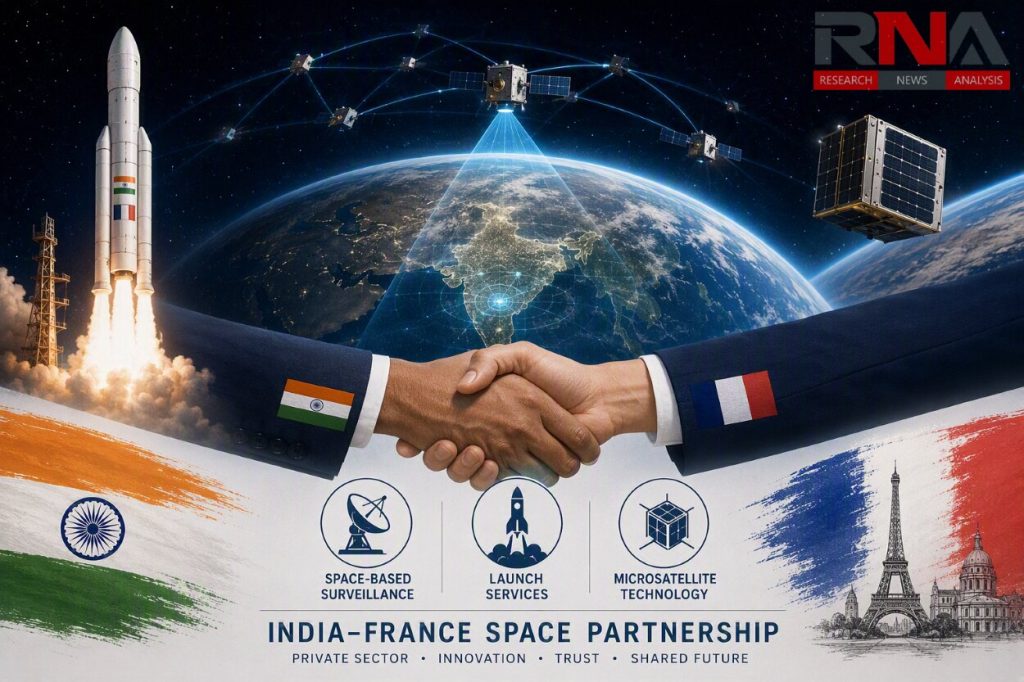
New Delhi: India and France have expanded their space partnership with three new private-sector agreements covering satellite launches, space-based surveillance and microsatellite technology, giving a commercial dimension to a relationship that has traditionally been driven by government agencies. The agreements, announced during the International Space Summit in Paris, also underline India’s growing reliance on private industry for building strategic space capabilities.
The most strategically significant of the deals involves France’s Safran Space and Indian space company Dhruva Space, which have signed contracts worth more than €5 million for equipment for India’s planned Space-Based Surveillance III (SBS III) constellation. The package includes communication systems, inertial navigation units, optical payloads and ground stations, with the 52-satellite constellation scheduled to be deployed between 2027 and 2030.
SBS III is intended to substantially strengthen India’s space-based surveillance architecture, giving the country’s security establishment greater access to persistent imagery and other information from orbit. The programme is particularly significant because it brings private Indian companies directly into the development of a large strategic satellite constellation, marking a further shift from an almost exclusively state-led space model towards a mixed industrial ecosystem.
For Safran, the Dhruva Space agreement extends an industrial relationship with India that already includes involvement in the country’s space programme and the Chandrayaan-3 lunar mission. For India, the contract provides access to established French aerospace technologies while allowing an Indian company to integrate those systems into a constellation being developed for a national strategic requirement.
The second agreement involves French launch-services company RIDE! and Indian company TakeMeToSpace, with RIDE! set to launch two satellites for the latter. TakeMeToSpace is developing what it describes as orbital data-centre capabilities, reflecting the emergence of new commercial applications in which computing, data storage and processing are increasingly being considered for deployment in space.
The arrangement also builds on RIDE!’s existing engagement with Indian space companies. The French company has previously worked with Indian partners on the integration and launch of a European atmospheric re-entry capsule aboard the Polar Satellite Launch Vehicle (PSLV), highlighting the increasingly two-way nature of commercial cooperation between the two space industries.
A third agreement brings French microsatellite manufacturer U-Space together with Indian engineering company AXISCADES to explore opportunities in India’s expanding microsatellite market. The companies intend to pursue a phased cooperation model under the broader Make in India framework, combining French satellite technology with Indian engineering, industrial integration and market capabilities.
Taken together, the three agreements show that the India-France space relationship is moving beyond the traditional government-to-government model. Instead, the partnership is increasingly linking the Indian and French commercial ecosystems in areas such as satellite manufacturing, launch services, space surveillance and smaller satellite constellations.
That transition has been encouraged by the wider policy direction of both governments. In June, India and France’s Innovation Roadmap 2030 explicitly called for stronger links between their private space ecosystems, while identifying Earth observation and human exploration as areas for deeper cooperation, including French expertise in zero-gravity activities and India’s planned future space station in low Earth orbit.
The political framework for this cooperation has also expanded. The prime minister, Narendra Modi, and the French president, Emmanuel Macron, during their February meeting, elevated bilateral relations to a Special Global Strategic Partnership and reaffirmed cooperation in space, including sovereign access to space and space situational awareness.
India and France have maintained close space cooperation for more than five decades through the Indian Space Research Organisation (Isro) and France’s National Centre for Space Studies (CNES). Their collaboration has included joint satellite missions such as Megha-Tropiques and SARAL, Earth observation, launch technologies, maritime domain awareness, space situational awareness and preparations for future human-spaceflight cooperation.
The two countries have also institutionalized the strategic dimension of their space relationship through a Strategic Space Dialogue covering both civil and defence-related issues. The first meeting was held in Paris in June 2023 and the second in New Delhi in March 2024, while the two governments have agreed to continue discussions on sovereign access to space and enhanced space situational awareness.
The timing of the new agreements is significant for another reason. The International Space Summit in Paris, held on September 9−10, has brought together governments, space agencies, industry and other stakeholders at a time when major powers are increasingly treating access to orbit, satellite communications, Earth observation and space-based surveillance as strategic capabilities rather than purely civilian assets.
France has been pushing for greater European strategic autonomy in space, while India has been pursuing greater technological and industrial self-reliance and opening its space sector to private investment. The convergence creates room for cooperation in which France contributes mature technologies and industrial capabilities, while Indian companies provide manufacturing scale, engineering capacity and access to one of the world’s fastest-growing space markets.
The Safran-Dhruva agreement is especially notable in this context because surveillance satellites sit at the intersection of commercial space technology and national security. While the latest contract does not by itself represent a shift in India’s strategic doctrine, it demonstrates how private industry is becoming an integral part of the country’s effort to build resilient space-based surveillance capabilities.
For India, the larger significance of the new deals therefore lies not simply in the value of the individual contracts. They point to a more mature phase of the India-France space relationship in which government agencies continue to provide the strategic framework, but private companies on both sides increasingly become the vehicles through which technology, manufacturing and commercial capabilities are brought together.