


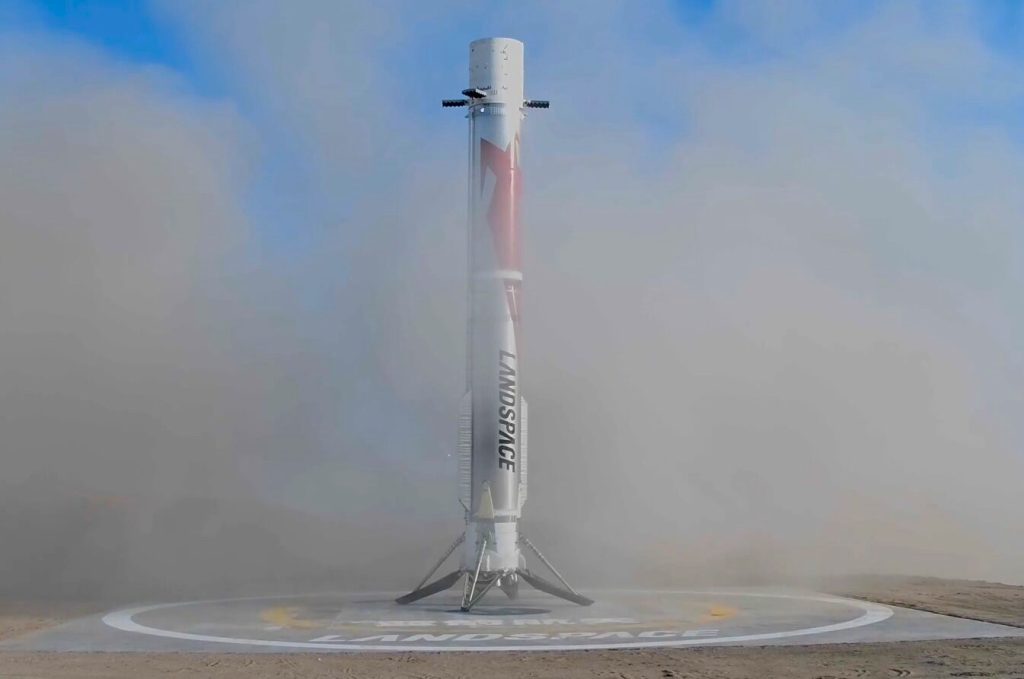
New Delhi: Chinese launch startup LandSpace successfully returned the first stage of its Zhuque-3 rocket to a landing pad in northwest China on Wednesday, giving the country its first controlled land recovery of an orbital-class booster. The flight, which also placed the Honghu-03 satellite into its intended orbit, moves China’s reusable-launch programme closer to commercial operations and introduces another potential challenger to a market transformed by SpaceX.
The Zhuque-3 Y2 lifted off at 7.35am China Standard Time (5.05am IST) from the Dongfeng commercial space innovation pilot zone near the Jiuquan Satellite Launch Centre, according to Xinhua. Its second stage continued towards orbit as the nine-engine first stage reversed course and descended to a recovery site in Gansu province, about 390 kilometres southeast of the launch pad.
LandSpace said the booster touched down at its designated position using deployable landing legs, completing China’s first land-based recovery of this kind. The mission was declared a complete success after the second stage delivered Honghu-03, developed by Hongqing Technology, to its planned orbit, according to Space.com.
The 66.1-metre Zhuque-3 is built largely from stainless steel and powered by liquid methane and liquid oxygen, a combination commonly described as methalox. LandSpace says the materials and propellants were selected with repeated flights, simpler manufacturing and lower refurbishment requirements in mind.
The vehicle has been positioned as a Chinese counterpart to SpaceX’s Falcon 9, although it remains less capable and far less mature operationally. Figures cited by Reuters give Zhuque-3 a payload capacity of 14.2 tonnes to low-Earth orbit in its expendable configuration, compared with 22.8 tonnes for Falcon 9.
Wednesday’s achievement came on only the rocket’s second flight and its second attempt at recovering an orbital-class first stage. During its maiden mission on December 3, 2025, the upper stage reached orbit, but an abnormal combustion event during the final landing burn caused the returning booster to crash near the recovery pad.
That failure nevertheless produced valuable information about the vehicle’s re-entry aerodynamics, thermal protection, guidance, engine restart and grid-fin control. Reaching the landing area but failing during the final descent also helped engineers isolate the last and most delicate part of the recovery sequence.
The Y2 mission therefore represented more than a repeat launch with a better ending. LandSpace demonstrated that it could absorb data from a failed attempt, modify the system and complete the entire sequence – ascent, stage separation, atmospheric return, braking manoeuvres and precision touchdown – on the next flight.
It was China’s fourth attempt to recover an orbital-class booster and its second successful retrieval. LandSpace’s first Zhuque-3 and the state-developed Long March-12A both reached orbit in December 2025 but failed during their respective recovery attempts.
China recorded its first successful orbital-booster recovery on July 10, 2026, when a Long March-10B first stage descended vertically towards an offshore platform and was caught by a system of steel cables and nets. The booster used four hooks to engage the capture mechanism rather than supporting itself on landing legs, making it a fundamentally different approach from the Zhuque-3 recovery.
The Long March-10B was not a previously flown or “used” rocket in the conventional commercial sense; it was a newly launched stage recovered after completing its first ascent. Its July mission proved that China could retrieve an orbital-class booster at sea, but a successful refly of the same hardware will be required to demonstrate actual reuse.
SpaceX completed the first powered landing of a booster used on an orbital mission on December 21, 2015, when a Falcon 9 first stage returned to a ground pad after launching 11 satellites. Blue Origin had landed its New Shepard booster about a month earlier, but that vehicle had followed a suborbital trajectory rather than placing a payload into orbit.
SpaceX made its first successful landing on an autonomous sea platform in April 2016 and flew a previously used Falcon 9 booster for the first time in March 2017. Blue Origin joined the orbital-class recovery group much later, landing the first stage of its New Glenn rocket on an Atlantic platform on November 13, 2025, according to the company’s mission account.
LandSpace now plans to fly a recovered Zhuque-3 stage within six months, which would be the decisive next test. The company ultimately wants each booster to complete as many as 20 flights, but that target will remain an engineering ambition until repeated launches establish its durability, reliability and turnaround time.
The landing also arrives at a financially important moment for LandSpace. The company is seeking to raise 7.5 billion yuan, or about $1.11 billion, through an initial public offering on the Shanghai Stock Exchange’s STAR Market and has told investors that it aims to become profitable by 2029.
Can China close the SpaceX gap?
The significance of booster recovery lies in what normally gets thrown away. A rocket’s first stage contains most of its engines, tanks, plumbing, avionics and structural hardware, making it one of the most expensive parts of the launch vehicle despite operating for only the opening minutes of a mission.
Recovering that stage creates the possibility of spreading its manufacturing cost across several launches instead of charging the entire cost to one customer. However, the economic advantage materializes only if the booster can be inspected, refurbished and flown again quickly enough, and if the payload sacrificed to landing fuel and recovery equipment does not outweigh the savings.
That distinction is why Zhuque-3’s touchdown is a major engineering accomplishment but not yet proof of a competitive reusable-launch business. LandSpace must now demonstrate that the recovered stage has survived re-entry without expensive structural, engine or thermal damage, and that it can be prepared for another mission without being effectively rebuilt.
The flight was technically demanding because an orbital-class booster returns through a far harsher environment than a low-altitude experimental vehicle. It must control its orientation after separation, withstand aerodynamic and thermal loads during high-speed descent, restart its engines reliably, correct its trajectory and reduce its velocity to almost zero over a comparatively small landing zone.
Zhuque-3’s methane propulsion could offer advantages during repeated use because methane generally produces less soot than the kerosene burned by Falcon 9. Cleaner combustion may reduce deposits inside engines and plumbing, although its value will depend on the performance and service life of LandSpace’s Tianque engines under operational conditions.
Stainless steel also offers relatively low material costs, good heat tolerance and comparatively straightforward fabrication, but it is heavier than the aluminium-lithium alloy used in Falcon 9. LandSpace must therefore balance manufacturing and thermal advantages against the payload penalty imposed by additional structural mass and the fuel reserved for recovery.
China is now pursuing two recovery architectures in parallel. The Long March-10B’s offshore net avoids the weight of landing legs and is designed to tolerate wider deviations from the intended touchdown point, but it requires specialized vessels, maritime logistics and the handling of hardware exposed to a corrosive saltwater environment.
Zhuque-3’s leg-assisted landing resembles the proven Falcon 9 system and leaves the booster upright for inspection and transport. Ground recovery avoids many marine complications, but it requires a suitable downrange landing corridor, highly accurate guidance and extensive safety arrangements around the recovery zone.
The wider commercial importance comes from China’s growing requirement to launch large numbers of low-Earth-orbit satellites. The Guowang and Qianfan broadband constellations are intended to compete with Starlink and require a launch rhythm that would be difficult and expensive to sustain using only expendable rockets.
Reusable vehicles could relieve that bottleneck by allowing engines and stages to return to service instead of waiting for replacements to emerge from factories. They could also support more frequent Earth-observation, navigation and communications missions, including constellations with clear civilian, military and dual-use applications.
China has deliberately nurtured private space companies since opening parts of its launch and satellite industries to private capital in 2014. Commercial space was subsequently designated a strategic emerging industry, and a national action plan has encouraged access to state-developed technology, testing facilities, telemetry infrastructure, finance and insurance.
LandSpace therefore operates within an ecosystem that combines private investment and corporate competition with state-defined strategic demand. That structure could provide Chinese launch companies with long production runs and dependable domestic customers, particularly as Beijing accelerates its satellite-internet and space-infrastructure programmes.
Nevertheless, SpaceX’s advantage is much larger than a successful landing technique. Falcon 9 completed 165 missions in 2025 – roughly as many as all other orbital launch vehicles combined – and had accumulated more than 600 booster landings by August 2026, giving SpaceX a vast body of operational data that cannot be replicated through design work alone.
SpaceX also benefits from vertical integration, established launch pads, recovery vessels, mature refurbishment processes and Starlink’s enormous internal demand for launches. Its frequently reused boosters have demonstrated that recovery can support a sustained launch tempo rather than remain an occasional engineering spectacle.
LandSpace has completed two Zhuque-3 flights and one landing, leaving an enormous gap in reliability statistics, production capacity and operational experience. Even a successful first reflight would mark the beginning of that learning curve, not the end of it.
Blue Origin’s New Glenn adds another American competitor, but its cadence also remains well below that of Falcon 9. The developing contest is consequently not yet a balanced three-way commercial rivalry; it is a race by newer systems to prove that they can industrialize reusability at the scale SpaceX has already reached.
Nor will the global launch market operate as a completely open marketplace. Export controls, national-security restrictions and geopolitical alignments mean Chinese rockets are unlikely to carry sensitive American or allied payloads, just as many Chinese government satellites will remain beyond the reach of Western providers.
Competition is more likely to develop through parallel ecosystems, with US companies serving western governments and much of the international commercial market, and Chinese providers supplying domestic programmes and selected overseas partners. If LandSpace can establish a reliable, competitively priced service, it could offer countries outside the western security framework another route to orbit and strengthen China’s influence across the space economy.
The strategic consequences extend beyond launch prices because frequent access to orbit enables rapid deployment and replacement of satellites. In a crisis, the ability to replenish communications, surveillance and navigation constellations quickly can carry as much importance as the individual spacecraft themselves.
Zhuque-3 has therefore cleared a threshold that China had pursued for years, and it has done so through a private company rather than only the traditional state aerospace establishment. The decisive question is no longer whether China can bring an orbital-class booster back intact, but whether it can refly one safely, repeatedly and cheaply enough to turn a dramatic landing into a sustainable commercial system.