


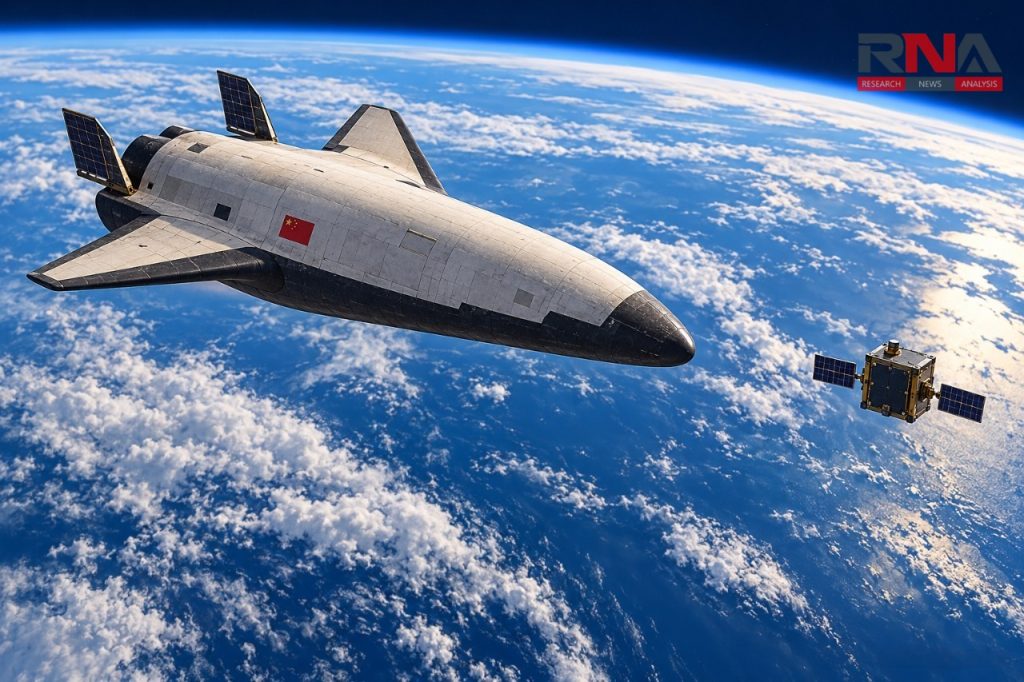
New Delhi: China’s secretive reusable spaceplane appears to have released and retrieved the same small satellite twice during its latest mission, offering fresh evidence of its ability to conduct controlled encounters in orbit. The reported manoeuvres highlight technology with potential civilian and military applications, although the available evidence does not establish that the spacecraft was conducting a weapons test.
The sequence was reconstructed by the astrophysicist and spaceflight analyst, Jonathan McDowell, using US Space Force tracking data, according to Defence Blog’s account of his recent assessment. It concerns the vehicle widely called Shenlong, or “Divine Dragon”, a name used by outside observers rather than an officially disclosed designation.
According to that assessment, the spacecraft deployed an object catalogued as 2026-024H on June 21 before apparently recovering it around July 12. It released the object again in late August, moved several thousand kilometres away, and subsequently returned for a rendezvous on September 10 and an apparent second recovery on September 13.
The distinction between an observed close approach and a confirmed physical capture remains important because China has not publicly explained these operations. Suggestions that a robotic arm performed the recoveries remain an interpretation of the activity, with no publicly disclosed technical account establishing the mechanism used.
The June deployment had also attracted the attention of the commercial space surveillance company LeoLabs, which reported detecting an unidentified object near the spaceplane on June 22. As Space.com reported at the time, the company assessed with high confidence that the object came from the Chinese vehicle after gathering further observations across its radar network.
China’s official launch announcement, carried by Xinhua, dates the start of the mission to February 7, when a Long March-2F rocket lifted off from the Jiuquan Satellite Launch Centre. The brief statement described the flight as a technology-verification mission intended to support reusable spacecraft development and the peaceful use of space, without detailing its payload or planned experiments.
This is the programme’s fourth publicly known orbital mission since its debut in September 2020, when the experimental vehicle spent about two days in space. Subsequent flights extended that endurance substantially: the second lasted 276 days, while the third, which returned in September 2024, lasted 268 days.
The latest activity builds on earlier experiments involving objects deployed by the spaceplane itself. In its assessment of the Chinese programme, published in June, the Secure World Foundation documented satellite deployments during the first three missions, alongside rendezvous, proximity operations and apparent docking or capture activity.
Such operations allow spacecraft to approach and work near one another, providing a foundation for satellite inspection, repair, refuelling and other services in orbit. The strategic concern arises because some of the same capabilities could, with suitable equipment, be adapted to interfere with or manipulate another spacecraft.
However, recovering an object released by the vehicle does not establish that it can seize an unwilling foreign satellite. The Secure World Foundation’s June assessment said the Chinese spaceplane had not approached non-Chinese space objects and characterized it principally as a platform for reusable spaceflight tests, hardware experiments and risk reduction.
Shenlong is frequently compared with the US military’s X-37B because both programmes involve reusable experimental spacecraft and limited disclosure of mission details. The US Space Force launched the X-37B’s eighth mission on August 21, 2025, aboard a Falcon 9 rocket from the Kennedy Space Center.
That comparison does not mean their demonstrated activities are identical, or that either vehicle’s secrecy alone proves an offensive role. In its X-37B fact sheet, the Secure World Foundation said the American vehicle had not been publicly shown rendezvousing with other known space objects and found little evidence supporting recurring claims that it was an operational orbital weapon.
The significance of Shenlong’s reported manoeuvres therefore lies in the repeated deployment and apparent recovery of an object over an extended mission. They provide evidence of increasingly capable orbital experimentation, while leaving the vehicle’s precise equipment, operational purpose and eventual military role unresolved.