


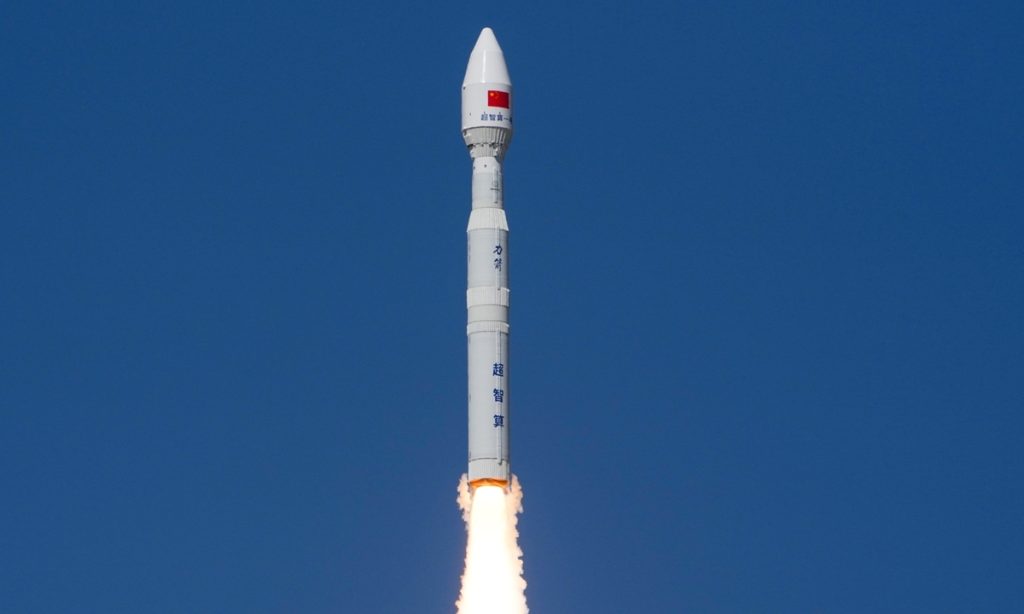
New Delhi: China’s Kinetica-1 rocket placed nine satellites into orbit on Sunday, completing the country’s sixth successful orbital mission in six days and underlining the growing launch capacity of its state-owned and commercial space sectors. The Sunday mission carried spacecraft for Earth observation, emissions monitoring, artificial intelligence computing, experimental communications and scientific research.
The four-stage solid-fuel rocket, also known as Lijian-1, lifted off from the Dongfeng commercial space innovation pilot zone in northwest China at 12.03pm local time, or 9.33am IST. CAS Space, the rocket’s developer, said all nine satellites entered their planned orbits, marking the vehicle’s 16th flight since its debut in July 2022.
The payloads comprised the Qinling-01 and Qinling-02 remote-sensing satellites, Pujiang-4, PEGA-SUS1, three Diting-01 spacecraft, Chaozhisuan-1 and the Yunxiao Pathfinder satellite. Their missions range from monitoring ecological conditions and greenhouse-gas emissions to testing space-based computing, artificial intelligence and high-speed optical communications.
Chaozhisuan-1, translated as Super Intelligent Computing-1, is designed to test the processing of large volumes of data directly in orbit instead of transmitting all raw information to ground stations. Equipped with onboard computing capacity, laser communications and an optical camera, it is intended to demonstrate how satellites could analyse imagery and other data before sending selected results to users on Earth.
PEGA-SUS1, a roughly 150-kilogram experimental spacecraft built by GalaxySpace, will test technologies associated with 5G non-terrestrial networks, artificial-intelligence-assisted data processing and optical communications. Its developers have said the satellite is designed to demonstrate a laser link capable of transmitting data at up to 100 gigabits per second, although its actual performance will have to be established through orbital trials.
Pujiang-4 will monitor carbon dioxide and methane emissions, helping identify known sources as well as unusual concentrations across its observation swath. Qinling-01 and Qinling-02 carry panchromatic and multispectral cameras for ecological observation over the Qinling Mountains and sections of the Yellow River basin in Shaanxi province.
The three Diting-01 satellites are intended to detect electromagnetic signals and locate their sources, giving the cluster potential applications in spectrum monitoring and communications management. Public information about the Yunxiao Pathfinder remains limited, though Chinese accounts describe it as a remote-sensing spacecraft developed for the Institute of Mechanics under the Chinese Academy of Sciences.
The latest launch ended an unusually concentrated sequence that began on September 15, when LandSpace’s Zhuque-2E Y7 rocket deployed 10 satellites for the Qianfan, or Spacesail, broadband constellation. Chinese state media described that flight as the first large-scale deployment for the network conducted by a privately developed commercial rocket.
Less than 16 hours later, the Gravity-1 Y3 rocket, developed by OrienSpace, lifted off from a sea platform off Shanghai with nine spacecraft. These comprised eight more Qianfan satellites and an ultra-high-speed wireless-communications experiment, together weighing more than three tonnes and entering an orbit about 800 kilometres above Earth.
On September 17, China launched two missions, as RNA Media had reported. First, it launched a Long March-12 launched the 25th group of satellites for China’s separate low-Earth-orbit internet network from the Hainan commercial spacecraft launch site. The liquid-fuelled rocket lifted off at 8.32am and successfully delivered the spacecraft to their designated orbit.
With four hours of the Long March-12 launch, a Kuaizhou-11 Y3 rocket flew from the Jiuquan Satellite Launch Centre, carrying the Tianyi-51 and Tianyi-52 satellites. The solid-fuel launcher is marketed as a rapid-response vehicle for small and medium-sized spacecraft, reflecting China’s efforts to maintain several launch systems for different payload classes and mission requirements.
The fifth mission in the sequence took place on Saturday, when a Long March-2D placed four PIESAT-2 satellites – numbered 13 to 16 – into their planned orbits from the Taiyuan Satellite Launch Centre. That flight was the 668th mission by a rocket from the Long March family, illustrating the scale and maturity of China’s government-run launch programme.
Kinetica-1 then closed the six-mission run with Sunday’s rideshare launch, demonstrating the role of standardized solid-fuel rockets in serving several customers on a single flight. The roughly 30-metre-tall vehicle can carry about two tonnes to low-Earth orbit or 1.5 tonnes to a 500-kilometre Sun-synchronous orbit, making it suitable for remote-sensing satellites and technology demonstrators.
Developed by CAS Space, a commercially operated company linked to the Chinese Academy of Sciences, Kinetica-1 has suffered one unsuccessful mission since entering service. Its latest success nevertheless strengthens the company’s plan to conduct launches more frequently, including a proposed first maritime flight that would give it access to a broader range of orbital inclinations.
The six-flight sequence is significant not merely because of its compressed timetable but also because it involved liquid- and solid-fuel rockets, land and sea launches, and government-run as well as commercially developed vehicles. It reflects China’s push to create a layered space-transportation system capable of deploying large broadband constellations, replenishing remote-sensing fleets and supporting emerging technologies such as orbital computing.
That expansion also has a strategic dimension, even though the announced payloads were primarily civilian or experimental. Dense communications and Earth-observation constellations can support disaster management, environmental monitoring and commercial connectivity, but the same infrastructure can provide resilient communications, rapid imagery and data-processing capacity with potential national-security applications.