


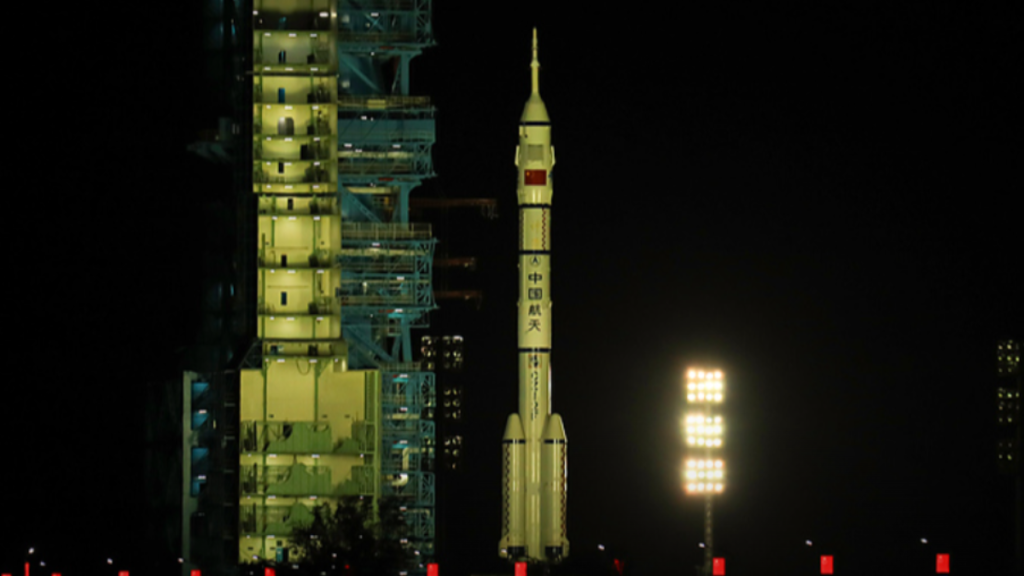
China’s space programme took another step forward with the launch of the Shenzhou-23 mission, sending three astronauts into orbit on a planned long-duration experiment aboard the China Space Station, including an expected year-long in-orbit stay for one crew member.
The mission, launched on Monday at 11:08 p.m. local time, lifted off aboard a Long March-2F Y23 rocket from the Jiuquan Satellite Launch Centre in the Gobi Desert. According to the China Manned Space Agency, the spacecraft successfully entered its preset orbit around 10 minutes after liftoff, marking the completion of its initial flight phase and a smooth orbital insertion.
The three-member crew is led by taikonaut Zhu Yangzhu and includes Zhang Zhiyuan and Lai Ka-ying. The mission marks several firsts for China’s human spaceflight programme.
Lai Ka-ying has become the first astronaut from the Hong Kong Special Administrative Region to take part in a crewed Chinese space mission, and also the first member of China’s fourth batch of taikonauts to travel into space.
The crew further comprises commander Zhu Yangzhu and pilot Zhang Yuanzhi, both serving in the People’s Liberation Army astronaut corps.
The mission also marks a milestone in China’s space programme, with Zhu Yangzhu – previously part of the Shenzhou-16 mission – becoming the first flight engineer from the third batch of astronauts to command a crewed Shenzhou flight.
The China Manned Space Agency has also said the Shenzhou-23 mission is expected to set a new record for the longest stay in orbit by Chinese astronauts, Xinhua News Agency reported.
CMSA spokesperson Zhang Jingbo said one astronaut from the Shenzhou-23 crew will carry out a year-long in-orbit stay experiment aboard the China Space Station.
Currently, the record is held by the Shenzhou-21 crew, which had spent 207 days in orbit as of Tuesday (May 26, 2026), after being launched on October 31, 2025.
“Assigning an astronaut to a one-year in-orbit stay is not simply doubling the duration of two six-month missions,” Zhang said, highlighting the added physiological, psychological and operational challenges involved in a prolonged stay in space.
Recently, another record in human spaceflight was set in April during a lunar mission, when NASA’s Orion spacecraft reached its maximum distance of 4,06,771 kilometres from Earth, marking a new milestone in deep-space exploration.