


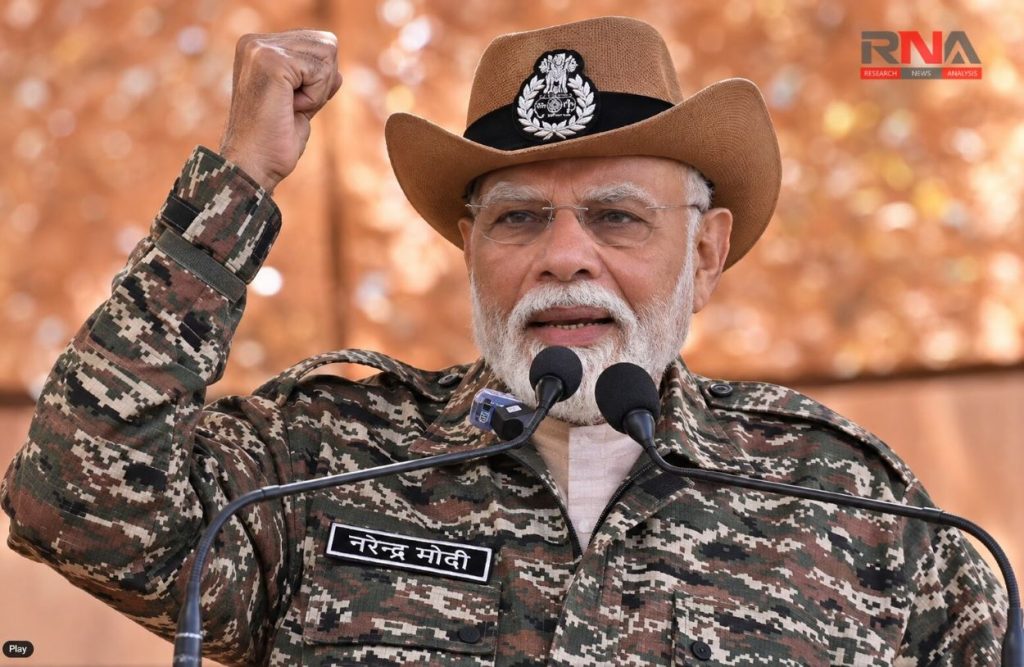
New Delhi: The prime minister, Narendra Modi, celebrated Diwali with security personnel in Chhattisgarh’s Bastar region on Sunday, marking the first festival of lights since the government declared India free of left-wing extremism after decades of armed conflict. The visit carried particular significance for one of the country’s longest-running internal security campaigns, which transformed large parts of central India into a battleground between Maoist insurgents and government forces.
Addressing security personnel deployed in Bastar, Modi credited their sacrifices and sustained operations with dismantling the Maoist insurgency that had dominated the region for decades. He described the occasion as the first Diwali since the end of Naxalism, presenting the government’s achievement as a major turning point in India’s internal security landscape.
The prime minister’s visit came more than seven months after the Centre announced on March 31 this year that India had achieved its target of eliminating left-wing extremism. The declaration followed a sustained campaign involving the Central Reserve Police Force (CRPF), its specialized Commando Battalion for Resolute Action (CoBRA), state police units and intelligence agencies, which progressively weakened the Maoists’ organizational and operational capabilities.
Earlier on Sunday, Modi announced his visit through a social media post, saying Bastar had undergone a significant transformation from an insurgency-affected region into one witnessing expanding development activities. He said he was travelling there to acknowledge the sacrifices, selfless service and commitment of personnel who had played a central role in restoring security.
From Maoist stronghold to government control
For decades, Bastar represented the geographical and operational centre of the banned Communist Party of India (Maoist), which waged an armed campaign against the Indian state. Its extensive forests, difficult terrain, limited road connectivity and historical developmental disadvantages enabled insurgents to establish influence across remote tribal settlements, particularly in districts such as Sukma, Bijapur, Dantewada and Narayanpur.
The insurgency reached some of its most violent phases during the late 2000s and early 2010s, when Maoist ambushes inflicted heavy casualties on security forces. Among the deadliest incidents was the April 6, 2010, attack near Tadmetla in Dantewada, where 76 security personnel were killed, exposing serious deficiencies in operational intelligence, tactical preparedness and coordination.
The government’s subsequent counterinsurgency strategy combined intensified security operations with the establishment of forward operating bases, improved intelligence-sharing and expanded infrastructure in previously inaccessible areas. Under the national policy and action plan adopted in 2015, security operations were increasingly coordinated with road construction, telecommunications expansion and efforts to extend government services into Maoist-influenced territories.
According to the Union home ministry, the number of districts classified as affected by left-wing extremism declined from 126 in 2014 to zero following the government’s March 2026 declaration. The ministry also reports that 668 new security camps have been established since 2014, helping security forces maintain a permanent presence in areas previously dominated by insurgents.
A major milestone for the CRPF
Modi’s Diwali visit coincided with another significant development for the CRPF, which recently completed 12 consecutive months without an operational fatality for the first time in 47 years. Its director general, GP Singh, attributed the achievement to improved equipment, training, operational planning and faster evacuation of wounded personnel, alongside the sharp reduction in Maoist violence.
The milestone, reported on November 2, is particularly significant because the force has historically suffered heavy casualties in counterinsurgency operations across central India. Nearly 50,000 CRPF personnel were deployed in Left-wing extremism-affected regions at the insurgency’s peak, including approximately 40,000 in Bastar.
However, the end of organized Maoist resistance does not automatically eliminate every potential security threat, particularly in regions where insurgent networks operated for generations. Maintaining intelligence coverage, preventing the regrouping of former cadres and ensuring effective local policing will remain essential as the government gradually shifts its emphasis from military-style operations to civilian administration.
The challenge after the insurgency
The next phase will test whether the security gains can produce lasting improvements in the lives of Bastar’s predominantly tribal population, whose communities have endured decades of violence, displacement and inadequate public services. According to home ministry figures, government initiatives across formerly Maoist-affected regions have delivered thousands of kilometres of roads, expanded mobile connectivity, educational institutions and banking facilities.
The Centre has also announced plans to convert several existing security camps in Chhattisgarh into public service centres offering access to welfare schemes and administrative facilities. Such measures are intended to strengthen the civilian government’s presence and reduce dependence on security deployments as the principal means of maintaining state authority.
Modi’s decision to celebrate Diwali in Bastar therefore served two purposes – recognizing the personnel who helped dismantle the insurgency and signalling the government’s intention to consolidate its gains through development. Whether that transition becomes permanent will depend increasingly on responsive governance, sustainable livelihoods, protection of tribal rights and the ability of local institutions to prevent the conditions that once helped the insurgency take root.