


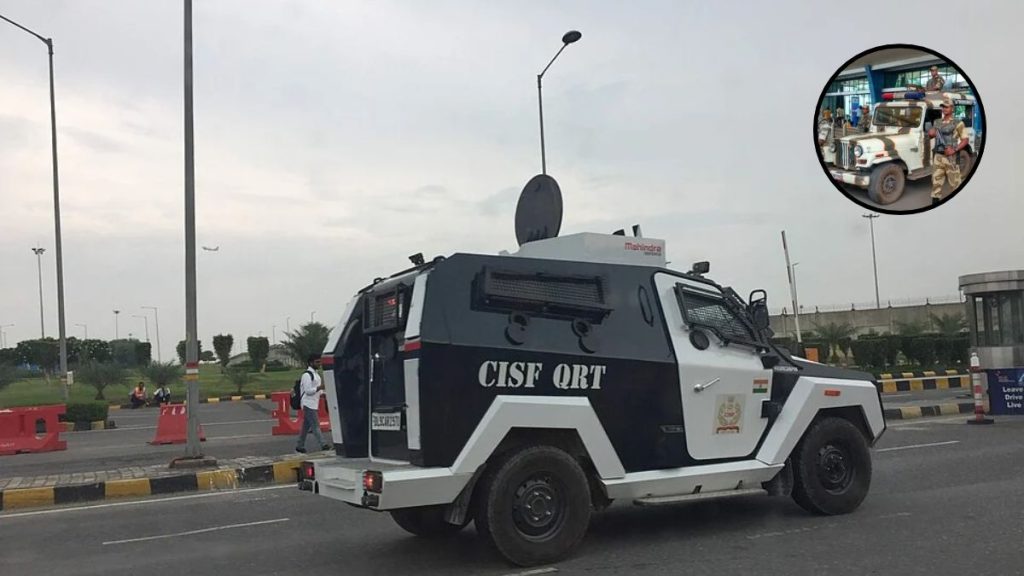
New Delhi: Central Industrial Security Force (CISF) deployment at Indian airports is expected to decline as private security personnel take on selected non-armed duties under revised staffing norms. The proposal is designed to contain aviation security spending and release trained CISF personnel for higher-priority assignments without transferring core protection responsibilities to private companies.
A phased shift towards private security personnel for selected non-armed airport duties is being planned, NDTV reported on Tuesday citing civil aviation ministry sources. The Bureau of Civil Aviation Security (BCAS) circulated a revised framework through an October 27 order, Hindustan Times reported while airport-specific staffing surveys and final approvals are still pending.
How much CISF deployment could fall?
Rather than imposing a uniform cut, the exercise seeks to match staffing with passenger volumes, flight movements, terminal design and security risks. Reported categories distinguish small airports handling fewer than 1 lakh passengers monthly, medium facilities handling 1 lakh to 10 lakh and major airports exceeding 10 lakh.
An official cited by Hindustan Times suggested reductions of around 10 per cent or more at some locations. That is an estimate, not a government-approved nationwide reduction. Airport surveys will determine proposals for review by the civil aviation ministry and final consideration by the home ministry.
According to NDTV, CISF provides security at 74 airports in the 119-airport breakdown reported by officials, while state police cover 45. These numbers do not represent every operational airport in India.
How would the government actually save money?
The savings case is more complicated than replacing a government guard with a cheaper private guard. CISF airport costs are met through a centrally administered aviation security financing arrangement, and CISF personnel who are redeployed will still receive government salaries.
The national aviation security fee trust, established in July 2019, centrally manages the aviation security fee (ASF). A government reply to parliament in February 2023 clarified that airport operators no longer directly owe CISF deployment costs under this system. Another reply confirmed that ASF replaced the security component of the former passenger service fee (PSF).
A smaller deployment could therefore reduce the cost charged to the pooled aviation security system, potentially easing pressure on the fee collected from passengers. But airport operators would need to pay for contracted guards, whose full costs include wages, training, statutory benefits, vetting, equipment, contractor margins and supervision.
The relevant calculation is the security expenditure avoided minus all replacement and oversight costs. A reduction in CISF posts is not automatically an equal reduction in public spending; if the reassigned personnel protect new airports or other installations, the main government benefit is avoiding the cost of recruiting additional specialist manpower for those assignments.
Neither the final number of positions to be changed nor an audited estimate of net savings has been released yet. Even if one airport reduces its CISF headcount by 10 per cent, the security bill need not fall by 10 per cent because fixed costs and specialized deployments remain.
What security will CISF continue to provide?
The force is expected to retain armed protection, airport perimeter security, mobile patrols, intelligence coordination, surveillance, quick response teams and protection of sensitive installations. These responsibilities require specialist training, weapons authorization and rapid coordination during emergencies.
The private staff could handle approved support assignments at designated access points, passenger movement areas and other routine non-armed positions. They would not automatically become authorized to perform armed duties or specialized passenger and baggage screening.
The distinction matters: a guard checking whether someone has the correct access permission is not performing the same job as an officer responding to a breach or screening for prohibited items. Staffing changes must preserve those operational boundaries.
Who supervises the private guards?
Rule 9 of the Aircraft (Security) Rules, 2023, requires private security agencies to operate under the chief aerodrome security officer’s (CASO) operational direction, with administrative supervision by the airport operator. Training must meet standards prescribed by the central government.
This arrangement keeps the airport security chain of command intact, but it creates practical requirements. Guards need background verification, authorized credentials, instruction in identifying suspicious behaviour and clear channels for reporting incidents. Contractors must also maintain staffing levels and replace absent personnel without leaving vulnerable access points unattended.
BCAS oversight, surprise checks, refresher training and joint emergency drills would help establish whether private personnel can carry out assigned duties reliably. Technology such as biometric entry and automated identity checks may reduce repetitive work but also need fallback procedures when systems fail.
Does private security increase the risk?
Not necessarily. Risk depends on the duty, the guard’s competence and how effectively the central force supervises it. A properly trained private employee may be suitable for a narrowly defined support role, while an inadequately trained employee at a sensitive entry point can create a security gap.
Accountability is particularly important when an incident crosses organizational boundaries. Airport operators, contractors, CASO and CISF units need written responsibilities and common reporting procedures, so a suspicious vehicle, unauthorized entry or unattended object is not passed between agencies without action.
The government must demonstrate that any saving is achieved without reducing response capability or relaxing mandatory screening and access controls. Those safeguards matter more than the uniforms passengers see.
Has India used private airport guards before?
Yes. In September 2022, the ministry of civil aviation announced the replacement of CISF personnel at non-core posts by 1,924 private security employees at 60 airports. The airports authority of India had appointed 581 personnel from Directorate General Resettlement-sponsored agencies for 45 airports, and 74 trained guards were already deployed at Kolkata.
The ministry said the objective was to lower security expenditure and release CISF personnel for other airports. The latest proposal is therefore a reassessment and potential expansion of an established practice, rather than a first experiment with private aviation security.
What changes for passengers?
Passengers may encounter private guards at more support points but should still undergo prescribed screening and identity or access checks. The proposed rationalization does not itself authorize weaker security procedures.
Any reduction in expenditure could help contain pressure on the Aviation Security Fee. It does not guarantee a fee cut, and even a lower fee would not necessarily mean cheaper tickets: fares also reflect airline pricing, fuel, taxes and other airport charges.
The real test: Savings without a security deficit
For the government, success would mean fewer specialist CISF personnel tied to routine posts, lower net aviation security expenditure and more trained staff available where threats demand them. For airports, it would mean reliable contractors operating under enforceable rules; for passengers, unchanged protection without avoidable increases in charges.
The calculation is straightforward, although the answer is not yet available: subtract private staffing, training and oversight costs from the CISF deployment costs avoided, then assess whether redeployment prevents additional recruitment or security expenditure elsewhere. Without published airport-wise figures and evidence that protection standards hold, a claimed manpower cut cannot yet be counted as either a verified government saving or a proven security improvement.