


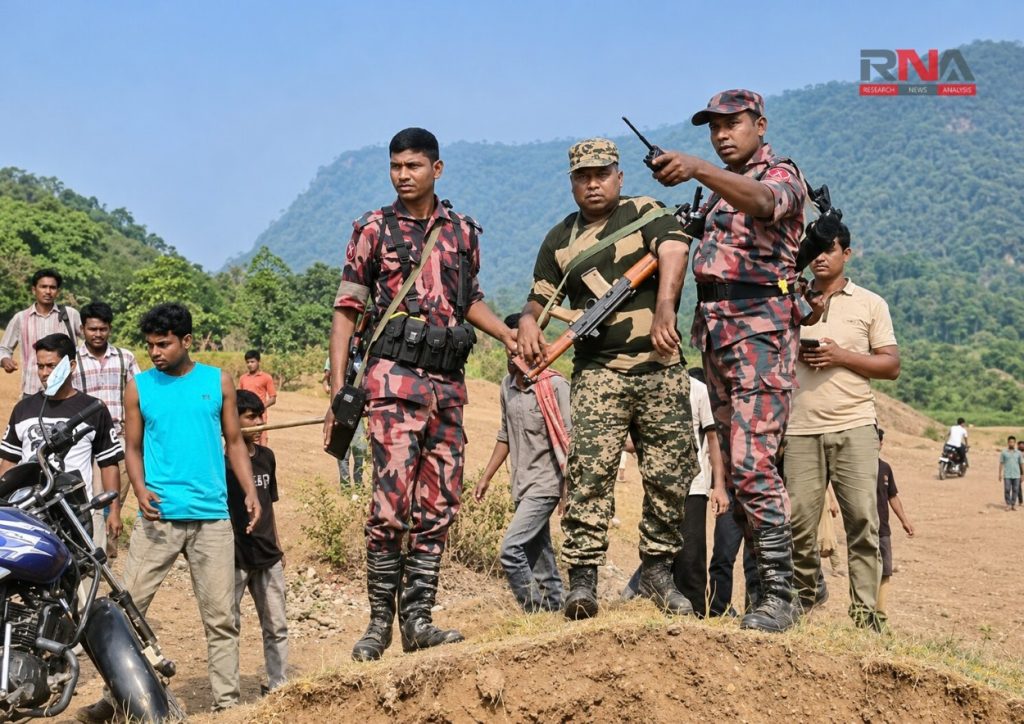
New Delhi: A Border Security Force jawan was detained by Bangladesh’s border guards, Border Guard Bangladesh, on Tuesday, after inadvertently crossing the international boundary from Meghalaya into Sylhet district, triggering an immediate intervention by senior officers of both countries. The soldier was subsequently released following a flag meeting between the two forces, ending a brief but potentially sensitive border incident at a time when India-Bangladesh relations remain under strain.
The incident occurred around 12.30pm in the Bichnakandi area of Gowainghat upazila, where the armed BSF jawan reportedly entered approximately 200 yards into Bangladeshi territory. According to the Daily Star, the commanding officer of Border Guard Bangladesh’s (BGB) 48 Battalion, Lieutenant Colonel Nur Uddin Ahmed, confirmed that the BSF jawan had been detained along with his firearm and taken to the Bichnakandi border outpost.
Indian officials described the crossing as accidental and contacted their Bangladeshi counterparts to arrange the jawan’s return through established border-management channels. Senior BSF officers in the Meghalaya sector sought a flag meeting, following which the jawan was handed back to Indian authorities and taken for a medical examination.
According to some reports, local residents initially intercepted the personnel before handing him over to the BGB, and some allegedly manhandled him. Videos purportedly showing Bangladeshi villagers surrounding the jawan as border guards escorted him away on a motorcycle circulated online, although their authenticity could not be independently verified.
A separate account by Bangladesh’s United News of Bangladesh referred to an allegation that the BSF jawan had assaulted a Bangladeshi tourist in the area. However, the BGB battalion commander acknowledged that he had heard the allegation but could not verify it, leaving the circumstances surrounding the encounter unclear.
The jawan’s identity has not been publicly established in the reports examined, and the precise circumstances in which he crossed the boundary remain under scrutiny. Nevertheless, his return following direct communication between the two border forces demonstrated that established mechanisms for resolving localized incidents continue to function despite wider diplomatic disagreements.
Why unfenced Meghalaya-Bangladesh border remains vulnerable
The episode has drawn attention to the difficult geography of the India–Bangladesh frontier, where rivers, hills, agricultural land and densely populated settlements complicate surveillance and boundary enforcement. The Bichnakandi area lies near Meghalaya’s border with Bangladesh, a region where the absence of continuous physical fencing makes patrol coordination particularly important.
India and Bangladesh share a 4,096.7-kilometre international boundary stretching across West Bengal, Assam, Meghalaya, Tripura and Mizoram, making it India’s longest land border with any neighbouring country. According to the Union home ministry’s 2025–26 annual report, approximately 3,232 kilometres had been physically fenced, leaving significant stretches dependent on other surveillance and security arrangements.
Meghalaya alone shares approximately 443 kilometres of boundary with Bangladesh, with nearly 40 kilometres reportedly remaining unfenced. Such gaps present operational challenges because patrols must distinguish between movements close to the boundary and actual crossings, often in terrain where physical landmarks and internationally agreed boundary markers are more important than fences.
The parliamentary standing committee on external affairs has previously highlighted the difficulties of completing border fencing, including riverine terrain, land acquisition problems and bilateral restrictions on construction close to the boundary. Its report on India-Bangladesh relations recommended closer coordination with Dhaka and faster resolution of technical and administrative obstacles to strengthening border security.
Border coordination continues despite diplomatic strains
The detention also comes against the background of disagreements between New Delhi and Dhaka over border management, unauthorized crossings and the treatment of people apprehended along the frontier. Although Tuesday’s incident was resolved quickly, it illustrated how an apparently accidental crossing can become a sensitive bilateral matter when armed personnel are involved.
At the 57th director general-level border conference held in New Delhi from June 8 to 11, the BSF and BGB discussed illegal crossings, transborder crime, smuggling and measures to maintain stability along the frontier. Both forces reaffirmed their commitment to peaceful border management and closer operational coordination, with another high-level meeting proposed for November in Dhaka.
These institutional arrangements provide an important distinction between localized security incidents and broader diplomatic disputes, allowing field commanders to establish contact without waiting for intervention from national capitals. Flag meetings, in particular, offer a practical means of verifying circumstances, discussing complaints and arranging the return of personnel or civilians who have crossed the boundary.
The latest episode occurred as the two countries were also dealing with the postponement of their fifth consular dialogue, originally scheduled for Tuesday and Wednesday in Dhaka. According to Prothom Alo, the meeting was deferred following an Indian request citing scheduling difficulties, against a broader backdrop of unsettled bilateral issues.
The swift release of the BSF jawan therefore carries significance beyond the immediate incident, demonstrating that tactical communication between the two border forces remains operational even when higher-level diplomatic engagement encounters difficulties. It also reinforces the importance of accurate boundary awareness, disciplined patrol procedures and established communication channels along one of South Asia’s most extensively patrolled international frontiers.