


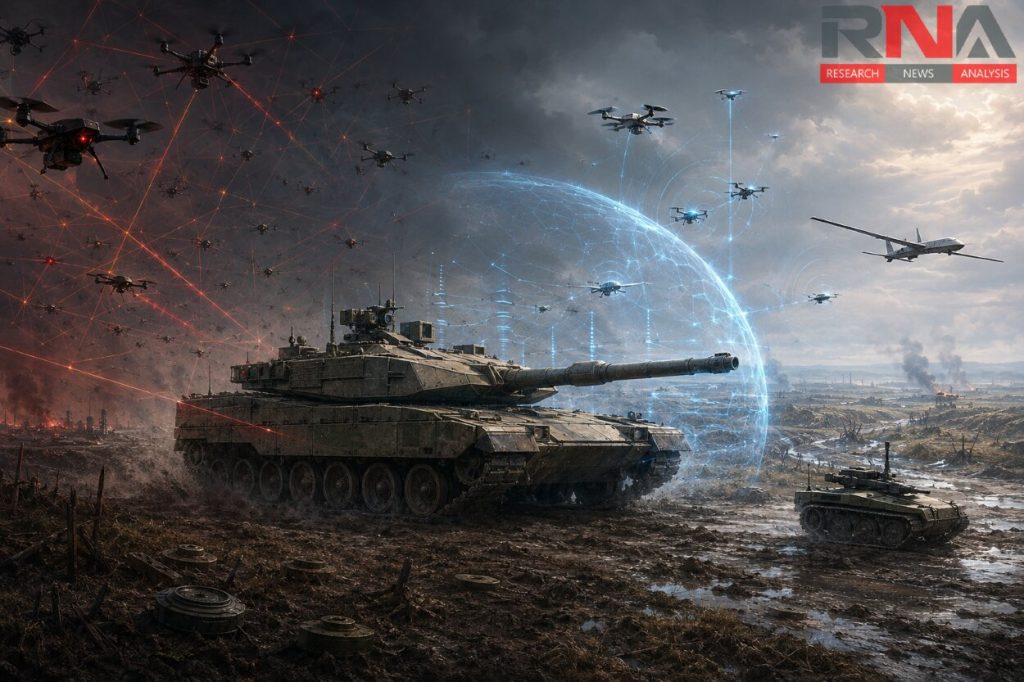
Ukraine’s western-supplied main battle tanks, once expected to help restore manoeuvre against Russian forces, are being committed far more selectively as drones, mines and artillery make large armoured movements exceptionally hazardous. Their experience has renewed the debate over whether the tank is approaching obsolescence or undergoing another fundamental transformation to survive a battlefield in which almost every movement can be detected.
A New York Times assessment published on Tuesday said drones had made Ukraine’s expensive western tanks almost unusable in their intended role, an argument subsequently amplified by Military Watch Magazine and others. The conclusion is striking, but the available evidence supports a more qualified finding, which is that western armour has lost much of its freedom of action in Ukraine, although it has not become militarily worthless.
Ukraine began receiving German-designed Leopard 2s, British Challenger 2s and US M1A1 Abrams tanks in 2023 after months of political debate among its partners. Kyiv hoped the vehicles’ firepower, protection and advanced optics would help its forces breach Russian positions and exploit any opening created during the counteroffensive that year.
By the time most of the tanks reached the battlefield, however, Russia had built deep defensive belts protected by anti-tank mines, artillery, attack helicopters, electronic warfare systems and persistent aerial surveillance. Ukraine also lacked the local air superiority, engineering capacity and mass of supporting forces that western armoured doctrine normally requires for a sustained breakthrough.
The problem was therefore larger than the performance of any individual tank. A Leopard, Abrams or Challenger entering a minefield under drone observation could be immobilized, struck by artillery and then repeatedly attacked by FPV (first person-view drones) before a recovery vehicle could reach it.
The danger became particularly visible in April 2024, when US officials said Ukraine had temporarily moved its Abrams tanks away from the frontline after five of the 31 vehicles supplied by Washington were lost to Russian attacks. At that time, Ukrainian officials told Associated Press that surveillance and hunter-killer drones had made it difficult for the tanks to operate without being detected and targeted.
Ukraine’s experience has not been confined to western vehicles, nor does it demonstrate the superiority of Russian tank designs. Russian armoured formations have suffered enormous losses from mines, anti-tank weapons, artillery and Ukrainian drones, forcing Moscow to reduce large mechanized assaults and employ tanks in smaller, carefully prepared groups.
A Royal United Services Institute study illustrates the scale of that change. It highlighted that Ukrainian intelligence detected only 23 Russian tanks operating within 70 kilometres of the frontline between August 1 and August 24, 2025, compared with 470 tanks on the southern axis alone in May 2023. Russia later increased its use of armour, but generally in deliberate attacks after drones, artillery and electronic warfare had attempted to weaken Ukrainian defences.
The same RUSI study, based on interviews with Ukrainian commanders and tank crews, found that western tanks were commonly regarded as too heavy and difficult to repair under field conditions. Crews valued their protection and survivability, but commanders found that operational availability could decline rapidly when damaged vehicles required specialized parts, recovery equipment or lengthy maintenance.
Repairability has consequently become almost as important as armour thickness. Ukrainian forces expect vehicles to be hit, making the speed at which a tank can be recovered, repaired and returned to combat a decisive measure of its real battlefield value.
This does not mean western tanks have failed in every role. Ukrainian Challenger 2 crews, for example, have praised the British tank’s accuracy, protection and long-range firepower, with the London’s Times reporting in February 2025 that one concealed vehicle engaged a Russian armoured column from about five kilometres.
Ukrainian brigade commanders interviewed by RUSI continued to describe armour as indispensable when used in platoon-sized groups to clear enemy positions, support infantry and draw fire away from dismounted troops. Tanks have also been employed for indirect fire, urban combat and defensive ambushes rather than the sweeping penetrations for which large armoured formations were designed.
The western fleet’s diversity has created an additional burden because Leopard 1s, Leopard 2s, Abrams and Challenger 2s have different engines, ammunition, tools, spare parts and maintenance requirements. Supplying a limited number of several tank types may deliver individual capabilities, but it does not automatically create a sustainable armoured force.
Calling these vehicles “useless” therefore confuses the vulnerability of a weapons platform with the failure to provide the operational conditions it needs. Ukraine has demonstrated that even the most advanced tank cannot substitute for reconnaissance, electronic warfare, mobile air defence, engineers, artillery, logistics and trained infantry operating as an integrated force.
How tanks are being redesigned for drone age
The tank is unlikely to disappear because armies still require protected, mobile firepower capable of destroying fortifications, supporting infantry and surviving threats that would devastate lighter vehicles. What is disappearing is the assumption that armour can concentrate openly, approach the frontline safely and lead an assault before enemy sensors and strike systems have been suppressed.
Future armoured operations are likely to begin with drones, electronic warfare teams, reconnaissance units and uncrewed ground vehicles identifying mines, enemy drone operators, artillery positions and anti-tank teams. Tanks would move forward only after these systems had created a temporary corridor through the surveillance-and-strike network protecting the enemy’s position.
This reverses the familiar order of battle in which tanks spearheaded the advance and supporting forces followed. Uncrewed systems may increasingly enter the most dangerous zone first, with tanks providing protected direct fire once the immediate drone, mine and anti-tank threat has been reduced.
Former US Army armour officer Michael P Losacco has argued through the Modern War Institute that attaching infantry to tanks is no longer sufficient because drones threaten both elements. He advocates dedicated reconnaissance and security forces operating ahead and, on the flanks, to detect enemy observers, drones and anti-tank teams before the main armoured formation is exposed.
The tank itself will also need layered protection against attacks from above. Passive armour and explosive reactive armour will be combined with electronic jammers, multispectral smoke, laser-warning receivers, drone-detection radars, remote-controlled weapons and active protection systems capable of destroying incoming missiles or drones.
Active protection, however, is not an invulnerability shield. The Institute for the Study of War reported on August 9 that Russia’s Arena-M system increased the number of Ukrainian drones required to destroy a protected tank, but could still be depleted or overwhelmed by repeated attacks.
That episode points towards a continuing contest between protection and saturation. A tank may defeat several incoming drones, but its defences must be reloadable, affordable and integrated with nearby counter-drone vehicles if it is to withstand attacks involving dozens of low-cost systems.
Weight is another area in which designers are being forced to reconsider established assumptions. Adding more conventional armour, cages, sensors and defensive systems can make a tank slower, harder to recover and too heavy for bridges, soft ground or strategic transport.
The US Army acknowledged this problem when it abandoned a planned incremental Abrams upgrade and moved towards the M1E3. The service said the future variant would be lighter, more survivable and built around a modular, open architecture that could accept new technology without repeatedly adding weight and logistical complexity, according to its September 6, 2023, modernization announcement.
Current design trends include smaller crews, automatic loaders, crewless turrets, hybrid-electric propulsion and reduced thermal and acoustic signatures. These features can shrink the protected volume, lower fuel consumption and allow surveillance or communication systems to operate without keeping a hot and noisy main engine running.
Britain’s Challenger 3 and Germany’s Leopard 2A8 represent a more evolutionary approach, which combine improved guns, sensors and modular armour with active protection. The Trophy system selected for Challenger 3 is intended to detect and intercept incoming rockets and anti-tank missiles, although future versions will also have to contend with top-attack drones and massed low-cost threats.
Future tanks will probably carry or control their own reconnaissance drones and loitering munitions, extending their view and striking range beyond the horizon. The tank commander will increasingly manage a local network of aerial and ground sensors instead of relying solely on the vehicle’s sights.
Repairability will influence design as strongly as firepower. Modular armour panels, interchangeable electronic units, accessible power packs and common components will be essential because a technically superior vehicle that spends weeks awaiting parts is less valuable than a simpler tank that can return to battle within hours.
Ukraine has also shown that platform survival and crew survival must be assessed separately. A tank that is disabled but allows its trained crew to escape may still represent a successful protective design because experienced personnel are harder to replace than the vehicle itself.
Some military specialists caution against drawing sweeping conclusions from Ukraine’s drone footage. Writing for the Modern War Institute, a former Canadian tank commander, Colonel Charles S Oliviero, and Lieutenant Colonel Phil Halton argued that drones are another formidable anti-armour threat rather than a complete replacement for tanks or combined-arms warfare.
Their central point is that drones can deny movement and destroy exposed vehicles but cannot seize and hold territory. Tanks remain among the most effective means of restoring mobility and delivering concentrated protected firepower once an army has suppressed the sensor, mine and strike systems that created the initial stalemate.
Other observers reach a similar conclusion from a different direction. A European Policy Centre assessment argued that Europe still needs heavy mechanized forces because missiles and drones can inflict damage but cannot occupy ground, although future armour must be paired with automation, uncrewed systems and protection against aerial surveillance.
For India, these lessons are directly relevant to the FRCV (future-ready combat vehicle) programme intended to replace the Indian Army’s T-72 fleet. The defence acquisition council approved the programme on September 3, 2024, describing the FRCV as a main battle tank with superior mobility, all-terrain performance, multilayered protection, precision firepower and real-time situational awareness, according to the Ministry of Defence.
The Ukrainian experience suggests that the FRCV’s success will depend not merely on gun calibre or frontal armour, but on active protection, organic drones, counter-UAV capability, electronic warfare resilience and rapid field repair. Weight and logistical endurance will require particular attention because Indian armour may have to operate across deserts, riverine plains and high-altitude terrain with sharply different mobility and recovery constraints.
The tank of the future will therefore be less an isolated armoured fortress than a protected combat node connected to drones, artillery, engineers, infantry and electronic warfare systems. Its survival will be created by the formation around it as much as by the armour fitted to its hull.