


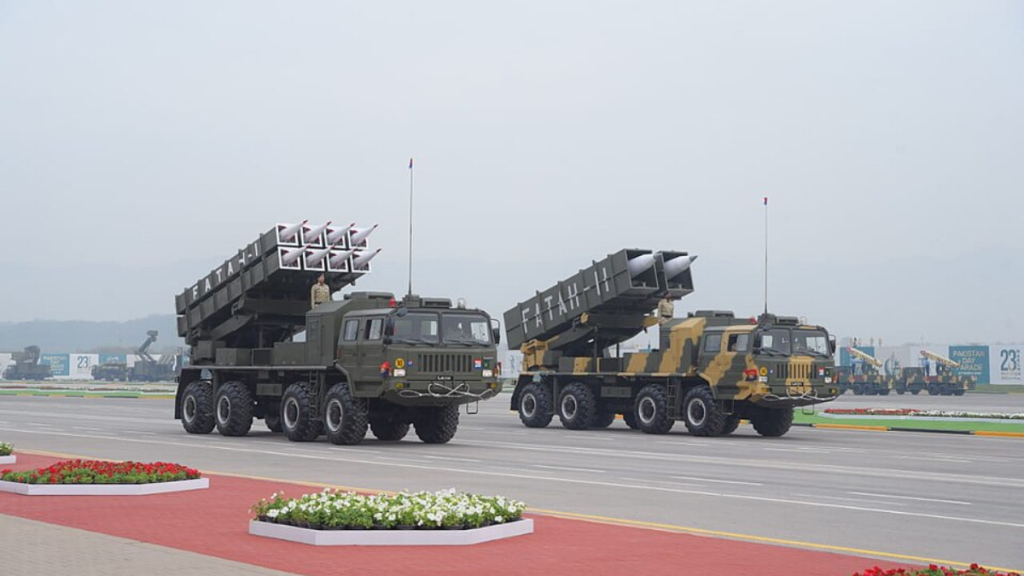
The operational debut of Chinese-origin weapon systems during Operation Bunyan um Marsoos in May 2025 has drawn renewed scrutiny, not merely for their battlefield employment, but for the locations from which they were deployed.
Multiple PLA-exported platforms, including the SH-15 155mm Mounted Gun System, were reportedly positioned within civilian settlements and in proximity to protected sites, revealing a force-disposition doctrine that systematically co-locates high-value foreign-supplied assets with civilian infrastructure to exploit the adversary’s target-discrimination constraints.
Across multiple conflicts and along the Line of Control, this operational pattern has become a consistent feature of Pakistan’s military posture. The deliberate embedding of combat assets within populated areas. The tactic operates on two functional layers. At the kinetic level, co-locating weapon systems within civilian zones raises the threshold for retaliatory strikes by increasing the risk of collateral damage.
At the information layer, any resulting civilian casualties generate exploitable narrative content for psychological operations, domestic mobilisation, and international diplomatic pressure. The civilian population, in effect, functions as both a passive shield and an active information-operations asset.
During Operation Bunyan um Marsoos, this doctrine was operationalised across multiple domains simultaneously. Drone launch infrastructure was identified at Sialkot International Airport and Mai Bhakhtawar International Civil Airport at Islamkot, both active civil aviation facilities. Additional launch sites were established in close proximity to a government school in Jandrot, Kotli, and at Padhar in Havelian District.
The use of dual-use civil aviation infrastructure for offensive strike operations represents a significant escalation in the deliberate blurring of military and civilian domains.
The Chinese-origin SH-15, a self-propelled wheeled artillery platform with a range exceeding 50 kilometres, was reportedly deployed in Bareela Sharif village, conducting direct-fire missions from within a populated settlement.
A second SH-15 deployment was identified near Rawalakot Advance Landing Ground, from where fires were directed at Poonch District. Deploying a long-range precision artillery system inside a populated settlement is no accident of logistics. It is a force-protection calculation, designed to complicate the adversary’s targeting decisions and exploit the legal constraints governing strikes near civilian infrastructure.
Further reported deployments included an air defence gun system in Kotla village, Gujrat; an RBS-70 MANPADS positioned atop a civilian structure in Zafarwal; and the FATAH-series guided battlefield rocket system, with a reported range of 140 kilometres, deployed within the populated area of Shakargarh.
Artillery systems were additionally reported near Bunguna Sahib Singh School, reinforcing the pattern of embedding high-value fire assets within protected sites.
Along the LoC, mortars, artillery detachments, and infiltration staging infrastructure have been routinely positioned within villages, a practice documented across both the 1965 and 1971 wars and sustained through present deployments.
Notably, during Operation Sindoor, India reportedly withheld strikes on several such co-located sites, a conscious targeting calculus prioritising civilian protection that stands in direct contrast to Pakistan’s force-disposition doctrine.