


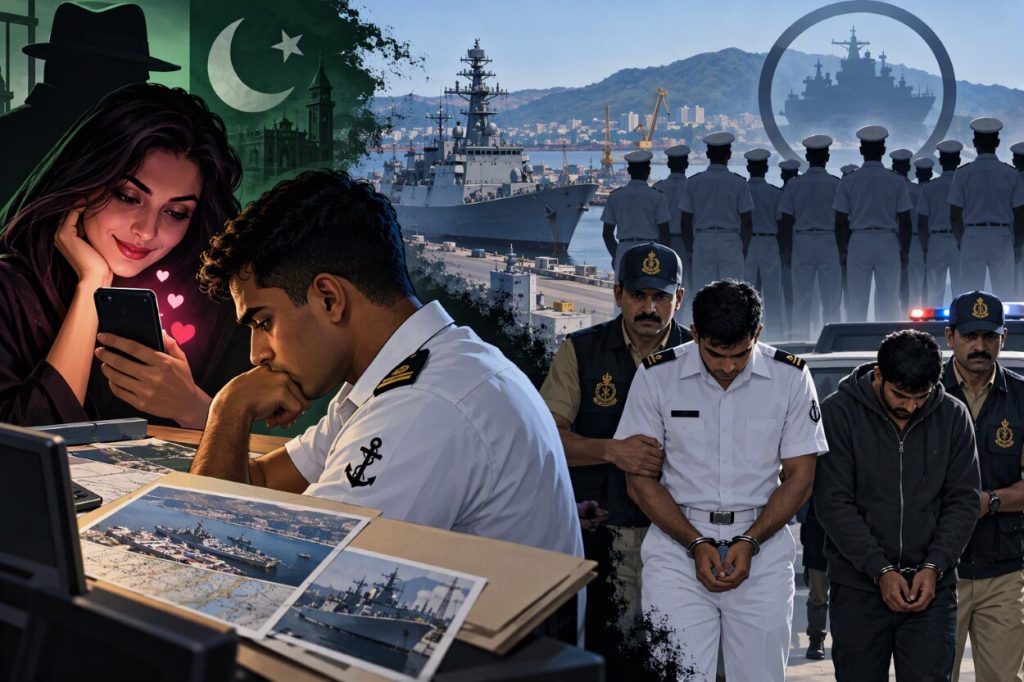
New Delhi: The Andhra Pradesh Police have placed 13 Navy personnel under investigation in a wider probe into an alleged Pakistan-linked espionage network, after arresting a naval employee and a civilian contract driver. The state police’s counterintelligence cell said on Tuesday that 18 people in all are being scrutinized under a case codenamed “Operation Firewall 2026”.
The two men arrested are Pradeep Mukherjee, a 31-year-old Navy employee attached to the Eastern Naval Command at Visakhapatnam, and Annam Sai Varaprasad, a civilian driver engaged for naval officers in the city. Police said a prima facie role was established against both, while the part played by the remaining 16 suspects is still being examined.
As RNA Media had reported, Mukherjee was taken into custody last Saturday at INS Agrani, a naval training establishment in Coimbatore, Tamil Nadu, where he was reportedly attending a management development course. He was brought to Vijayawada on a transit warrant and, like Varaprasad, remanded in judicial custody until October 14.
According to investigators, Mukherjee had been in contact for several months with a woman believed to be a Pakistani intelligence operative, whom he met through social media. Police allege that both men passed sensitive information on defence establishments and strategic locations, including those in Visakhapatnam, through encrypted communication channels.
The counterintelligence cell said it launched a coordinated operation on October 1, working with the police forces of 10 states, state anti-terrorism squads and Navy officials. Electronic gadgets were seized from the suspects under due legal procedure, and the investigation into the others continues.
The police release did not specify what information was shared or how sensitive it was. Being under scrutiny is also not proof of wrongdoing, and the Navy had not issued a public statement on the case in the earliest reports.
The case revives memories of Operation Dolphin’s Nose, named after a hill adjoining the Eastern Naval Command at Visakhapatnam. On December 20, 2019, Andhra Pradesh intelligence officers, working with central agencies and Naval Intelligence, arrested seven Navy personnel and a hawala operator, after which the National Investigation Agency took over the case.
The NIA found that Navy personnel had been befriended on platforms such as Facebook and WhatsApp and paid through bank deposits routed via Indian associates with business interests in Pakistan. The number of Navy personnel arrested eventually reached 11, with 15 arrests in all by June 2020, while the Navy maintained that its critical assets had not been compromised.
Early reports at the time suggested that the sailors were junior and lacked access to classified material, and that they were paid small sums of ₹5,000 to ₹10,000 through a hawala dealer. The trial is still on – in November 2025, an NIA special court sentenced two more accused to five years and 10 months in jail, taking the number of convictions to six.
The latest arrests also follow a similar case earlier this year. In March this year, the Uttar Pradesh anti-terrorism squad (ATS) arrested Adarsh Kumar, alias Lucky, a 24-year-old posted with the Southern Naval Command at Kochi, for allegedly passing information to Pakistan’s Inter-Services Intelligence.
The pattern across these cases is consistent. Pakistani handlers appear to favour low-cost social media approaches aimed at junior or contract staff rather than any technical penetration of naval networks, which makes personal digital conduct, and not just cybersecurity, the Navy’s main point of vulnerability.