


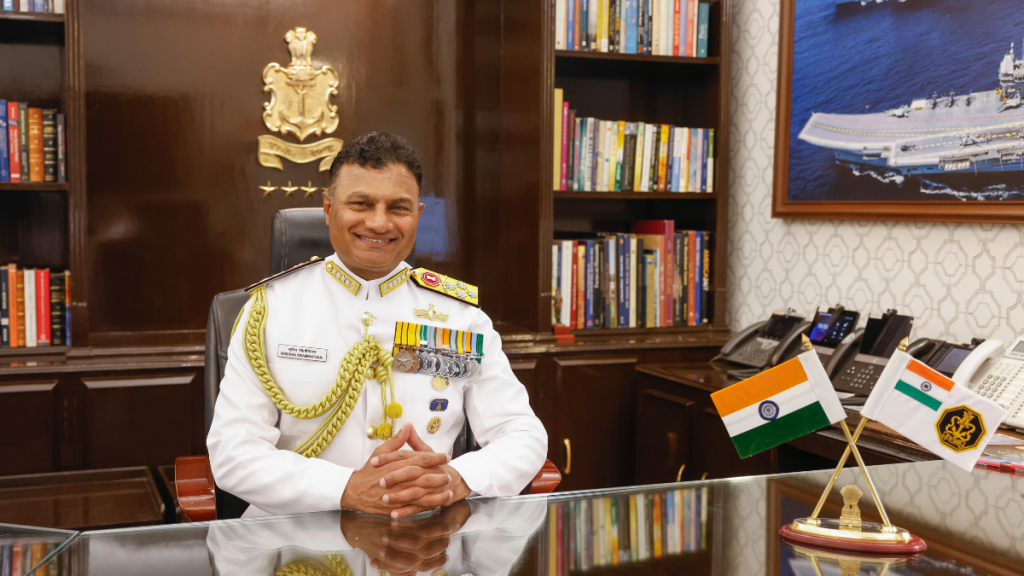
New Delhi: The chief of the naval staff, Admiral Krishna Swaminathan, on Monday said that delivering indigenous naval capability in an acceptable time frame requires “collective efforts on the five areas that contribute for effective capability building”. He listed the five areas as deeper ideation, prototyping, testing, contracting and induction, and life-cycle support.
Speaking at the fifth edition of Swavlamban, the Indian Navy’s flagship Naval Innovation and Indigenisation Seminar, at the Manekshaw Centre, the Navy chief said ideation must be “not only aligned to present and future operational needs, but also aware of emerging technological possibilities.” The second area, which is prototyping, means “translating promising ideas into viable prototypes in a time-bound manner.” The third, testing, involves “validating products in near real-world operational conditions in a seamless and time-bound manner.”
On the fourth area, contracting and induction, the CNS stressed the need for “working with the industry, to bridge the “Valley of Death”, between successful prototype development and procurement orders, while developing capacities for faster production and induction at scale.” The term refers to the gap many start-ups and MSMEs face between building a working prototype and receiving a procurement order.
The fifth area, life-cycle support, asks that each product be seen “not only as the end of an innovation cycle, but the start of an enduring capability that evolves through software upgrades, technological enhancements and sustained life-cycle support.”
Growth since 2022
The CNS said Swavlamban has “evolved considerably in scope and scale” since its inception in 2022. Navy-specific iDEX challenges have grown more than tenfold, from 20 in 2022 to 229 now, about 35 per cent of all iDEX challenges across the defence sector. So far, 41 AoNs worth over ₹3,500 crore have been accorded and 25 contracts valued at over ₹1,900 crore have been signed. Visitor participation has nearly quadrupled, from about 800 at the first edition to about 3,000 last year, he added.
The admiral credited industry for its progress. “This progress is the result of the innovation, enterprise and commitment of our industry partners, MSMEs and startups,” he said. “I congratulate all these stakeholders for their collective efforts.”
Emerging technologies
Looking ahead, the Navy chief said the achievements so far “provide us a strong foundation for the next phase of our journey together.” He added that the advances in artificial intelligence, autonomous systems, robotics and quantum sensing offer opportunities “to reimagine and reinforce naval capabilities.”
“Our endeavour should be to rapidly harness these technological advances and convert promising innovations into operational advantage. If we wish to succeed in our journey of self-reliance, we must set the highest standards for ourselves, assess our work honestly, and remain steadfast in our efforts.”
He said the seminar’s theme, “Strength and Power through Innovation and Indigenisation,” “underscores the need to stay ahead of the technological curve, and translate innovation, into operational capability.”
Publications and iDEX winners
Adm Swaminathan said two publications to be released at the seminar by the defence minister would help industry understand the Navy’s needs. “These two publications will help our industry partners, start-ups and MSMEs become aware of the Indian Navy’s indigenisation requirements and future mission concepts,” he said.
He also congratulated the iDEX challenge winners, calling Swavlamban’s journey “a testament to the ingenuity and enterprise of our innovators, and the growing partnership between the Navy and industry”.
The Navy chief said, “As we move forward, we must sustain this momentum and further our collective effort. We must speed up the process of converting promising ideas into operational capabilities and develop an innovation ecosystem aligned with the evolving operational requirements of the Army, Navy and Air Force”.
The two-day seminar, on October 26 and 27, brings together the armed forces, industry, start-ups, MSMEs, academia and investors to advance indigenous technological innovation and strengthen defence self-reliance. Since 2022, it has evolved into a national platform connecting the Navy’s operational requirements with the capabilities of Indian industry and academia, with the aim of accelerating the journey from innovation to deployable capability and strengthening maritime preparedness and Atmanirbharta (self-reliance).