


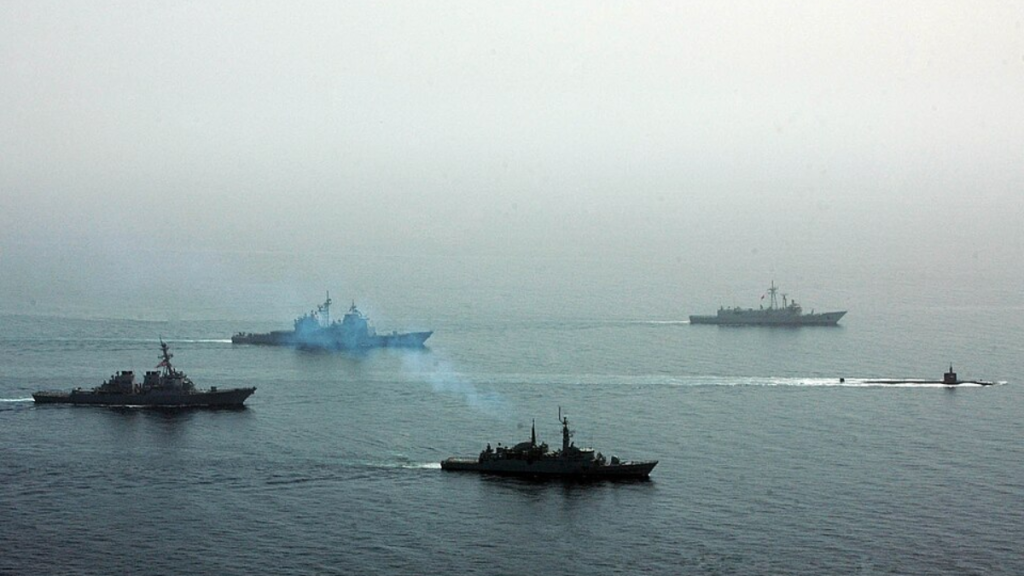
On the evening of September 15, in the North Arabian Sea, a Pakistan Navy patrol vessel struck an Indian warship. The Pakistani ship, PNS Hunain (F-273), returned to harbour with substantial hull damage, while the Indian vessel, largely undamaged, continued with her operational deployment. Within a day, both capitals had summoned the other’s chargé d’affaires. Yet the most consequential decision taken that evening has attracted the least attention. It was the decision, on an Indian bridge, not to hold course.
An Indian warship was operating in international waters on a routine surveillance mission when the Pakistani offshore patrol vessel began closing at high speed. According to India’s account of the incident, warnings were transmitted repeatedly over VHF Channel 16, the international distress and calling frequency. Despite those warnings, Hunain is said to have accelerated, closed from the starboard side, and cut across the bow of the Indian warship. The two vessels made contact. New Delhi’s account attributes the collision to the Pakistani ship’s high-speed handling and unsafe manoeuvring.
What that reconstruction describes is not an ambiguous encounter but a manoeuvre no reasonable reading of the Collision Regulations can accommodate. Rule 2 binds every mariner to the ordinary practice of seamen; Rule 8 requires that action to avoid collision be positive and taken in ample time. A high-speed bow-crossing at close range satisfies neither. It also sits, on India’s account, in contravention of Article 10 of the 1991 India-Pakistan Agreement on Advance Notice on Military Exercises, Manoeuvres and Troops Movements, which is understood to require naval vessels of the two states to remain at least three nautical miles apart in international waters, precisely so that small errors do not become fatal ones. That separation is not ceremonial. At close quarters and at speed, hydrodynamic interaction between hulls can defeat the rudder of a well-handled ship. The three-mile rule exists because the margin for recovery, once it is surrendered, cannot be recovered at will.
The pattern of damage is itself suggestive. The Indian vessel is widely reported — though not confirmed by New Delhi — to have been INS Kolkata, a destroyer roughly three times the displacement of a Damen-derived patrol vessel like Hunain. When a lighter ship crosses the bow of a heavier one and contact follows, the lighter ship tends to absorb the consequence. Hunain’s return to harbour with structural damage, set against the Indian ship’s continued deployment, is consistent with that geometry.
Here lies the point that deserves emphasis. Restraint at sea is not passivity, and it is rarely the path of least resistance. A commanding officer confronted with an aggressive shadower faces a genuine temptation to stand on: holding course asserts the right of navigation, concedes nothing, and can later be defended as lawful. Altering course, by contrast, looks like yielding. It surrenders the tactical point and invites the accusation of having been pushed. Yet even under provocation, the captain of the Indian warship appears to have taken action aimed at avoiding a more serious collision. That is the harder choice, and arguably the more professionally sound one. The measure of a warship captain is not willingness to accept risk, which is common, but judgement about which risks are worth accepting.
Islamabad tells the story differently. Pakistan’s Foreign Office says its navy had been conducting the SEASPARK-26 exercise within the country’s Exclusive Economic Zone (EEZ) since September 1, that an Indian warship and its embarked helicopter had repeatedly attempted to enter the exercise area since September 7, and that INS Kolkata changed course on September 15 and struck PNS Hunain despite the Pakistani ship’s evasive manoeuvres. It credits its own navy’s “professional and responsible conduct” with preventing escalation. Neither government’s account has been independently verified, and it’s worth noting the two versions are not as flatly contradictory as they first appear: a warship can be in “international waters” in the legal sense — where high-seas freedoms of navigation apply — while also being inside another state’s EEZ, which is why India’s “routine surveillance” framing and Pakistan’s “EEZ incursion” framing can both be technically defensible descriptions of the same patch of ocean.
The stakes extend well beyond seamanship. This is the first instance of overt military friction between the two states since last year’s four-day conflict, which ended in a ceasefire after raising fears of a wider war. Had that graze become a ramming, and had sailors drowned, the sequence that followed would not have been governed by bridge officers — and Pakistan’s navy would have paid a far heavier cost.