


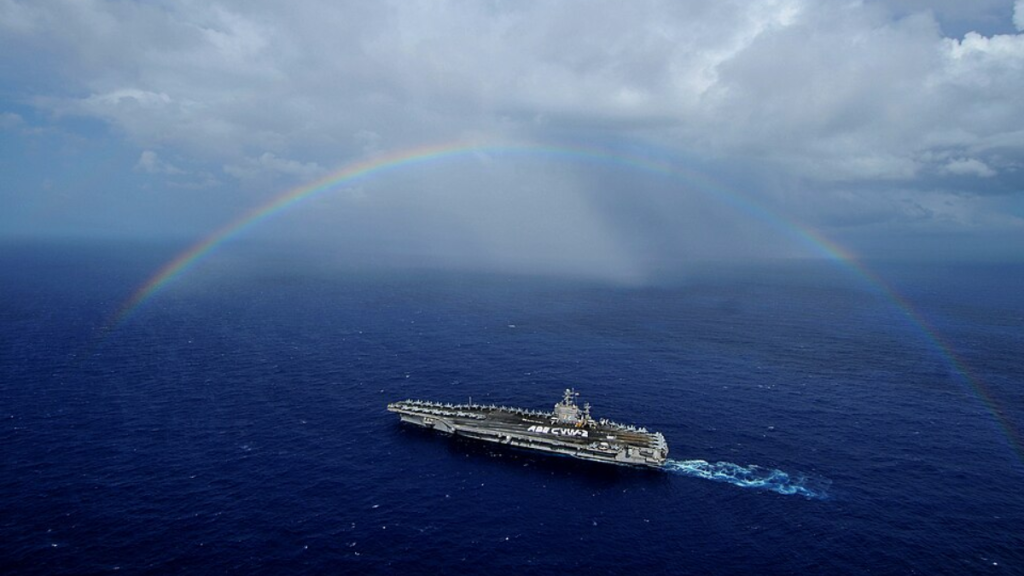
New Delhi: In January this year, as Iranian authorities suppressed nationwide protests and Washington considered its response, the USS Abraham Lincoln Carrier Strike Group entered the Middle East to give the United States greater capacity to defend its forces or strike Iran. The carrier had not yet fired a shot, but its arrival converted presidential warnings into a visible military option that Tehran could neither dismiss nor misunderstand.
The meaning of that deployment changed after US–Israeli strikes on Iran began on February 28. By April 24, the USS George HW Bush had joined the Lincoln and the USS Gerald R. Ford in the region, creating the first three-carrier US concentration there since 2003 and bringing with it 12 accompanying ships, more than 200 aircraft and about 15,000 personnel, according to US Central Command.
The January deployment demonstrated the carrier’s traditional role in coercive diplomacy; the April concentration showed how quickly that instrument can become an operational force once deterrence fails. Before a conflict, a carrier changes the adversary’s calculations; during one, it supplies sustained air power; and after the fighting, it can reassure allies and support negotiations from a position of strength.
Coercive diplomacy without automatic escalation
Aircraft carriers occupy an unusual place in statecraft because they are unmistakably military but their deployment does not, by itself, constitute an act of war. A carrier can move closer to a crisis, remain over the horizon or withdraw if tensions ease, giving political leaders a range of options that the permanent establishment of a base or the deployment of ground forces does not provide.
When the president, Donald Trump, described the force moving towards Iran in January as an “armada”, he paired the threat with the hope that it would not have to be used. The Lincoln and its accompanying warships nevertheless expanded Washington’s ability to defend US forces or undertake military action, making the deployment more consequential than a warning delivered through diplomatic channels alone, as Reuters reported at the time.
This is the attraction of naval power in a crisis: it combines mobility with persistence. An air force may require access to another country’s bases and airspace, while an army deployment can create an impression of political commitment that becomes difficult to reverse; a carrier operating in international waters carries fewer of those constraints.
The distinction should not be overstated because an adversary can still interpret a carrier’s movement as preparation for attack. Yet the force remains more politically adjustable than many alternatives, allowing a government to increase pressure without immediately crossing the threshold into combat.
Presence and absence both send signals
A carrier’s diplomatic value is visible not only when it arrives but also when it is missing. When the Ford remained in the Caribbean following US operations in Venezuela, the Middle East briefly lacked a US carrier before the Lincoln reached the region on January 26, and the gap drew attention because it temporarily narrowed Washington’s choices.
Absence does not necessarily indicate weakness: carriers require maintenance, training and crew rest, and even the US Navy cannot keep all 11 of its ships continuously deployed. It does, however, remind allies and adversaries that naval presence is finite, and that decisions about where to position a carrier reveal which theatre a government considers most urgent.
A frigate or destroyer can demonstrate presence, conduct surveillance and launch long-range missiles, but it cannot reproduce the political or military weight of a carrier strike group. The difference lies in scale: a carrier brings a sovereign airfield, an embarked air wing, command-and-control facilities and a defensive screen capable of sustaining operations without depending entirely on bases ashore.
A visible symbol of resolve
In US service, a carrier normally operates with its air wing, guided-missile destroyers, logistics vessels and other supporting assets, while submarines may also operate in support of the group. That combination allows it to conduct air defence, surveillance, electronic warfare, anti-submarine operations and long-range strikes while moving across maritime theatres.
The Ford class adds another dimension to this signalling power. Its electromagnetic aircraft launch system, advanced arresting gear, redesigned flight deck and greater electrical capacity were intended to increase the tempo of air operations, with the US Navy reporting in February 2026 that preliminary tests indicated a higher sortie-generation rate than that of the older Nimitz class.
This does not mean every technological claim should be accepted without qualification. The Ford’s new systems experienced prolonged development problems, and the debate over electromagnetic and steam catapults has again become politically contentious, but the underlying principle remains unchanged: a carrier’s credibility depends on the speed, range and persistence with which it can put aircraft into the air.
That credibility explains the familiar language surrounding carrier deployments — a “clear message”, a demonstration of “resolve” or an expansion of “options”. The ship influences a crisis through what it can visibly do, even before an order is given to do it.
Why maritime powers continue to pay the price
Comparisons of the world’s carrier fleets require care because not every large vessel with a flight deck possesses the same capabilities. Fleet carriers operating fixed-wing combat aircraft, short take-off and vertical landing carriers, helicopter carriers, amphibious assault ships and drone carriers are often placed in the same category, producing inflated and sometimes misleading totals.
The United States remains in a class of its own with 11 nuclear-powered fleet carriers. China operates three — Liaoning, Shandong and Fujian — after commissioning the electromagnetic-catapult-equipped Fujian in November 2025, while India and the United Kingdom each operate two fixed-wing carriers and Italy fields two ships capable of supporting short take-off aircraft.
France operates one fleet carrier, Charles de Gaulle, which remains the only nuclear-powered aircraft carrier outside the US Navy, alongside three Mistral-class amphibious helicopter carriers. Japan operates four helicopter destroyers, but only its two larger Izumo-class ships are being modified to support F-35B fighters; Australia, Egypt, South Korea, Brazil, Turkey and Thailand operate various amphibious, helicopter or light aviation ships whose combat roles differ substantially from those of conventional carriers.
Russia’s Admiral Kuznetsov, meanwhile, has remained unavailable during a prolonged and troubled refit and cannot reasonably be counted as an operational carrier. These distinctions matter because owning a flight deck is not the same as maintaining a carrier air wing, trained crews, escorts, munitions, replenishment vessels and the dockyard capacity needed for sustained operations.
Countries continue to make that investment because a carrier can turn a navy designed primarily for coastal defence into an instrument of foreign policy. Britain has used its Queen Elizabeth-class carriers to demonstrate alliance commitments and conduct Indo-Pacific deployments, while France uses Charles de Gaulle to preserve an independent expeditionary capability that few European states possess.
A carrier also provides functions that extend beyond combat, including humanitarian assistance, evacuation, disaster relief and medical support. More importantly for diplomacy, it allows a government to place substantial national power near a crisis without first negotiating access to a foreign airbase.
Power projection has limits
Aircraft carriers are neither invulnerable nor automatically decisive. Satellites, submarines, long-range anti-ship missiles, drones and increasingly sophisticated surveillance networks can track and threaten them, forcing carrier groups to operate with extensive air, surface and underwater protection.
Their cost must also be measured beyond the price of the hull. Aircraft, escorts, weapons, maintenance facilities, replenishment ships and thousands of trained personnel form part of the capability, while prolonged deployments impose a heavy burden on crews and can reduce readiness elsewhere.
A carrier therefore cannot substitute for submarines, land-based aircraft, long-range missiles or diplomatic access agreements. Its value comes from functioning as part of a wider force, not from serving as a prestige platform whose presence is assumed to compensate for weaknesses in other areas.
Nor does sending a carrier guarantee that coercive diplomacy will succeed. The Lincoln deployment in January 2026 expanded Washington’s options and sharpened its warnings, but the subsequent war demonstrated that visible force can fail to produce accommodation and may instead become the machinery through which escalation is conducted.
What this means for India
India’s two carriers, INS Vikramaditya and INS Vikrant, already provide the Indian Navy with mobile air power in the Indian Ocean. Their combined operation in the Arabian Sea in June 2023, involving more than 35 aircraft and supporting ships and submarines, was presented by the defence ministry as a demonstration of maritime security and power projection beyond India’s immediate coastline.
For much of India’s post-Independence history, military planning was dominated by land threats from Pakistan and China. Carriers have limited relevance to a short, land-centred conflict, but their utility increases in the Bay of Bengal, the Arabian Sea, the approaches to the Malacca Strait and an Indian Ocean witnessing more persistent activity by the Chinese PLA Navy.
India’s April 2025 agreement with France for 26 Rafale-Marine aircraft — 22 single-seat fighters and four twin-seat trainers — is intended to strengthen its carrier aviation capability while an indigenous naval fighter is developed. The acquisition addresses only part of the requirement because sustained carrier operations also depend on escorts, airborne surveillance, anti-submarine warfare, replenishment and reliable maintenance cycles.
Two carriers do not guarantee that two will always be available. Refit, repairs and training can keep one ship out of operational service, which is why supporters of a third carrier argue that India requires three to maintain a dependable presence on both its eastern and western seaboards.
The counterargument is equally serious: money committed to another carrier cannot be spent on nuclear-powered attack submarines, conventional submarines, unmanned systems, maritime reconnaissance aircraft or long-range weapons. The choice is therefore not between possessing maritime power and abandoning it, but between different ways of generating sea control, deterrence and reach.
If India wants to be regarded as a leading Indo-Pacific power, it must be able to influence events beyond its territorial waters and sustain that influence when a crisis lasts for months rather than days. An aircraft carrier can help provide that leverage, but only when it is properly equipped, protected and supported by a balanced fleet.
The real test is not whether India can build another large ship. It is whether the country can place a fully operational carrier group at the point of decision, keep it there without outside permission and ensure that its presence strengthens diplomacy rather than merely displaying steel.