


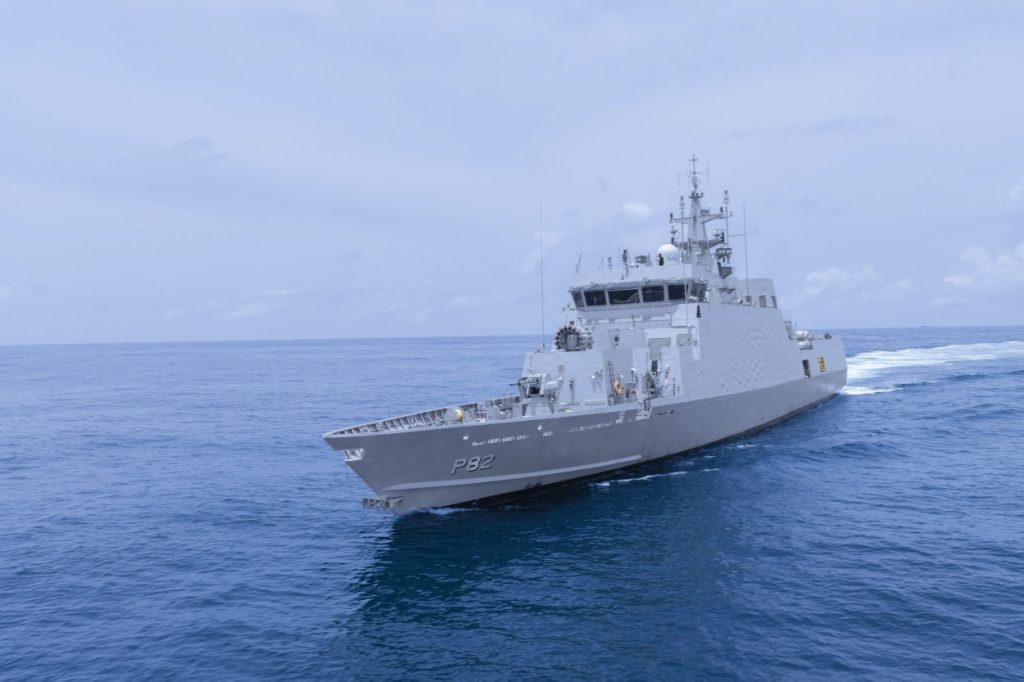
New Delhi: The Indian Navy commissioned INS Mangrol at the Naval Dockyard in Mumbai on Monday, strengthening its ability to detect and counter hostile submarines in shallow coastal waters. Built by Cochin Shipyard Limited (CSL), the vessel will help protect ports, harbours and coastal approaches where larger warships face operational constraints.
Mangrol is named after the coastal town and major fishing harbor located in the Junagadh district of Gujarat.
The flag officer commanding-in-chief of the Western Naval Command, Vice Admiral Sanjay Vatsayan, presided over the commissioning ceremony. Mangrol is the third vessel in CSL’s Mahe-class anti-submarine warfare shallow-water craft (ASW-SWC) series, following INS Mahe and INS Malvan.
The ship forms part of a wider programme to acquire 16 specialist coastal submarine hunters, with eight vessels each being built by CSL and Garden Reach Shipbuilders and Engineers (GRSE). Its designation as the third vessel refers to the Mahe class, rather than the Navy’s entire shallow-water anti-submarine fleet.
Mangrol’s equipment includes the Abhay hull-mounted sonar, lightweight torpedoes and an indigenous anti-submarine rocket launcher, providing the means to detect underwater contacts and engage hostile submarines. The ship also carries the Maareech advanced torpedo decoy system, developed by Defence Research and Development Organisation laboratories and produced by Bharat Electronics Limited, to help counter incoming torpedoes.
Powered by three diesel engines driving waterjets, the vessel is designed for high manoeuvrability in shallow and confined waters. Its additional roles include underwater surveillance, low-intensity maritime operations and mine warfare-related tasks.
The defence ministry signed the contract for CSL’s eight vessels on April 30, 2019, and Mahe, Malvan and Mangrol were launched together on November 30, 2023. As RNA Media had reported earlier, Mangrol was subsequently delivered to the Navy on August 21 this year, ahead of its formal commissioning.
With more than 80 per cent indigenous content, Mangrol reflects the growing contribution of Indian manufacturers to warship construction and the integration of weapons and sensors. The Mahe-class programme is also intended to replace the ageing Abhay-class anti-submarine corvettes, which entered service between 1989 and 1991.
Speaking at the ceremony, Vatsayan said the Navy had commissioned 10 ships in 2026, with another eight expected to enter service before the year’s end. He said the fleet comprised 131 ships and 20 submarines, while 42 ships were under construction at Indian shipyards.
The new vessel is named after Mangrol, a coastal town and fishing harbour in Gujarat’s Junagadh district. It carries forward the name of the earlier INS Mangrol, a minesweeper that served until April 7, 2004.
What are shallow-water craft and why does Navy need them?
Shallow-water craft are vessels designed to operate where limited depth and restricted manoeuvring space constrain larger ships. In this programme, they are specialized anti-submarine warships whose principal task is to search for and counter underwater threats near the coast.
A key feature is their relatively shallow draught – the vertical distance between the waterline and the bottom of the hull. CSL’s published specifications for the Mahe class give a draught of approximately 2.7 metres, a length of 78 metres, a maximum speed of 25 knots and an endurance of 1,800 nautical miles.
Their importance lies in the approaches to ports and naval bases, through which merchant vessels and warships must pass. The operational logic is to strengthen surveillance in these constrained areas, where an underwater threat could disrupt shipping or endanger vessels entering and leaving harbour.
Limited depth does not necessarily make a submarine easier to find, because underwater detection depends heavily on sound. Coastal shipping noise, seabed features and variations in temperature and salinity can complicate detection or help a submarine conceal its presence.
As Nato’s explanation of submarine hunting describes that submarines can exploit heavy maritime traffic and seabed features to mask themselves. Changes in the water’s acoustic properties also affect how sound travels, making knowledge of local conditions important to an effective search.
Sonar provides the main means of searching underwater: passive sonar listens for sounds, while active sonar transmits sound and analyses returning echoes. A detected contact must then be identified and tracked, requiring trained crews to interpret sensor information before deciding whether it represents a threat.
These craft therefore work within a wider anti-submarine network involving maritime patrol aircraft, helicopters and other warships. The defence ministry’s account of Mangrol’s role specifically envisages such cooperation, allowing different platforms to contribute to detection, tracking and engagement.
Dedicated coastal submarine hunters give the Navy more vessels suited to local depths and operating conditions, while larger warships remain available for broader fleet missions. Their value rests on combining access to shallow waters with specialist sensors, weapons and coordinated surveillance to defend India’s maritime approaches.
Therefore, INS Mangrol will strengthen the Navy’s coastal submarine-hunting fleet and add specialist protection for ports, harbours and maritime approaches.