


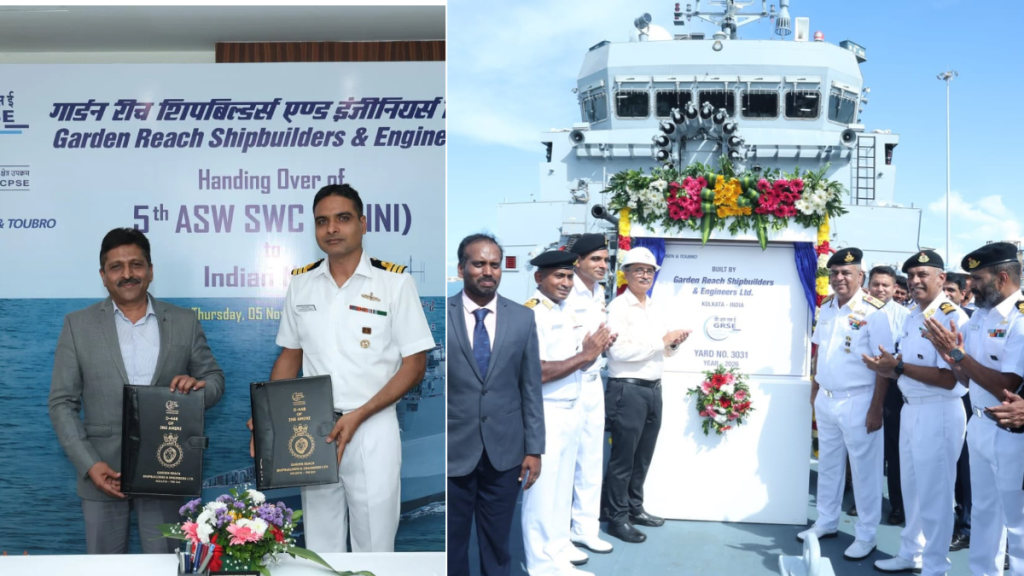
New Delhi: The Indian Navy has received INS Amini, an indigenous anti-submarine-warfare shallow-water craft (ASW-SWC), from Garden Reach Shipbuilders and Engineers (GRSE), Kolkata. The vessel was delivered at Kattupalli in Tamil Nadu on Thursday, adding a new platform to the Navy’s fleet for operations against underwater threats.
Following the delivery, the Navy described the vessel as a “Defender of the Deep” in a post on X. The post highlighted its underwater warfare capabilities and the indigenous technology incorporated into the ship. The Navy said the vessel was equipped with state-of-the-art lightweight torpedoes, indigenous rocket launchers and sonars.
Built by GRSE, INS Amini is designed to undertake antisubmarine warfare operations in shallow waters. Its sonar systems help detect and track underwater threats, while its lightweight torpedoes and rocket launchers provide the capability to engage hostile underwater targets. These systems make it a specialized platform for coastal antisubmarine operations.
The vessel has been named after Amini Island in the Union territory of Lakshadweep. It is also the reincarnation of the erstwhile INS Amini, a Petya III-class antisubmarine warfare corvette that was decommissioned in 2002. The new ship continues the Navy’s tradition of carrying forward the names of distinguished warships from its earlier fleet.
INS Amini has more than 80 per cent indigenous content, highlighting the contribution of Indian shipbuilders and domestic manufacturers to naval modernization. Its construction reflects the growing capacity of India’s defence industry to develop specialized warships and integrate locally produced equipment into naval platforms.
For the Navy, the delivery strengthens its ability to detect and respond to submarine threats in shallow-water environments. Coastal waters require specialized surveillance and antisubmarine systems, making platforms such as INS Amini important for protecting maritime approaches.
The vessel also supports the India’s Aatmanirbhar Bharat (self-reliance) initiative by strengthening India’s domestic defence manufacturing ecosystem. A higher level of indigenous content encourages local production, reduces dependence on foreign suppliers and expands the country’s capabilities in warship construction.