


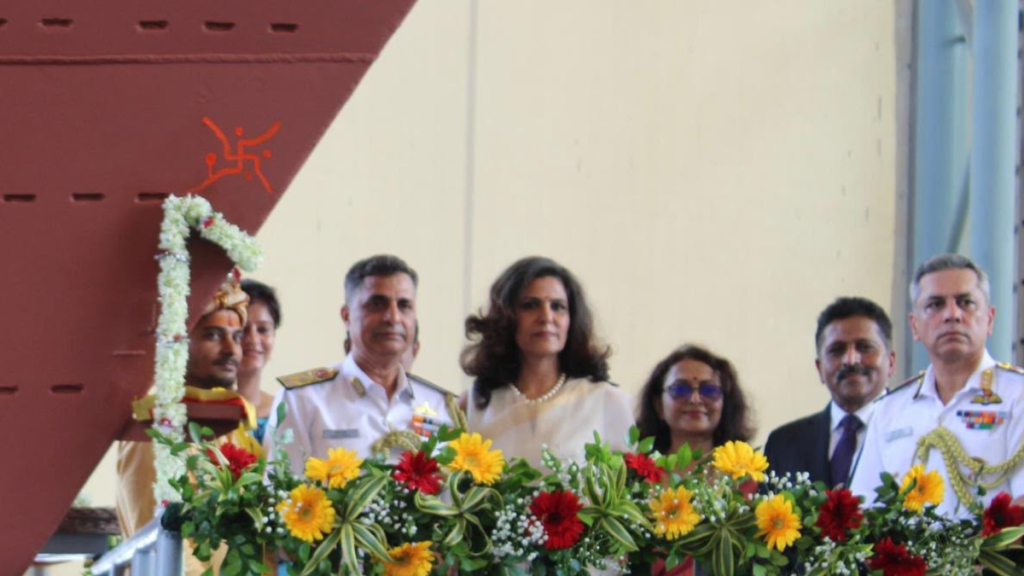
New Delhi: The Indian Navy’s next-generation offshore patrol vessel Shruti was launched at Garden Reach Shipbuilders and Engineers (GRSE) in Kolkata, on Tuesday. This marks another step in an 11-ship programme aimed at strengthening India’s maritime surveillance and long-endurance patrol capability.
Yard 3037 was launched by Manika Sadhu in the presence of Vice Admiral Sanjay Sadhu, Controller of warship production and acquisition. Senior officials from the Indian Navy, Ministry of Defence and GRSE attended the ceremony.
Shruti is the second of four next-generation offshore patrol vessels (NGOPVs) built by GRSE to be launched. The first, Sanghmitra, entered the water in May. Goa Shipyard is building seven vessels under the programme, while GRSE is constructing four.
A ₹9,781 crore programme
The ministry of defence signed contracts with Goa Shipyard and GRSE in March 2023 for 11 NGOPVs at a total cost of ₹9,781 crore under the Buy (Indian Indigenously Designed, Developed and Manufactured) category.
The new ships will augment the Navy’s existing offshore patrol vessels with larger platforms capable of remaining at sea for longer periods and undertaking a wider range of missions.
According to GRSE, the vessels are about 113 metres long and 14.6 metres wide, displace around 3,000 tonnes and can reach a top speed of 23 knots. They have an endurance of about 8,500 nautical miles at 14 knots, giving them the reach required for extended deployments.
Vice Admiral Sadhu said Shruti would have 85 per cent indigenous content when completed. He also said the Navy currently had 44 platforms on order, all being built by Indian shipyards, underlining the growing scale of domestic warship construction.
Built for wide array of missions
The NGOPVs are designed for missions ranging from maritime surveillance and protection of offshore energy installations to search and rescue, anti-piracy patrols and counter-infiltration operations.
Their four-metre draught will allow them to operate closer to the coast. GRSE says the vessels can also undertake maritime interdiction, visit, board, search and seizure operations, non-combatant evacuation, convoy protection, humanitarian assistance and disaster relief and special operations.
They can additionally provide fleet maintenance support and operate in hospital and communications-intelligence roles when required.
Money Control reported that Shruti will carry advanced sensors and weapons, including a Super Rapid Gun Mount, AK-630 close-in weapon system, stabilised remote-control guns and electronic warfare equipment. The vessel will also have facilities for helicopter operations.
Name rooted in Indian heritage
The name Shruti draws from India’s Vedic tradition. Shruti, meaning “that which is heard”, refers to the body of sacred literature that includes the four Vedas.
The ship’s crest depicts the Ursa Major constellation and a red-and-white lighthouse, continuing the design adopted for the Navy’s new patrol vessel class. The naming reflects the Navy’s practice of linking its platforms with themes from India’s history and cultural heritage.
The launch comes as the Indian Navy faces growing demands to maintain a sustained presence across vital sea lanes.
Speaking at the ceremony, Vice Admiral Sadhu referred to the impact of the US-Iran conflict on strategic chokepoints such as the Strait of Hormuz. He said the Navy would continue to help ensure the safe passage of India’s energy supplies and other essential commodities.
GRSE chairman and managing director P R Hari said the shipyard plans to deliver five warships to the Navy by the end of the current financial year and launch the remaining two NGOPVs under its four-ship order.