


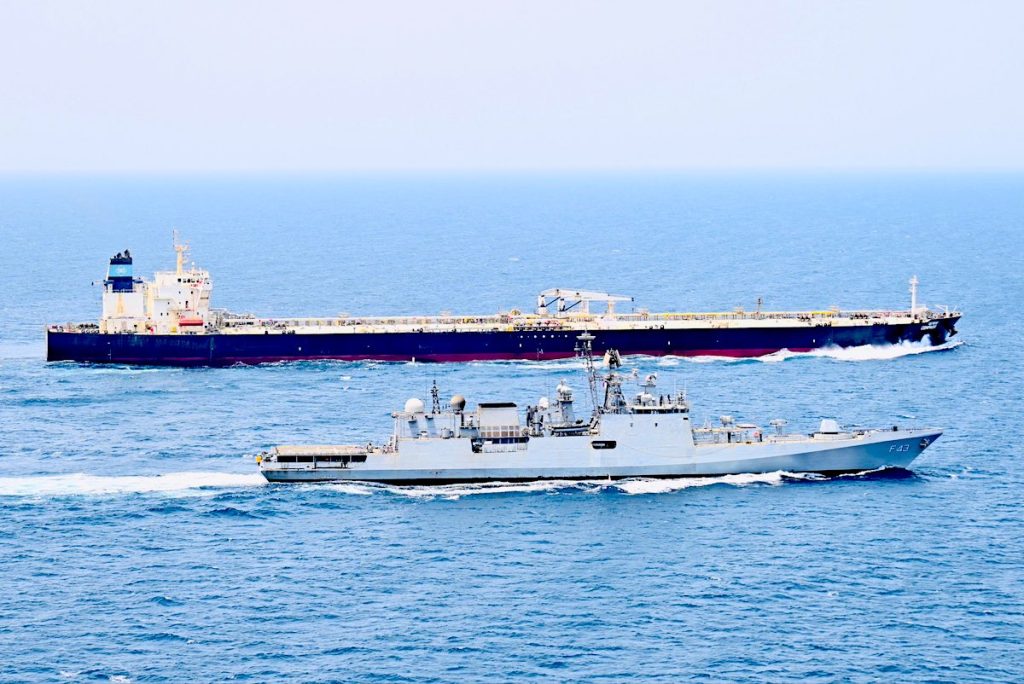
New Delhi: The Indian Navy has escorted two crude-oil tankers through the increasingly dangerous Bab-el-Mandeb Strait, deploying INS Trishul and INS Aditya to protect the merchant vessels as attacks and threats against commercial shipping intensify around Yemen. The Western Naval Command said on Monday that the warships escorted MT Compass and MT Thalatta through the high-risk waters on Sunday and Monday respectively.
According to VesselFinder, MT Compass, IMO 9422366, is an Indian-flagged crude-oil tanker, while MT Thalatta, IMO 9321720, is a Liberian-flagged Suezmax crude-oil tanker with a deadweight capacity of about 158,850 tonnes. Available vessel-tracking data show both vessels heading north towards the Suez Canal, although neither the Navy’s statement nor independently verifiable open-source shipping data examined by India Sentinels disclose their precise cargoes, loading ports or ultimate consignees.
The escorts mark a major Indian naval response to a rapidly deteriorating security environment around Bab-el-Mandeb, the narrow gateway connecting the Gulf of Aden with the Red Sea and, through the Suez Canal, the Mediterranean. Commercial traffic through the strait has fallen sharply in recent weeks as Yemen’s Iran-aligned Houthis expanded their campaign against shipping and declared what they described as a blockade of Saudi maritime exports.
Heightened immediate risk
The immediate risk was underlined only days before the Navy’s operation when the Indian-flagged MSV Faize Noore Oliya was struck by a projectile near Yemen on August 4 and subsequently sank in the Red Sea. All 14 crew members, including 13 Indians, were rescued by the Yemeni Coast Guard, while Yemen’s internationally recognized government accused the Houthis of carrying out the attack with an explosives-laden boat; the group did not comment on the allegation.
Indian interests had already been directly exposed to the crisis before that attack. In late July, the Suezmax tanker Amazon, carrying about one million barrels of Saudi crude for Indian Oil Corporation, and the Aframax tanker Rodos, carrying roughly 700,000 barrels for Mangalore Refinery and Petrochemicals Limited, switched off their Automatic Identification System transponders while exiting the Red Sea for India after Houthi threats against Saudi oil shipments.
The dangers extend beyond vessels flying the Indian flag or carrying India-bound oil, with Indian seafarers forming a sizeable part of crews aboard foreign-flagged merchant ships operating across the region. The Ministry of External Affairs said in July that Indian seafarers had suffered the highest number of fatalities among nationalities affected by attacks on commercial shipping, while New Delhi has repeatedly condemned the targeting of civilian vessels and crews.
The threat around Bab-el-Mandeb has continued to grow despite sharply reduced merchant traffic. On August 6, Reuters reported that only one vessel had crossed Bab-el-Mandeb the previous day, compared with 20 a day earlier, after the Houthis claimed missile attacks against two Saudi oil tankers – one near Yanbu in the Red Sea and another in the Gulf of Aden.
Tensions rose further over the weekend when the Houthis launched missile and drone attacks on Mocha, close to Bab-el-Mandeb, killing seven people and injuring dozens, according to Yemen’s government forces. The group also claimed a drone strike against Saudi Aramco’s Jazan refinery on the Red Sea coast, where Saudi authorities said a fire was extinguished without casualties.
The two ships and latest mission
INS Trishul is the second of the Indian Navy’s Talwar-class stealth guided-missile frigates and was commissioned on June 25, 2003. The 3,700-tonne, 125-metre warship can operate multi-role helicopters, carries a range of surface, air-defence and anti-submarine weapons and sensors, and has a top speed of about 30 knots, making it well suited to escort and maritime-security missions in contested waters.
INS Aditya, meanwhile, is a fleet replenishment and support ship whose principal role is to sustain warships at sea by providing fuel, stores and other logistical support during prolonged deployments. Its presence alongside Trishul gives the Navy a more sustainable escort package, allowing combat ships operating far from Indian bases to remain on station longer without depending on frequent port calls; Aditya has also previously operated with Indian and US Navy surface combatants during extended Indian Ocean deployments.
The latest mission also comes as India has stepped up diplomatic pressure for commercial shipping and civilian seafarers to be kept outside the expanding Middle East conflict. The external affairs minister, S Jaishankar, told his Iranian counterpart, Abbas Araghchi, on July 31 that attacks on commercial shipping and seafarers must be avoided under all circumstances, while India has repeatedly raised maritime security and the protection of crews in its exchanges with regional governments.
Those appeals have so far failed to halt attacks on merchant vessels or restore confidence in the region’s principal sea lanes, with violence continuing around both Bab-el-Mandeb and the Strait of Hormuz. If the threat persists, the escorts of Compass and Thalatta may prove less an isolated operation than an indication of a growing Indian Navy role in providing security to Indian-flagged, Indian-crewed and strategically important commercial shipping traversing the conflict-affected waters of West Asia.