


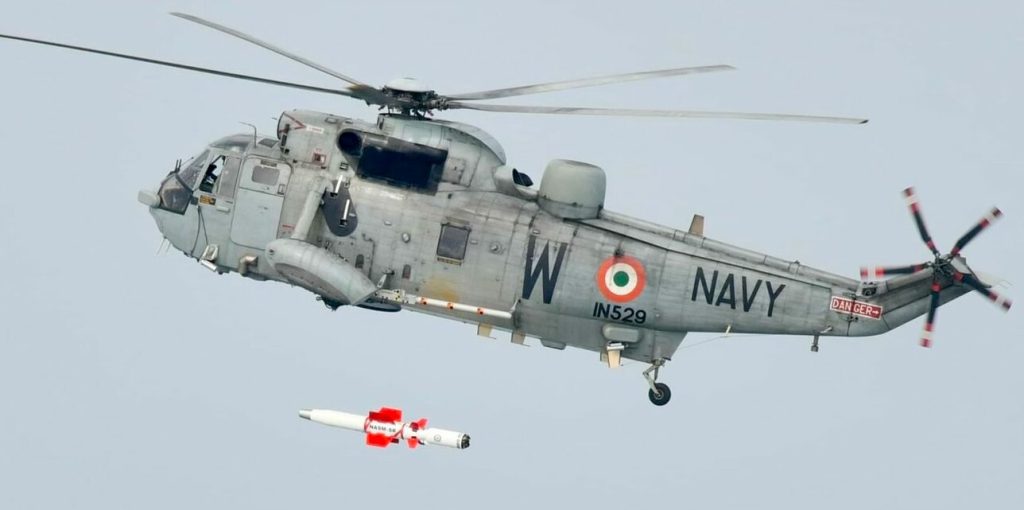
New Delhi: The Indian Navy officially decommissioned its fleet of Sea King-Mk42B helicopters and number-plated the Indian Naval Air Squadron 330, known as the “Harpoons”, on Monday. The retirement marks the end of a 36-year operational chapter for the anti-submarine warfare helicopters, which were widely regarded as the backbone of India’s maritime strike capability.
The Sea King helicopters have been in service with the Indian Navy for 55 years, dating back to the commissioning of the first Sea King-Mk42 variant in 1971. However, the specific Sea King-Mk42B variant – also known as the “Bravo” fleet – was inducted between 1989 and 1990.
A final ceremonial flight took place at INS Shikra, the Western Naval Command’s air station in Mumbai, bringing the squadron’s illustrious journey to a close. The INAS 330 was originally commissioned on April 17, 1971, under the command of Commander MP Wadhawan, and it went on to become one of the most decorated units in the Navy, earning 22 Nausena Medals.
The retirement of the Mk42B fleet clears the deck for the Navy’s transition to the American-made Sikorsky MH-60R Seahawk “Romeo” helicopters, a $2.12 billion procurement designed to modernize the service’s rotary-wing fleet. India ordered 24 of these advanced multi-mission helicopters in 2020 to replace the ageing Sea Kings, which had increasingly become difficult to maintain due to spare-part shortages.
While the Mk 42B “Bravo” variants have been stood down, the Sea King’s run in India is not entirely over. One active squadron, INAS 350, nicknamed the “Saaras”, continues to operate the Sea King-Mk42C variant from INS Dega in Visakhapatnam. The “Saaras” squadron, which recently phased out its UH-3H helicopters, absorbed the Mk42C fleet previously stationed with the Marine Commando Flight in Mumbai. These remaining helicopters will continue to execute search and rescue, humanitarian assistance, and special operations missions.
The phase-out of the INAS 330 squadron is a strategic realignment for the Navy as it inducts platforms capable of handling modern underwater threats. The incoming MH-60R helicopters bring advanced dipping sonar, Hellfire air-to-surface missiles, and Mark 54 anti-submarine torpedoes, alongside enhanced data links for network-centric operations. While the new Romeos represent a significant technological leap over the legacy systems, naval aviation officials noted that the Sea King Mk 42B leaves behind an unparalleled operational record that will be difficult to match.
‘Flying Frigates’ – Legacy of Sea King
For more than five decades, the Westland Sea King has been the undisputed sentinel of the Indian Ocean, a rotary-wing powerhouse that fundamentally shaped the operational doctrine of the Indian Navy. Originally acquired from the United Kingdom to counter the growing threat of modern submarines, the Sea King evolved from a basic maritime utility aircraft into a formidable hunter-killer platform.
The story of the Sea King in India began on April 17, 1971, with the commissioning of INAS 330, the “Harpoons”, at INS Garuda in Kochi. The squadron received its baptism by fire almost immediately during the 1971 Indo-Pakistani War. On July 26, 1971, a Sea King became the first multi-role helicopter to land on the aircraft carrier INS Vikrant. By November 1971, the Harpoons were conducting extensive anti-submarine warfare patrols, clocking over 156 hours of combat effort and successfully executing vectored attacks against suspected enemy submarine contacts.
While the early variants established the foundation, it was the induction of the Sea King-Mk42B in the late 1980s that truly revolutionized the Navy’s aviation capabilities. Procured between 1989 and 1990, the ‘Bravo’ fleet was heavily customized for Indian requirements.
These helicopters were affectionately dubbed the “Flying Frigates” because they could perform almost every mission expected of a frontline warship. Equipped with advanced dipping sonar, sonobuoy dispensers, and Sea Eagle anti-ship missiles, the Mk42B was designed to track hostile submarines and engage surface targets independently. The helicopter’s payload could also include Whitehead A244S torpedoes and Mk11 depth charges, making it a lethal asset during maritime patrols.
The Sea King-Mk42B was not just a weapon of war; it was a critical instrument for humanitarian assistance and disaster relief as well. The versatility of the platform allowed it to seamlessly transition from combat patrols to search-and-rescue operations.
One of its most memorable deployments occurred during the devastating 2018 Kerala floods, where Captain P Rajkumar executed a daring rescue mission. Battling poor visibility, torrential rain, and dangerous obstacles, he manoeuvred his Sea King-Mk42B to airlift 26 stranded civilians in a single sortie – a feat that earned him the Shaurya Chakra.
Beyond domestic shores, the Sea King proved its mettle in complex regional deployments. The helicopters played a pivotal role in Operation Pawan in Sri Lanka, providing essential surveillance, combat patrol, and logistical support for Indian forces. Whether operating from the decks of INS Viraat, Godavari-class frigates, or Brahmaputra-class warships, the Sea King-Mk42B consistently extended the tactical reach of the fleet across the Indo-Pacific.
As the Bravo fleet bows out to make way for the MH-60R Romeos, the Sea King’s silhouette will not disappear from Indian skies just yet. As mentioned earlier, the INAS 350 Saaras squadron at INS Dega will continue to fly the Sea King-Mk42C variant. Transferred from the Marine Commando Flight, these remaining helicopters are optimized for special operations and will sustain the Navy’s search-and-rescue mandate.
The retirement of the INAS 330 Sea King-Mk42B fleet marks the closure of an era characterized by exceptional professionalism, resilience, and operational brilliance. As the Indian Navy embraces the future with advanced network-centric platforms, the legacy of the “Flying Frigates” remains deeply etched in the service’s history. The Sea King did not just serve the fleet; for 55 years, it was the undisputed king of the maritime domain.