


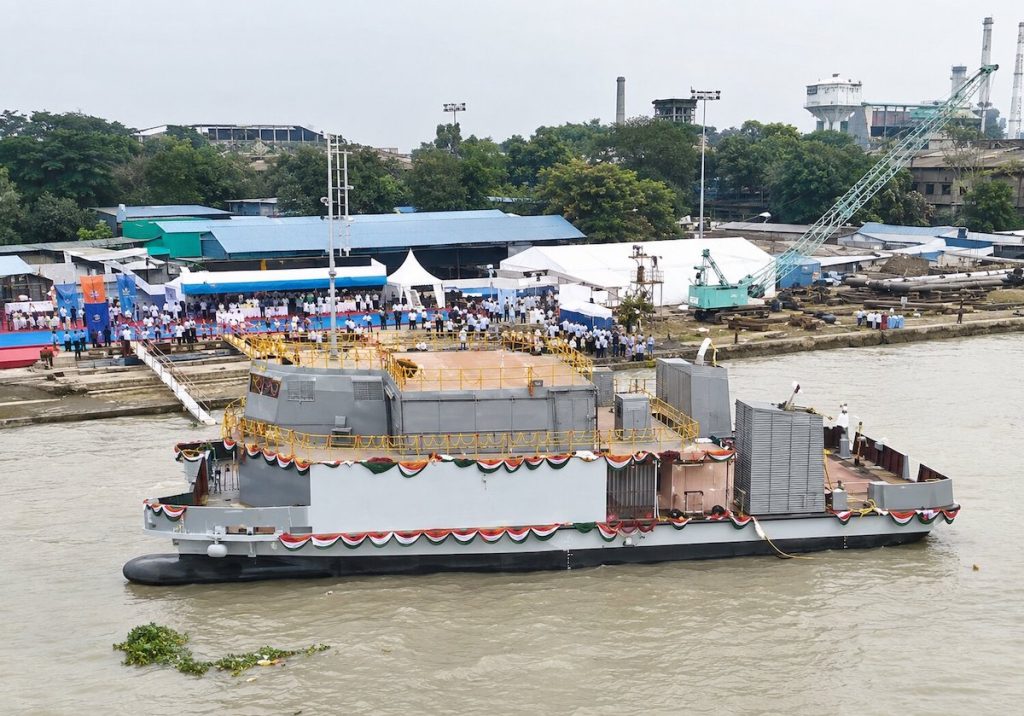
New Delhi: The Indian Navy has launched DSC A24, the fifth and final vessel of its diving support craft (DSC) project, at Titagarh Rail Systems Limited’s Kolkata facility on Saturday. The launch closes out a five-ship indigenous shipbuilding programme that began more than five years ago and adds another vessel to the Navy’s underwater operations fleet.
The catamaran-hulled craft was side-launched into the Hooghly river at 3.05pm, according to the shipbuilder. Kamal Singh, wife of the chief of personnel, Vice Admiral Gurcharan Singh, performed the traditional naming ceremony, with senior naval officers and company representatives in attendance.
DSC A24 displaces between 300 and 400 tonnes and has been built to the naval rules and regulations of the Indian Register of Shipping. Its twin-hull design, similar to that of its four sister vessels, gives it greater stability, more deck space and better sea-keeping characteristics than a conventional single-hull craft of comparable size – qualities the Navy considers essential for sustained diving operations in coastal and harbour waters.
The vessel carries what the shipbuilder describes as state-of-the-art diving systems, purpose-built for operational dives rather than merely training exercises. Titagarh Naval Systems, the subsidiary of Titagarh Rail Systems that executed the contract, has said the ship’s indigenous content runs to roughly 70 per cent, a figure the company has cited as evidence of the depth its supply chain has reached under the Make in India programme.
The Diving Support Craft project traces back to a contract signed between the ministry of defence and the then Titagarh Wagons Limited on February 12, 2021. The first vessel, A20, was launched at the same Kolkata yard on August 31, 2023, followed by A21 and A22 – the latter’s keel laid in August 2022 and eventually launched in September 2025 – and then A23 in April this year. With A24 now in the water, the entire five-ship order has moved from contract to completion within roughly five and a half years, a reasonably quick turnaround by the standards of Indian naval shipbuilding.
Design work on the class involved hydrodynamic assessments and model testing at the Naval Science and Technological Laboratory in Visakhapatnam, ensuring the hull form met naval performance requirements before construction began. Each craft measures around 30 metres in length, sized deliberately for manoeuvrability in confined harbour environments as well as open coastal waters.
The five vessels will be distributed across the Navy’s diving units, where they are expected to support salvage operations, underwater repairs, mine countermeasures training and general diving support duties that were previously carried out with older, less capable platforms. For a Navy expanding both its submarine fleet and its underwater warfare capabilities, dedicated diving support tonnage of this kind fills a gap that is often overlooked in discussions dominated by frigates, destroyers and submarines.
The launch comes at a time when the Navy has also been refreshing its shore establishments. Vice Admiral Alok Ananda recently took over as the 13th commandant of the Indian Naval Academy in Ezhimala, succeeding Vice Admiral Manish Chadha, in a change that – while unrelated to the DSC programme – underscores the broader personnel movements under way within the service this year.
For Titagarh Rail Systems, the completion of the DSC order also serves as a marker of its growing standing among private shipbuilders working with the Navy. The company’s naval systems arm has increasingly positioned itself alongside established public-sector yards, and the successful delivery of all five DSC on a private production line is likely to strengthen its case for future defence shipbuilding contracts.