


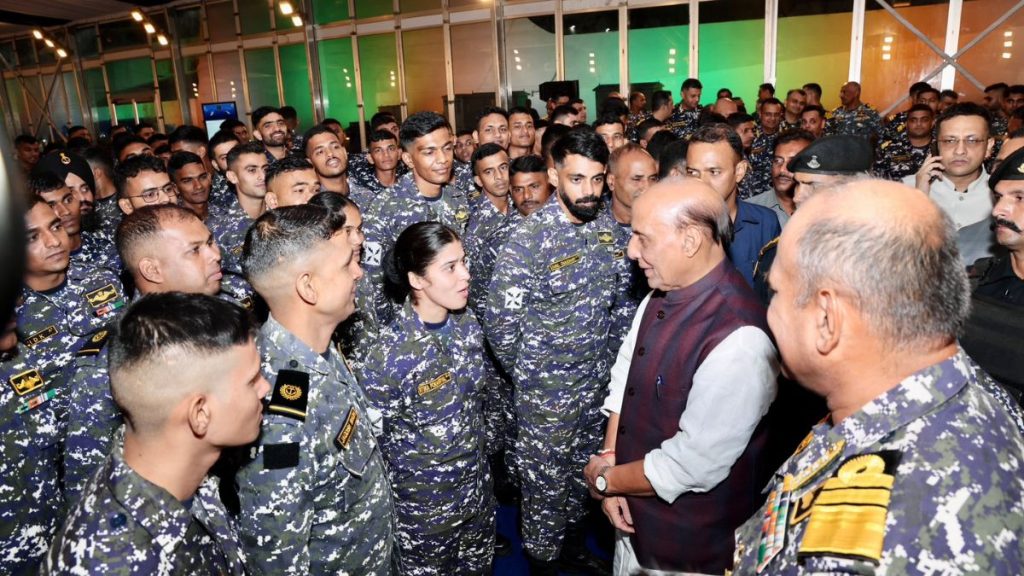
New Delhi: The defence minister, Rajnath Singh, on Monday described the Indian Navy as one of the world’s most powerful navies and said its presence was being strongly felt across the Indo-Pacific, while warning that the challenges confronting India in the 21st century were becoming more difficult. Addressing naval personnel at a “bada khana” (grand feast) at the naval dockyard in Visakhapatnam, he called for sustained preparedness and continued adaptation of the force’s capabilities to changing security circumstances.
“Thanks to your valour, our Navy is counted among the most powerful navies in the world,” Singh said, adding that the force was making its presence felt across the Indo-Pacific. He said the Navy had consistently fulfilled its responsibilities whenever India or the wider international community required it.
“I am also proud that whenever the country and the world have needed it, our Navy has always performed its duty. The waves of the sea never ask what the weather is like today, they simply continue doing their work. In the same way, our soldiers never ask what the challenge is or how difficult it is,they continue doing their duty,” Singh said.
“Their responsibility is only that our maritime borders must remain secure, and the honour of the tricolour must be upheld across the world,” he added.
Addressing personnel and their families, Singh said: “When a sailor protects the country at sea, their family takes on a different front at home. As defence minister, I have not come here merely for a ceremonial visit. I have come to say that your defence minister, has been with you and will continue to stand shoulder to shoulder with you.”
He also cautioned personnel about the demands ahead.
“The present era is filled with serious challenges. Challenges we are facing in the 21st century today are more difficult than before,” Singh said.
Growing reach, changing capability
Singh said the Navy had adapted to changing circumstances and pointed to indigenous aircraft carriers, nuclear-powered submarines, stealth frigates, Scorpene-class submarines and modern weapons as evidence of its evolving capability profile.
Referring to the Navy’s record during the 1971 war, he recalled Operation Trident, the Indian naval attack on Karachi harbour.
“During Operation Trident, when the Indian Navy attacked the Karachi port, the world was left stunned. You proved that the Indian Navy does not merely defend the seas; it also has the capability to strike the enemy in their own territory,” Singh said.
His remarks came days after the September 29–October 1 naval commanders’ conference reviewed the Navy’s operational and materiel preparedness amid rapid technological change. The conference placed emphasis on maritime surveillance, artificial intelligence, big data, autonomous and uncrewed systems, cyber operations, logistics, jointness, technology absorption and indigenization.
At the conference, Singh had also pointed to Indian warship deployments in the South China Sea, Mediterranean and Atlantic as evidence of the Navy’s growing blue-water capability. He said recently commissioned warships contained more than 75 per cent indigenous content.
Sea as security and prosperity
Singh’s Visakhapatnam remarks also placed maritime power within a broader economic and strategic framework. He called for a philosophy of “advancing prosperity and power through the sea”, arguing that the maritime domain should be viewed not only as an arena of national security but also as a pathway to development and economic opportunity.
That approach also reflects the Navy’s emphasis on protecting sea lanes and energy security. At the naval commanders’ conference, Singh highlighted Operation Urja Suraksha and the safe transit of Indian-flagged merchant vessels through the Strait of Hormuz.
The chief of the naval staff, Admiral Krishna Swaminathan, and the flag officer commanding in chief (FOC-in-C) of Eastern Naval Command, Vice Admiral Sanjay Bhalla, were present at the Visakhapatnam event.
Singh’s broader message was that the Navy’s growing reach and indigenous capabilities must be matched by sustained preparedness for an increasingly complex maritime environment, while the sea is viewed as a source of security, prosperity and strategic power.