


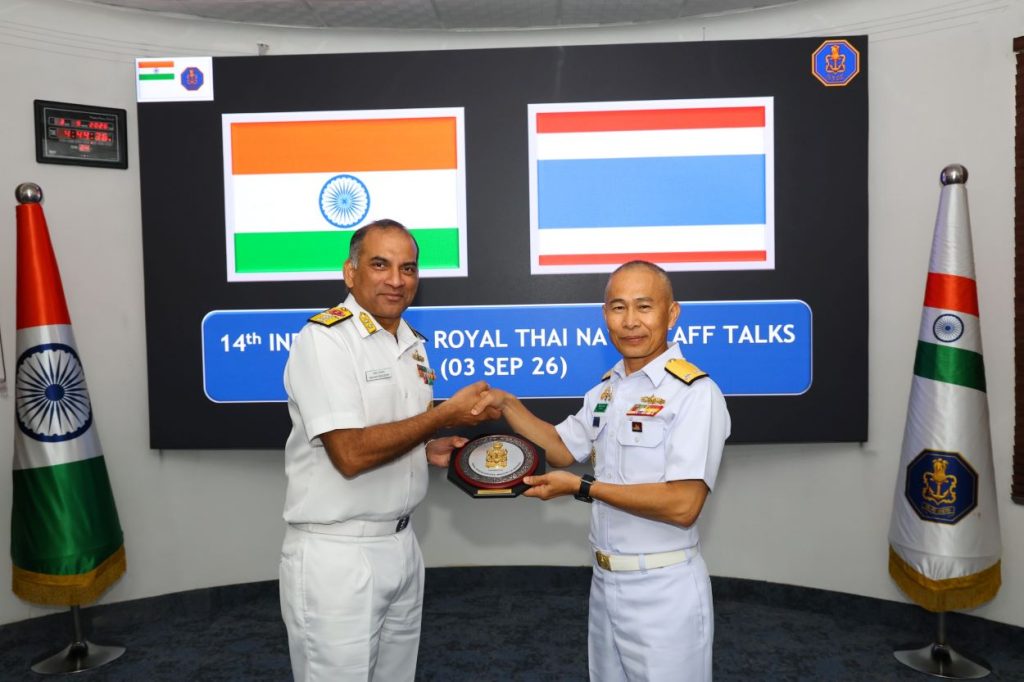
New Delhi: The Indian Navy and the Royal Thai Navy have concluded their 14th staff talks in New Delhi, seeking to expand operational cooperation, professional training and capacity-building between the two maritime forces. The dialogue, held on Thursday, also identified additional areas in which the navies could work together, the Indian Navy said.
The discussions were co-chaired by Rear Admiral Sachin R Sequeira, the Indian Navy’s assistant chief of the naval staff for foreign cooperation and intelligence, and Rear Admiral Chaksawat Saiwong, director of the office of policy and planning in the Royal Thai Navy’s naval operations department. The two delegations reviewed the foundations of their bilateral engagement and reaffirmed their commitment to maintaining regular institutional and operational exchanges.
Although the Navy did not disclose the specific proposals considered at the meeting, staff talks typically provide a mechanism for reviewing joint activities, planning future interactions and addressing matters related to training, information-sharing and maritime security. The latest dialogue assumes importance as India and Thailand seek to translate their wider strategic partnership into stronger cooperation between their armed forces.
The two countries elevated their relationship to a strategic partnership during the visit of the prime minister, Narendra Modi, to Bangkok in April 2025. Their joint declaration called for deeper defence and security cooperation, including through military exchanges, joint exercises, training, defence-industry collaboration and coordinated responses to traditional and non-traditional security challenges.
Naval cooperation has emerged as a particularly important element because India and Thailand are maritime neighbours connected through the Andaman Sea, close to the western approaches to the Strait of Malacca. The waters carry a substantial share of global commerce and face challenges ranging from piracy, trafficking and illegal fishing to natural disasters and other maritime emergencies.
The two navies have conducted coordinated patrols along their international maritime boundary since 2005, helping to strengthen surveillance and promote adherence to international maritime law. The 40th India-Thailand Coordinated Patrol concluded in November 2025, demonstrating the continuity of a mechanism designed to improve information exchange, curb unlawful activity and protect shipping.
Operational engagement received a further boost in December 2023 when the two forces conducted their first bilateral maritime exercise alongside the 36th coordinated patrol. That exercise included tactical manoeuvres, surface and anti-air drills, weapon firings and seamanship evolutions, marking a shift from parallel patrolling towards more complex operational coordination.
The staff-level dialogue also complements India’s broader engagement with Thailand through the Association of Southeast Asian Nations and New Delhi’s Act East policy. For India, cooperation with the Royal Thai Navy supports maritime awareness around the Andaman and Nicobar Islands and reinforces partnerships near a critical passage linking the Indian and Pacific oceans.
The latest talks indicate that both navies intend to build on this established framework rather than limit the relationship to occasional port calls or ceremonial exchanges. Expanded training, capacity-building and operational collaboration could enable them to respond more effectively to maritime crime, search-and-rescue contingencies and humanitarian emergencies across their adjoining waters.