


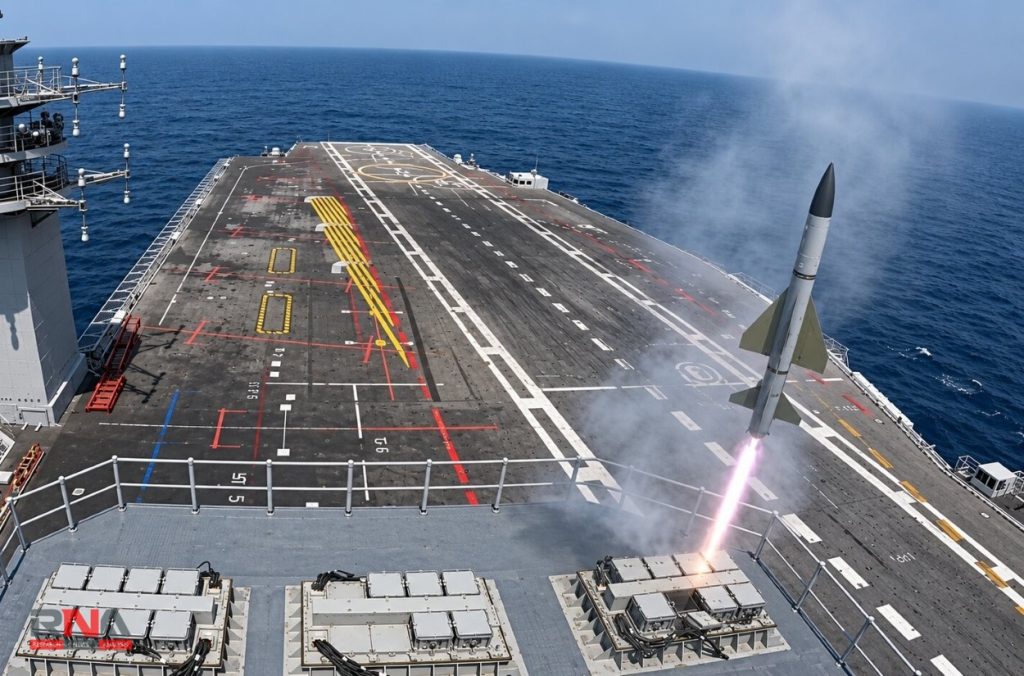
New Delhi: India has signed a ₹1,976.40 crore contract with Israel Aerospace Industries (IAI) to modernize the Barak-1 point-defence missile systems fitted aboard Indian Navy warships, strengthening their ability to counter hostile aircraft and incoming anti-ship missiles. The agreement covers extensive hardware and software upgrades as well as the replacement of ageing components, allowing the Navy to maintain the operational effectiveness of its existing shipborne air-defence systems.
The contract was signed in New Delhi on Wednesday in the presence of the defence secretary, Rajesh Kumar Singh, under the “Other Capital Procurement Procedure”. According to the defence ministry, the modernization programme is intended to improve the system’s capabilities and engagement range, although it has not disclosed the technical specifications of the upgrades or their implementation schedule.
The agreement follows the Defence Acquisition Council’s approval of the Barak-1 modernization proposal on August 5, 2025, as part of a broader package of defence acquisitions valued at approximately ₹67,000 crore. The package also included proposals for BrahMos missile fire-control systems and launchers, compact autonomous surface vessels and other equipment intended to strengthen the armed forces’ operational capabilities.
Developed in Israel, the Barak-1 is a short-range, vertically launched surface-to-air missile system designed to protect warships against aircraft, anti-ship missiles and other aerial threats. Unlike longer-range naval air-defence systems that can protect several vessels within a formation, the Barak-1 primarily provides point defence – the final missile-based protective layer around an individual ship.
The existing Barak-1 missile has a reported engagement range of approximately 12 kilometres and can intercept low-flying threats, including anti-ship missiles approaching close to the sea surface. Its compact vertical-launch arrangement allows warships to deploy the missiles without having to turn a launcher towards an incoming target, providing rapid defensive responses against threats approaching from different directions.
The Israeli system has been an important component of the Navy’s air-defence architecture for more than two decades, having been acquired to address vulnerabilities in the protection of frontline warships against airborne attacks. It is deployed on several naval platforms, including Shivalik-class frigates and the aircraft carrier INS Vikramaditya, where it supplements other defensive weapons and sensors.
The latest agreement is particularly significant because ageing electronic components and declining availability of replacement parts can affect the long-term serviceability of complex missile systems. By replacing obsolete hardware and updating software, the Navy can extend the operational usefulness of its existing equipment without immediately undertaking the more expensive and technically demanding process of replacing entire weapon installations.
However, the defence ministry has not specified which warships will undergo the upgrades, how many Barak-1 installations are covered or whether the agreement includes modifications to the missiles themselves. It has also not clarified whether the improvements will significantly increase interception range or primarily enhance the reliability, processing capabilities and maintainability of the existing systems.
Indigenous replacement under development
The Barak-1 modernization comes as India continues developing an indigenous alternative through the Defence Research and Development Organisation’s (DRDO) vertical launch short-range surface-to-air missile (VL-SRSAM) programme. Designed specifically for shipborne applications, the new weapon is intended to intercept aircraft, helicopters, unmanned aerial vehicles and low-flying anti-ship missiles, potentially replacing the Israeli-origin Barak-1 on Indian warships in the future.
The indigenous missile underwent a successful flight trial on March 26, 2025, when it intercepted a high-speed aerial target at very close range and low altitude during a test at Chandipur in Odisha. The demonstration validated its ability to perform the rapid manoeuvres needed to engage threats approaching a ship at short distances, an essential requirement for modern naval point-defence weapons.
Defence industry assessments suggest that the VL-SRSAM could eventually offer a considerably greater engagement envelope than the original Barak-1, although its operational performance will depend on further testing, integration and induction. The continued investment in the Israeli system therefore indicates that the Navy intends to sustain its existing defensive capabilities during the transition towards newer, indigenously developed weapons.
India and Israel also maintain a substantial defence partnership in longer-range naval missile systems, notably through their collaboration on the Barak-8, which forms the basis of the long-range surface-to-air missile system used aboard several Indian warships. Unlike the Barak-1, which is primarily intended for close-in protection, the Barak-8 provides a wider defensive envelope against aerial threats and forms part of the Navy’s layered air-defence architecture.
The ₹1,976.40 crore agreement reflects the Navy’s need to balance the modernization of its existing weapons with the gradual introduction of new-generation systems. It also underlines the continuing importance of India’s defence relationship with Israel, even as New Delhi seeks to increase indigenous production and reduce dependence on foreign suppliers for critical military technologies.