


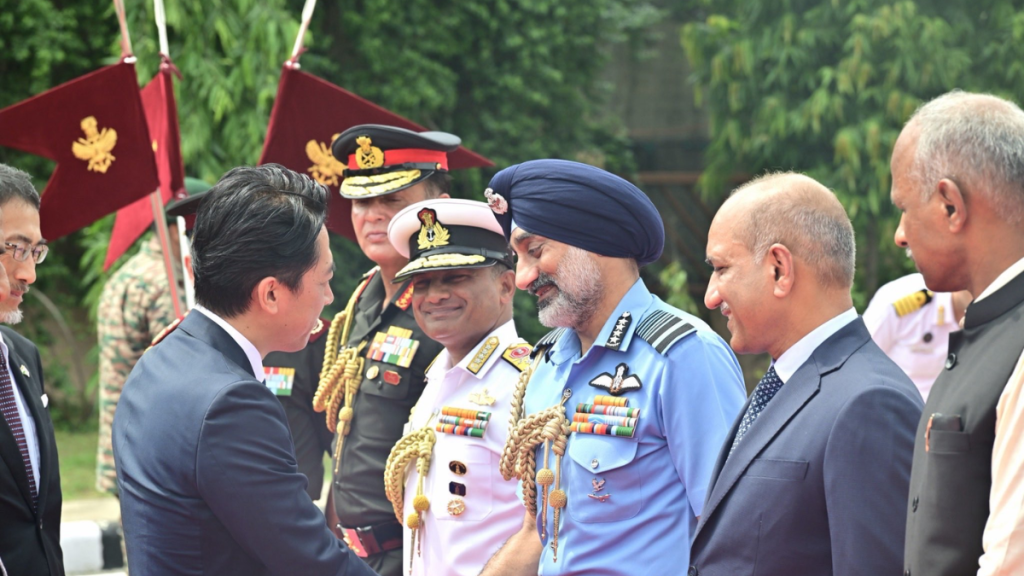
New Delhi: India and Japan moved to widen their defence partnership at sea, with the two countries agreeing to closer naval coordination, greater access to repair facilities and possible collaboration in designing and building warships. The push comes as both sides seek to strengthen their ability to operate together across the Indo-Pacific.
The decisions were taken during talks between defence minister, Rajnath Singh, and his Japanese counterpart, Shinjiro Koizumi, in New Delhi. Japan’s Ministry of Defense said the two ministers signed an MOA on maritime security cooperation and reaffirmed their commitment to further deepening defence cooperation to realise a Free and Open Indo-Pacific.
The agreement will facilitate cooperation in areas such as maritime domain awareness, search and rescue missions and disaster-relief operations. India and Japan will also look at improving naval coordination through port visits, joint drills, personnel exchanges and logistical support.
A key area of the discussions was defence shipbuilding. The two countries agreed to examine joint development opportunities in naval ship design and construction, bringing together Japan’s technological capabilities and India’s manufacturing capacity. Tokyo’s use of Indian production facilities under the Make in India initiative will also be discussed further.
The two sides are also working towards reciprocal use of ship repair infrastructure, with an arrangement on ship repairs expected to be concluded soon. India and Japan additionally agreed to strengthen their mine countermeasure capabilities.
Unicorn project becomes defence-technology focus
Defence technology emerged as another major area of cooperation during the talks, with Singh welcoming Japan’s revised framework for transferring defence equipment and technology. Both ministers highlighted the Unicorn integrated communications antenna system being developed for Indian warships as an important project in bilateral defence ties.
The system is the first defence equipment transfer project between the two countries, and both sides said they would work towards its early implementation.
The two governments will also push discussions on additional equipment and technology requirements and strengthen collaboration between the DRDO and Japan’s ATLA in advanced defence research. A Defence Industry Forum is also planned to bring the two countries’ defence sectors closer.
Japanese fighter aircraft to join India exercise
Military cooperation between the two countries is also set for a significant expansion with Japanese fighter aircraft preparing to come to India for Veer Guardian 26 later this year. It will mark the first time that Japan’s Air Self-Defence Force fighter jets participate in the bilateral air exercise in India.
The two sides agreed that future military exercises should involve more complex scenarios, greater use of unmanned platforms and, where feasible, short-notice drills. Cooperation between the two countries’ Special Operations Forces will also be expanded.
India, Japan broaden Indo-Pacific coordination
Beyond their bilateral military relationship, India and Japan agreed to step up cooperation involving other regional partners. The ministers welcomed the India-Japan-Indonesia naval Passex conducted in February and backed more such initiatives involving third countries.
The countries will also advance cooperation under the Indo-Pacific Logistics Network, which is aimed at enabling faster movement of personnel and supplies during natural disasters. Japan is scheduled to host the second tabletop exercise under the initiative in September.
New Delhi and Tokyo will also speed up preparations for their fourth Foreign and Defence Ministerial Meeting, or 2+2 dialogue, in Tokyo later this year. The two sides reiterated their opposition to attempts to alter the status quo through force or coercion and stressed the importance of maintaining freedom and safety of navigation and overflight.
To ensure that the growing list of initiatives translates into action, India and Japan will establish a Working Group led by senior officials to coordinate cooperation covering operations, intelligence, defence equipment, technology and industry.
Koizumi’s India visit also included a tribute to Indian soldiers at the National War Memorial in New Delhi. He later travelled to Mumbai, where he visited the Western Naval Command and INS Chennai.