


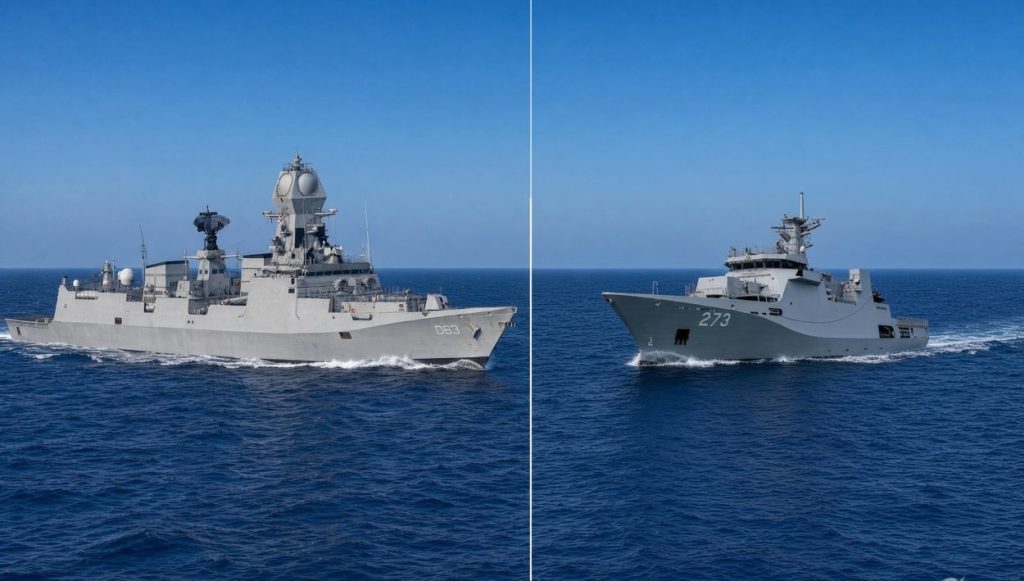
New Delhi: An Indian Navy warship and a Pakistan Navy corvette collided in international waters of the north Arabian Sea on Tuesday evening, in an incident that has since drawn a strong diplomatic protest from New Delhi. The collision, roughly 220 kilometres east of Oman, took place while the Indian warship was on a routine surveillance patrol and the Pakistani vessel closed in at high speed, according to Indian defence sources.
The Indian Navy unit involved has not been officially named by the government, though several defence-focused publications have identified it as INS Kolkata, a Kolkata-class guided-missile destroyer. The Pakistani vessel has been identified as PNS Hunain, a Yarmook-class corvette built at the Damen shipyard in Romania and commissioned into the country’s navy only in July 2024.
According to Indian government sources, the Pakistani ship manoeuvred in an unsafe and unprofessional manner before the two vessels made contact. No major damage was caused to the Indian warship, the external affairs ministry has said, though reports citing Pakistani sources indicate that PNS Hunain sustained considerably more serious damage and has since returned to harbour for repairs.
On Wednesday, New Delhi responded by summoning Pakistan’s chargé d’affaires in New Delhi, Saad Ahmad Warraich, to the External Affairs Ministry and lodged a formal protest, describing the conduct of the Pakistani naval unit as “unacceptable and unprofessional”. The MEA said the incident was in direct contravention of Article 10 of the 1991 India-Pakistan agreement on advance notice of military exercises, manoeuvres, and troop movements, which requires warships from either side to maintain a minimum separation of three nautical miles in international waters.
Meanwhile, India’s chargé d’affaires in Islamabad was simultaneously instructed to lodge an identical protest with Pakistan’s foreign ministry – calibrated two-capital approach that placed the episode formally on record in both directions. Neither government has released video, photographs or (AIS) automatic identification system data that would allow the sequence of events to be independently verified.
Pakistan’s foreign office has offered a starkly different account. It has said its navy was conducting the Sea Spark-26 exercise within its own exclusive economic zone since September 1, and that an Indian warship, along with its embarked helicopter, had repeatedly attempted to enter the exercise area since September 7. Islamabad claims INS Kolkata changed course on September 15 (Tuesday) and struck PNS Hunain despite the Pakistani ship’s efforts to avoid contact, after which the Indian vessel increased speed and left the area.
Pakistan has described the Indian warship’s conduct as “highly provocative” and warned that it could have triggered a serious crisis. It has credited its own navy’s “professional and responsible conduct” with preventing further escalation, while calling on India to honour bilateral agreements and exercise restraint at sea. India has not commented publicly on Pakistan’s version of events, and the two accounts remain irreconcilable pending any independent inquiry.
The collision comes at a moment of unusual sensitivity in the bilateral relationship. India and Pakistan have not exchanged ambassadors since ties were downgraded in 2019, leaving charges d’affaires to carry the weight of crisis communication on both sides. Coming so soon after Operation Sindoor and the four-day conflict of May 2025, even a routine maritime mishap now carries the potential to be read as something considerably graver.
How Indian warship avoided a far worse outcome
What has drawn particular attention within India’s strategic community is not the collision itself but what did not follow it. Sources familiar with the incident have said that even under what they described as extreme provocation from the Pakistani side, the commanding officer of the Indian warship exercised considerable restraint, taking deliberate action to prevent a far more serious accident – one that could have resulted in significant loss of life and material damage.
This is a point worth dwelling on. PNS Hunain, at roughly 2,600 tonnes, is a considerably smaller and less capable platform than the Indian destroyer it collided with – a corvette-sized offshore patrol vessel built primarily for coastal defence, maritime security, and search-and-rescue work, rather than for high-intensity naval combat. India’s frontline destroyers, by contrast, are among the most heavily armed surface combatants in the Indian Ocean region, equipped with long-range surface-to-air and anti-ship missiles and layered defensive systems.
Had the Indian commander chosen to respond in kind to what New Delhi has called provocative manoeuvring, the disparity in size and firepower between the two vessels meant the potential for serious harm to the smaller Pakistani ship and its crew was considerable. That did not happen.
Instead, by all accounts, the Indian side prioritized de-escalation over retaliation, absorbing the contact and withdrawing rather than compounding the danger. Analysts have noted that this reflects a wider principle of professional naval conduct: the true measure of a warship’s captain lies not in a willingness to accept risk, which is common enough in close-quarters manoeuvring, but in the judgement of which risks are worth taking at all. In this instance, sound judgement appears to have prevailed over the temptation to escalate.
Former security officials have echoed this reading. Retired police and defence commentators have pointed out that the episode could easily have become “a major tragedy” given the proximity and speed involved, and that the absence of serious injury or loss of life owes something to the discipline shown aboard the Indian vessel. That discipline, rather than any dramatic show of force, is what New Delhi appears keen to project in the aftermath – a Navy confident enough in its superiority not to need to prove it at the cost of an unnecessary escalation.
For now, the diplomatic protest lodged by India, alongside its call for Pakistan to prevent any repetition, is likely to remain the primary instrument of response. Whether Islamabad’s counternarrative gains traction, or whether the episode fades as an isolated maritime incident, will depend considerably on what, if anything, emerges from either side in the way of verifiable evidence in the coming days.
[This article was updated at 9.01am, Thursday, September 17, 2026.]