


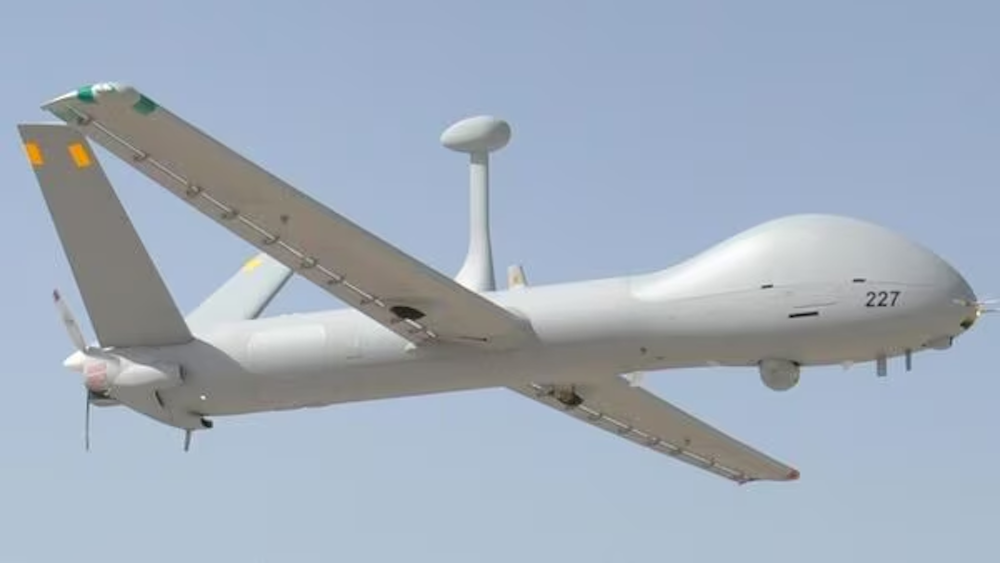
New Delhi: The Indian Navy on Wednesday said that one of its Drishti-10 Uncrewed Aerial Vehicle (UAV) crashed into the sea off Porbandar airfield in Gujarat while conducting a training sortie earlier in the day. In a statement, the Navy said no injuries or loss of life had been reported on the ground, and that the cause of the crash is currently under investigation.
The Drishti-10, built by Adani Defence and Aerospace and also known as the Hermes 900, is an Indian-assembled variant of the Israeli-designed platform used by the Navy for maritime surveillance and reconnaissance.
This is not the first such incident involving the type. A Drishti-10 Starliner drone went down near the Porbandar coast in January 2025 during acceptance trials ahead of its delivery to the Navy, after reportedly losing command mid-flight. Porbandar has served as a key operating base for the platform, with the Navy having steadily expanded its fleet of these drones in recent years to strengthen round-the-clock sea surveillance.
Further details on the circumstances of Wednesday’s crash are awaited pending the outcome of the Navy’s inquiry.
The Drishti-10 is a medium altitude long endurance (MALE) UAV, meaning it’s designed to fly at moderate altitudes (up to around 30,000 feet) for extended periods, with an endurance of roughly 30–36 hours per sortie. It is the Indian-assembled variant of the Israeli Elbit Systems Hermes 900, built by Adani Defence & Aerospace at its Hyderabad facility in partnership with Elbit.
Designed primarily for intelligence, surveillance and reconnaissance (ISR) missions, it carries payloads such as electro-optical/infrared sensors and synthetic-aperture radar, and is used by the Indian Navy for maritime surveillance, helping ease the burden on manned aircraft like the P-8I.
It is capable of fully autonomous, satellite-linked operations and has been inducted by both the Navy and Army under the “emergency procurement” mechanism.