


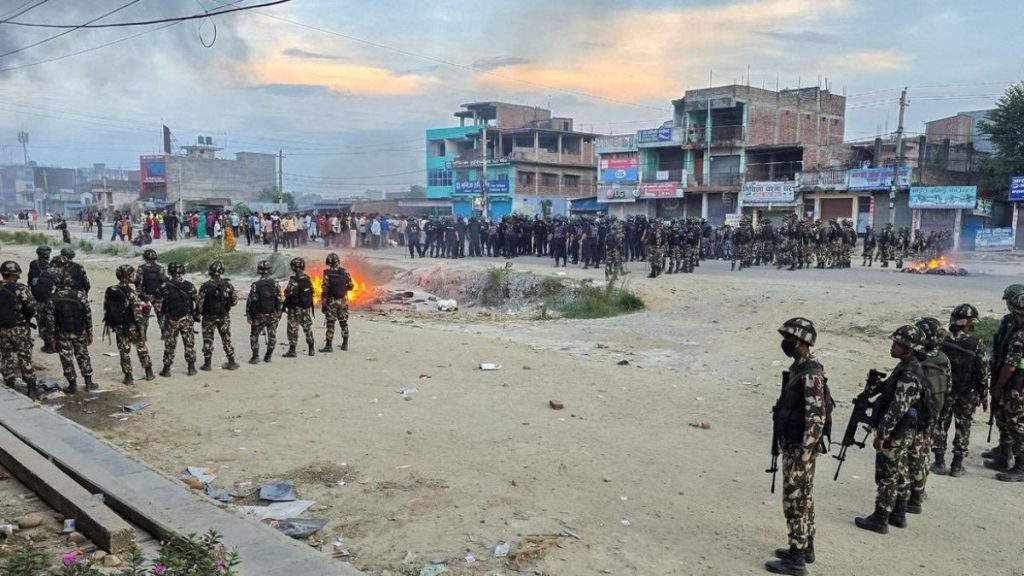
New Delhi: Communal violence in Nepal’s southern Terai has entered its second week, leaving at least three people dead, forcing authorities to impose curfews across four districts and deploy the Nepal Army. The unrest has also prompted India to tighten security along the Bihar-Nepal border as a precaution against any spillover.
According to reports, the unrest was rooted in tensions between the Hindu and Muslim communities, who were holding separate religious observances in proximity to one another. Tensions had reportedly been simmering for some time over the use of loudspeakers during religious functions and the display of religious flags in shared public spaces, a friction point that has recurred periodically in parts of the Terai, where Hindu and Muslim communities live in close, interspersed settlements.
The unrest began on July 26 in Kaptangunj, a town in Nepal’s Sunsari district, when that friction escalated into an argument and then stone-pelting between the two groups. It has since spread to the neighbouring districts of Siraha, Dhanusha and Saptari in Madhesh Province.
According to the Kathmandu Post, mobs armed with sticks and spears have roamed the streets of the Madhesh region, threatening and assaulting people believed to belong to a different religion, while homes and businesses have been burned down, despite the Nepal Police, the Armed Police Force and the Nepal Army being deployed in force. The newspaper reported that all three civilian deaths recorded so far occurred after police opened fire.
The Kathmandu Post also reported that social media has fuelled the unrest, with anonymous or fake accounts on Facebook, TikTok and X amplifying hateful rhetoric and spreading misinformation. Among the false claims circulating, the newspaper said, are allegations that Rohingya refugees are behind the violence, that groups of Muslims are entering Nepal from India seeking revenge and that Nepal’s Hindu majority is under attack from its Muslim minority. None of these claims has been verified by authorities.
How the trouble began
According to Nepal Police, tensions flared in Kaptangunj over the use of loudspeakers and the display of religious flags, triggering a heated argument that quickly escalated into stone-pelting between the two groups.
As the situation spiralled, security personnel attempted to disperse the crowd. When those efforts failed, police opened fire, leaving one person dead at the scene and several others injured.
In the days that followed, the unrest spread beyond Sunsari into neighbouring districts. A teenager was killed during fresh clashes in Siraha, while another person injured in the initial violence later died of his injuries, taking the death toll to three. Dozens of people, including security personnel, have also been injured.
The unrest across Nepal’s Terai
The violence that began in Sunsari did not remain confined to a single district. Within days, protests and communal tensions spread to the neighbouring districts of Siraha, Dhanusha and Saptari in Madhesh Province, prompting authorities to expand security measures across Nepal’s southern Terai.
By July 31, the government had imposed indefinite curfews in parts of four districts such as Sunsari, Siraha, Dhanusha and Saptari while prohibitory orders remained in force in several sensitive areas. The Nepal Army was deployed alongside the Nepal Police and Armed Police Force after local police struggled to contain fresh protests and incidents of arson and vandalism in some areas.
According to Nepal Police, eight people have been arrested in connection with allegedly inciting communal violence – five from Siraha and three from Dhanusha. The president of Nepal, Ram Chandra Paudel, appealed for peace and national unity, while the prime minister, Balendra Shah, promised a neutral investigation and accountability for those responsible.
The latest unrest has so far claimed three lives and injured dozens of people, including security personnel. Authorities have also made it mandatory for people entering Nepal through Sarlahi district to carry valid identity documents, reflecting heightened security concerns along the India-Nepal border.
Why Bihar has tightened security
For India, the concern is less about the violence crossing the border and more about the nature of the border itself. India and Nepal share an open frontier under the 1950 Treaty of Peace and Friendship, allowing citizens of both countries to move freely without visas.
That makes Bihar’s Madhubani district, which borders Nepal’s Terai region, particularly sensitive whenever unrest breaks out across the frontier. Thousands of people cross the border every day for work, trade, healthcare and family visits, making it difficult to ignore developments just a few kilometres away.
As a precaution, Bihar Police have stepped up patrolling, intensified vehicle checks and deployed additional personnel at border police stations. Authorities have also appealed to residents not to believe or circulate rumours and to immediately report any suspicious activity.
Importantly, there have been no reports of communal unrest on the Indian side. The enhanced security measures are intended to maintain vigilance until the situation in Nepal stabilises.
India’s response
While India has not publicly commented on the communal violence in Nepal, it has maintained that engagement with Kathmandu remains ongoing. At the Ministry of External Affairs’ weekly briefing on Friday, spokesperson Randhir Jaiswal said India has “several issues on the bilateral agenda” with Nepal, adding that these are being discussed at both the technical and other levels.